Thursday, March 24, 2011

March meeting names, etc.

I was skimming the March meeting schedule during a particularly dull talk this afternoon, looking for amusing session and talk titles. (For obvious reasons this is a much more remunerative game at the MLA.) I am probably the wrong person to be doing this, being somewhat inured to the weirdness of many terms. For this reason the biophysics titles are a lot more amusing (to me) than the condensed matter ones. (Another piece of evidence: Alan recently pointed out that I had given a talk titled "Solidity and frustration in multimode cavities." This seemed a sensible and even drab title at the time...)

My favorite session title/concept was "Migrations of Physicists" -- it had talks by Russian, Chinese, etc. physicists etc. but I think the talks were meant to be anecdotes rather than studies. I couldn't attend as there was an actual physics session (well, 40-ish) at the same time.

Some others:

Sessions
Drowning in carbon: the imperative of nuclear power
Semiconductor growths [this one probably a typo]
Thermoelectric materials: skutterudites, novel and nanostructured materials
Gapless spin liquids
Macromolecular crowding effects in the cytoplasm
Functional gels
The corporate feel: atomic force microscopy in industry

Speakers with interesting names (a very partial list): Behtash Behin-Aein, Bonna Newman, Reza Farhadifar, Nigel Scrutton, Spiros Skourtis, Nicholas Economou, Thorsten Ritz, Stefan Blugel, Adilson Motter, Eric Pop, Yves Acremann, Christian Pfleiderer, Yoshinori Onose, Weida Wu, Laurent Bellaiche (the last five were all in the same session).

(Google Analytics is going to love this post.)

In other news we got the following excellent email from the Illini-Alert emergency system this morning (the entire thing was just a technical error, something to do w/ testing the alert system...):


subjectActive Shooter/Threat

Active shooter at BUILDING NAME/INTERSECTION. Escape area if safe to do so or shield/secure your location.

Wednesday, March 23, 2011

From Dallas with Dyspepsia

I am coming around to the view that these APS meetings are generally awful. Some people insist that they're great if treated correctly, but I don't see it, I have been exhausted and irritated ever since we arrived and immediately found out that physicists had overwhelmed all the restaurants near the convention center. The coffee-shop lines have been consistently dire. The meeting itself has been wearying -- I had signed up, unwisely, to give two talks, neither of which I put together until the very last minute -- and there are far fewer talks this year than in prev. years that I feel compelled to go to.

We're staying at the Magnolia, an enormous hotel in downtown Dallas that's notable primarily for its lurching turn-of-the-20th-cent elevators. (They're also really slow.) There are three Englishwomen here who seem to spend most of their time riding the elevators and repeating a few obvious jokes about them. (I wonder if this is a successful pick-up strategy?) As convention centers go this one is exceptionally ugly, and abuts a graveyard with a huge Confederate memorial (Jefferson Davis's marble neck-beard is like a wrinkled goiter), but is otherwise OK. It is adequately provided with restrooms, and the wireless internet is a LOT better than one expects at these things. If only my laptop had a functioning battery... but one is forced to hang out in corners w/ power outlets.

I wonder what the etiquette is re gawking at people's name-tags. Personally I can't help it.

Sunday, March 20, 2011

Two barroom speculations and a rant

To be taken at the appropriate level of seriousness... (this was the drift of my side of a conversation w/ Matt P. and CWA last night) NB I expect blogging to be near nil next week, though I might post dispatches from Dallas. 

BS1. All professions will eventually become professions for women, just as all names will eventually become names for girls. (Of course there are more possible names than professions...) The argument is of the "Griffiths" variety and runs as follows. Once any profession becomes over, say, 60% female, it stays that way; men are far less likely to enter it. This effect is much stronger than the reverse one. (Aptitude etc. are largely irrelevant for most professions; social pressures are much more important in determining what people decide to pursue.) Over time any profession becomes more than 60% female because of random fluctuations. QED. (An implication is that this should happen sooner in smaller professions, subfields, etc. There is some evidence for this in, e.g., vet-med.)

BS2. Why are one's past struggles and sufferings such an important part of self-definition? In particular, why are all the best barroom stories tales of mishap? A standard answer, re struggles, is that one is reluctant to admit that effort was ever wasted, but this doesn't extend to suffering. An alternative resolution: one gives meaning to one's life by making a narrative out of it; it is naturally desired that one's narrative will appeal to others, and the easiest way to appeal to others is to appeal to their Schadenfreude, which is the most enduring of human emotions.

R. The invasion of Libya worries me because it suggests that people have either forgotten the lessons of Iraq or learned the wrong ones. This is especially true of the British and the French, who I suppose were especially liable to suspect that Iraq was a failed war because unilateralism or the fake WMD excuse. Yes, it was bad to start a war unilaterally and worse to start it on false pretenses, but neither of these has much to do with why Iraq ended up so badly: that failure was due to the lack of any clear positive goals, the fact that "regime change" is a misnomer for "regime removal," or the thoughtless replacement of tyranny by anarchy. (No one's admitting to the term "regime change" but David Cameron clearly has it on his mind.)

Friday, March 18, 2011

Balloons, drowning, iridescence, and pastoral

The Germans must have a word for the pleasure one gets from this kind of thing:


There is a very famous Heaney poem on precisely this conceit:

Lightenings viii

The annals say: when the monks of Clonmacnoise
Were all at prayers inside the oratory
A ship appeared above them in the air.

The anchor dragged along behind so deep
It hooked itself into the altar rails
And then, as the big hull rocked to a standstill,

A crewman shinned and grappled down the rope
And struggled to release it. But in vain.
'This man can't bear our life here and will drown,'

The abbot said, 'unless we help him.' So
They did, the freed ship sailed, and the man climbed back
Out of the marvellous as he had known it.
One should distinguish this effect from the subtly different one in Auden's line about an island being "a lake turned inside out" or Thom Gunn's image of a gas poker as a "backwards flute." There is nothing odd about the pleasure one gets from negatives that look like something quite different from the original photograph; this is just "wit" of the usual kind. There is a lot of local wit in the New Yorker cartoon (one is reminded, e.g., of the Piranha brothers, though these fish are evidently not piranhas) and the Heaney poem leans very heavily on its last line, but I think there's something intrinsically appealing about the situation. I'm reminded of Empson's reading of Donne as a Copernican:
if you take the world not as the universe but as this planet it becomes something one might conceivably get outside but which it would be absurd to try to get outside; there are more than one of them, but each creature is right in giving an absurd importance to his own.

This is from the Pastoral book, and the "move" of creating a set of precise set of correspondences between the everyday world and some entirely foreign world is like pastoral (the chapter on "Marvell's Garden" goes on about this, "the mind, that ocean where each kind / doth straight its own resemblance find" etc.) -- but the suffocation motif is important, I think, and emphasizes the sense that people are limited, trapped in some particular element... Anthropomorphizing the fish (or alien) serves a double purpose as it allows the reader to see the situation from both points of view at once; it's an acceptance of one's limitations from a point of view that evades the limitations by not being fixed, and this is satisfying for the same obscure reason that the verbal ambiguities are. 

Like the ambiguities, this doubleness of perspective is necessary because perception, like language, is not polyphonic, and can only achieve polyphony through instability. I've always felt that a better term than "ambiguity" for what Empson meant is iridescence. (D.H. Lawrence was here first: "how boring, how small Shakespeare's characters are! / But the language so lovely, like the dyes from gas-tar.") Why one finds this appealing is a little obscure to me, but at least it's a familiar mystery rather than a new one.

Wednesday, March 16, 2011

Rationality and other lost causes

I'm writing this in a state of sleep-deprivation and, to some extent, relief; after a week of trying -- stupidly -- to finish up a paper before the APS meeting (in Dallas next week), I have had to resort to plan B/damage control: pad talks and be opaque enough (hopefully!) to avoid getting scooped.

Note that Alan has a new blog (linked, as one might expect, on the right.) In this post he touches on a longstanding disagreement between us on "reasonableness." To be a little reductive, Alan is (like most of my friends) a firm believer in self-improvement, intuition pumps, Science, and the like; I am a nihilistic slob, with considerable sympathy for irrationalism. Part of this is, no doubt, due to differences in temperament (this is the only way I can explain the fact that I'm not a vegetarian), but differences in intellectual history also have something to do with it.

I should distinguish between contemplative and instrumental rationality: the former is about getting facts right, not believing false arguments, etc.; the latter is about getting what one wants, whatever that might be. (The former is a limiting case of the latter.) Given a list of desires and beliefs, instrumental rationality tells you what actions are (in some pretty obviously meaningful sense) "rationally binding." In certain very specific contexts (e.g., a prisoner trying to escape), what one wants is clear, and instrumental rationality is a useful tool.

Perhaps some cases in the historical core material of economics -- purely profit-maximizing regimes of endeavor -- resemble this; however, whether any of it applies to everyday life is much less clear, as it is not evident that people have fixed desires in any meaningful sense. (I wholeheartedly agree with Andrew Gelman's aphorism that "the utility function is the epicycle of social science," which I probably consider to be more broadly true than Gelman does.) In order to adapt instrumental rationality to everyday life, one is forced to do a sort of three-step: (a) assume that a utility function exists, (b) use a combination of survey data, "revealed preference," behavior, and intuition-pumping to figure out what the utility function says, (c) accuse people of being irrational when the "best" utility function doesn't do a good job of predicting their behavior.

Bertrand Russell remarks, re Locke's ethics:
Almost all philosophers, in their ethical systems, first lay down a false doctrine [in context: a false descriptive theory of human motivation], and then argue that wickedness consists in acting in a manner that proves it false, which would be impossible if the doctrine were true. Of this pattern Locke affords an example.

To the extent that (b) is about empirics (revealed preference or survey data), the three-step above clearly falls into this pattern, with (a) as the false doctrine. To the extent that it relies on intuition pumps, these are only as reliable as one's prejudices. Extreme cases can be dismissed on the grounds that they're outside the expected regime of validity of one's moral systems. (Derek Parfit attempts unpersuasively to counter this argument somewhere, I forget his point.) On the other hand, there is no particular reason to expect that true observations about human nature of the kind that come out of neuroscience etc. (which are bound to be statistical) are likely to imply, or "go with," a moral system. In order to make this sort of inference one must bring in a principle of the form "what is 'normal' is 'healthy' and 'good'" -- or some equivalent kind of naturalistic inference even in the individual non-collective sense -- that I find (even in its mild forms like "it cannot be morally binding to be an outlier") both repugnant and not a priori true.

In short, I believe that this line of thinking is unlikely to get anywhere specific, and the standard attempts to work around the skeptical arguments remind me of the epic exercise in flailing that is the Russell/Whitehead Principia Mathematica. This is, perhaps, where differences in training (not to mention the degree of one's interest in self-improvement) come in: Alan would presumably say that one ought to learn philosophy to (a) at least understand the skeptical arguments (self-improvement) and (b) find a systematic framework, however imperfect, to address these questions in. As regards (a) there are lots of causes in physics and math that are understood to be lost causes. I understand many of them very hazily -- it is useful to know enough to realize when a line of inquiry you once thought promising turns out to be equivalent to a lost cause -- but do not have the time to buttress my skepticism. And I think (b) relies on an assumption about conscientiousness being intrinsically worthwhile -- esp. w.r.t. important matters -- that is quite unnatural for a physicist; one does not waste time on problems, no matter how important, that are generally believed to be intractable, unless one starts out with a specific reason to believe the consensus is wrong. If the most elaborate reflection doesn't produce policy that's demonstrably better than dominance reasoning plus coin-flipping -- and the upshot of the skeptical arguments, I think, is that it cannot -- one shouldn't waste time on it. Ideas do not get A's for effort.

---

An especially important example -- pace Kuhn, a paradigmatic one -- of a lost cause is Aristotelian physics. Steven Weinberg (again via Alan) wrote of "the shift (which actually took many centuries) from Aristotle's attempt to give systematic qualitative descriptions of everything in nature to Newton's quantitative explanations of carefully selected phenomena." The primary lesson of this example is that the best way to get a handle on some problem is not always -- or even generally -- to approach it head-on. One is better off explaining something thoroughly and working outwards. The flip side is that one might end up with meteorology, in which the questions "of interest" are intractable and the explicable phenomena (icicle bending!) aren't of much interest. (If I were an economist I would be working on Zipf's law.) Almost all phenomena -- and a fortiori almost all relevant ones -- are in practice impossible to understand from first principles.

There's much more to be said about all of this but I'll restrict myself to a brief note on "ideology" as the term is used in physics. An "ideology" is a widely believed but vague and/or unprovable rule of thumb that can be applied to prove various specific results. It is, in general, a rule about what questions to ask and what kinds of answers to look for. The "renormalization group" idea in physics is an ideology that plays a role that's roughly like that played by evolution in biology: one cannot reduce it to a precise, true, non-vacuous statement, but it guides the field. Ideologies are what Weinberg refers to as the "soft" parts of theories:
There is a "hard" part of modern physical theories ("hard" meaning not difficult, but durable, like bones in paleontology or potsherds in archeology) that usually consists of the equations themselves, together with some understandings about what the symbols mean operationally and about the sorts of phenomena to which they apply. Then there is a "soft" part; it is the vision of reality that we use to explain to ourselves why the equations work. The soft part does change; we no longer believe in Maxwell's ether, and we know that there is more to nature than Newton's particles and forces. ... But after our theories reach their mature forms, their hard parts represent permanent accomplishments.

This distinction exists to some degree outside particle physics -- a great deal has been learned about the lineages of various species, etc., even if the ideology that led to these discoveries turns out to be false. But it's worthwhile to distinguish between the predictions of a theory -- i.e., predictions that come out of the "hard part" -- and those of an ideology, which come from the soft part. The latter cannot be disproved in any straightforward way -- they are just patterns we impose on selected agglomerations of fact -- and change, as
often as not, because the community becomes interested in other problems where the ideology is less useful. (For instance, an ideology in condensed matter physics is -- very roughly -- that any graph of the properties of a large system that exhibits jumps is a sign that there's something "topological" about the system. This ideology has led to a number of fascinating discoveries about the way electrons move in metals; however, it is always possible to have jumps for all sorts of non-topological reasons. A bit of particle physics ideology that was behind Weinberg's Nobel Prize-winning work was the puzzling-to-an-outsider belief that all bosons [particles obeying Bose-Einstein statistics] are gauge bosons.)

As I understand them, both "incentives" and adaptationism are ideologies of this kind. I think ideologies are great as long as one's ultimate objective is to solve specific problems. One should perhaps be more careful, though, when trying to justify specific research programs on the grounds that they might "prove" or "disprove" the ideology; it's (in T.S. Eliot's phrase) like trying to dispel a fog with hand grenades. I.e., a lost cause.

Saturday, March 12, 2011

Lowellcat after Dice

If the volume were any higher I'd be tempted to spin these off into yet another blog. (Pic courtesy Matt P.)

The Auntie-novel

You should read Colm Toibin's new LRB essay on "the importance of aunts" in the C19 novel. As it doesn't excerpt well I'll try to summarize Toibin's argument. He begins with the question of why heroines tend to be -- either actually or in effect -- motherless, why "the novel is a form for orphans." Toibin's answer is that this is structural:
Mothers get in the way in fiction: they take up space that is better occupied by indecision, by hope, by the slow growth of a personality, and – as the novel itself develops – by the idea of solitude. It becomes important to the novel that its key scenes should occur when the heroine is alone, with no one to protect her, no one to confide in, no possibility of advice.
Aunts are useful because they are surrogate mothers who can be introduced and removed at will, and also because the niece-aunt relation is partly volitional. This brings Toibin to a discussion of aunts and mothers in Jane Austen's novels, commenting briefly on the good and bad aunts in P&P and then turning to the role of Lady Bertram -- the indolent woman who fosters the heroine in Mansfield Park -- and what the character is for [my emphases]:
A novel is a pattern and it is our job to notice how the textures were woven and the tones put in place. [...] It is a release of certain energies and a dramatisation of how these energies might be controlled and given shape. Characters in fiction are determined by the pattern, and they determine the pattern in turn.

Lady Bertram in this context is easy to read; her role in the pattern of Mansfield Park is obvious. She is not good, she performs no good or kind act that matters; nor is she bad, since she performs no bad act that matters either. But she is there in the book, in the house, in the family. Fanny has already lost one mother, who has effectively given her away. Aunt Norris plays the role of the wicked aunt who appears now and then. Lady Bertram has four children of her own, and with the arrival of Fanny, she effectively acquires a fifth. Austen now has a problem. If she makes Lady Bertram merely unpleasant, Fanny will have to respond to her unpleasantness in scene after scene, because Lady Bertram is, unusually, an aunt in residence rather than an aunt who comes and goes. This will then become the story of the book: a simple story of cruelty and resistance to cruelty. And if Lady Bertram is actively cruel to Fanny, how will she treat her own children? If she treats them with kindness, then the intensity of their agency will be diluted and dissolved. If she is cruel to them too, then the singleness of Fanny, her solitude as a force in the book, will not emerge.

It would really make sense to kill Lady Bertram, or to have her not be there, allow her to be one of those unmentioned mothers in fiction, an unpalpable absence. But in that case, Fanny wouldn’t join her household [...] So Austen has to have Lady Bertram be there and not there at the very same time; she has to give her characteristics which are essentially neutral. [...] it must have been tempting to allow her to have some role, to be silly or irritating or amusing like Mrs Bennet in Pride and Prejudice. But Austen has the ingenious idea of making the sofa, rather than the household, the realm over which Lady Bertram reigns, and making sleep, or half-sleep, her dynamic. She is too sleepy to care.
This is the heart of the essay, and I find its nuts/bolts approach to literary analysis extremely refreshing. It is the sort of thing one wishes one had thought of. Toibin's overall defense of Mansfield Park is less compelling. ("She has a way of noticing and registering which has nothing to do with virtue, but everything to do with the novel’s pattern." Maybe, but this doesn't mean she isn't a bore. Toibin doesn't explain why Fanny couldn't have been made interesting, and in general his is a theory of aunts rather than nieces... An argument he hints at but doesn't make is that Fanny is dull to parallel Lady Bertram's dullness; this parallel is unlikely to occur to th reader, though.)

Toibin doesn't say much about Austen's other novels, which also contain aunts and quasi-aunts (Lady Russell in Persuasion, and Mr. Knightley is an aunt of sorts). Instead he returns briefly to the idea of aunts as plot device ("one of the other purposes of aunts is that they allow for dramatic entrances and departures. All through the 19th century, aunts breach the peace and lighten the load."), and then turns to Henry James as a later stage in the development of the aunt, viz. as the point at which a pattern has been established and can be subverted for effect -- for instance, the scene in The Portrait of a Lady where the heroine discovers that her husband and surrogate aunt are lovers. This is obvious, I think, but serves as an interesting confirmation of the existence of a tradition of aunts. Then he turns to The Ambassadors, which again has a sexually active aunt, and delivers the things-clicking-into-place paragraph:
And so once more James has sexualised an aunt. It is as though Henry Crawford had come to Mansfield Park in search of Lady Bertram rather than Fanny; or Mr Darcy was found in the countryside in his shirt-sleeves with none other than Mrs Bennet; or Mr Bingley was found in a carriage with Lady Catherine de Bourgh. In other words, James took what was necessary for a novel in his time to have power and weight – the replacement of the mother by the aunt – and then saw what was possible [...]

(In other words HJ invented the cougar.) And then, having run out of things to say about aunts, he turns to another aspect of the tension between the Victorian novel and the family, which is the presence of single men who are not looking for wives. This leads him, via bad-husband/oppressed-wife/single-man triangles in Trollope and George Eliot, to the character of the clever, generous, and manipulative invalid Ralph Touchett in The Portrait of a Lady. (Perhaps naturally for Toibin, all roads lead to Henry James.) What James does with the disruptive single man is, interestingly, the opposite of what he does with the aunt -- he desexualizes Touchett -- though what he gets out of this is a little unclear. (I think Touchett's illness is best understood as a necessary distinguishing feature, given that the book abounds in attractive single men; it also accounts for his death.)

So aunts are: (a) givers of advice etc., (b) excuses for the characters to be away from their parents when important things happen, (c) diverting. (They can be more than one of the above.) Mothers, if present, must be diminished like Mrs. Bennet. The novel must happen on neutral ground; plausibility, however, forbids a young woman of the appropriate social class from being alone, so the aunt is structurally necessary (b), and, like a spandrel, can accommodate additional decorative purposes (a, c). It's amusing to think of the structure of a novel as being constrained, almost overdetermined, by the stories you must exclude and the sympathies you must prevent from developing. A few further thoughts:
  • The queens in the two Alice books are aunts of a kind; they serve purposes (a) and (c). But purpose (b) doesn't exist: the aunt is an end rather than a means. On the other hand, the witch in Rapunzel is mostly (b). In general Toibin doesn't talk about aunts-as-witches, but there is an obvious similarity. One would suppose that, while (b) is somewhat specific to Victorian social structure, (a) and (c) are more durable archetypes.
  • Nor does Toibin talk about Dickens, and Betsey Trotwood in particular. Orwell notes, in his essay on Dickens, the importance of "that recurrent Dickens figure, the good rich man [...] who ‘trots’ to and fro, raising his employees’ wages, patting children on the head, getting debtors out of jail and in general, acting the fairy godmother." These figures imply a safety net for the hero/ine. One of the stories that have to be excluded is the precariousness of the individual's position in 19th cent. England; a coming-of-age novel, with its implicit individualism, must avoid this if it isn't to be a primarily social novel; sympathetic aunts are a way of heading off certain questions.
  • The afterlife of aunts in comic literature -- from Lady Bracknell to Wodehouse's Aunts aren't Gentlemen -- is another interesting adaptation of the template. Their demise in serious literature naturally has to do with the social changes that made it natural for single women to live apart from their parents. Where have functions (a) and (c) migrated, though?

Thursday, March 10, 2011

What is school history for?

Richard J. Evans writes in the LRB about the Tories' attempt to make school history less critical, more "narrative"-based, and generally more old-fashioned:
The demand, really, is for a celebratory history: how otherwise could it serve as the cement of national identity? Sample exam questions proposed by the Better History group for the new curriculum have included: ‘Why did Nelson and Wellington become national heroes?’; ‘What liberties did English people enjoy by the end of the 17th century that they hadn’t had at the start?’; and ‘How dangerous was the Spanish Armada?’ – the examinee, it’s presumed, isn’t going to answer from the point of view of the Spanish. 

There are two lines of objection to this, both with considerable force, one minor and one less so. The minor  one is that it'd all be white-people-centric and thus wrong for a diverse society. The proposed alternatives could be either (a) teach people of different ethnic groups different celebratory histories, (b) teach everyone a fairly diverse history. (a) is, I think, rightly horrifying to many people, and anyway defeats the purpose of creating a "cement"; (b) is a sensible (within-these-parameters) but not radical fix, which would have the incidental advantage of distinguishing Cameron from the more off-putting Little England types.

The major objection is that celebratory history is intrinsically a bad, stultifying, sort of thing that leaves people incompetent to analyze texts later in life:

Even more calamitous is the prospect of history teaching in the schools confining itself to the transmission and regurgitation of ‘facts’. [...] When I started teaching history at university in the 1970s, many first-year students were incapable of critical reading of this kind. (I ran into trouble with one class when I began to point out the problems in the arguments put forward by one of the books I had set them to read. ‘Why did you make us read it,’ one of them complained, ‘if you don’t agree with it?’) Better history teaching in schools changed all that, but now Gove wants to abandon these skills all over again. Better History declares that ‘it is by the acquisition and use of historical knowledge that historians are primarily judged’ – but in reality that only makes a Mastermind contestant.
It is possible to teach actual skills only if history is taught in depth, and that means a focus on a limited number of specialised topics. 

At some level I'm very sympathetic to all of this, but it is both muddled and blinkered to think of school history as being about the training of future academic historians. Evans distinguishes, near the end of his article, between history and "memory," but it is not obvious to me that history-the-academic-discipline is what should be taught at the high-school level. After all, what does society lose if people like Evans have to teach kids how to question sources -- yes, it's a waste of their time, but in this case they'd probably be better at it than the average schoolteacher. Is it that one should train kids to be anti-authoritarian because "this makes them better citizens" etc.? If so, then the Tories should, almost by definition, object to the idea; besides, it would surely be easier to teach "critical thinking" in a class about contemporary issues...

I am beset here by a basic ambivalence about what school should be for, beyond literacy, numeracy, and related survival skills. It takes people much longer to grow up than it does to become literate; what -- other than socializing -- is one to do with the rest of the time? One line of thought is to focus on what kids are good at, maybe beef up the math curriculum ("teh Chinese are invading!"), teach more foreign languages, etc. but there is only so much that one is ever going to use and it seems hard (though possible with some backing from neuroscience) to justify teaching explicitly useless skills. Another line of thought is to have everybody acquire an agreed-upon set of references and symbols, preferably reasonably rich and ambiguous, that can then be used in various kinds of civic and artistic discourse. This is perhaps roughly what's implied by teaching history as memory -- it's like doing the Greek myths, but with that frisson of fact... and, of course, with the right place names.

Evans's article strongly reminded me of Gordon Wood's criticism of Jill Lepore's book about the Tea Party, which is that she was unreasonably dismissive of memory as opposed to history. (I'll note in passing that I enjoyed Wood's book The Purpose of the Past on the whole.) Here is Bernard Bailyn, quoted by Wood on the slave trade:
the memory of the slave trade is not distant; it cannot be reduced to an alien context; and it is not a critical, rational reconstruction. It is for us, in this society, a living and immediate, if vicarious, experience. It is buried in our consciousness and shapes our view of the world. Its sites, its symbols, its clues lie all about us.
This is particularly relevant, and dangerous, in America, where the past's shadows are large and proximate. Memory is a political project, which is why it appeals to Gove and Cameron; but these partial, allegorical readings of the past are the only reason we care about what happened. To the extent that this is true, I wonder if it wouldn't be worthwhile to try and move the emblems as far away from the present as possible, to lower the temperature and have the myths be more mythical, and their literal truth less important for practical purposes. If liberalism and conservatism centered around alternative readings of the Metamorphoses rather than the Fourteenth Amendment, perhaps we'd have a saner public discourse?

Addendum Wood's article "Conspiracy and the paranoid style: Causality and deceit in the eighteenth century" has one of the best subtitles ever.

"Superb" as birdname prefix

Re the superb owl meme: it should be better-known than it is that "superb" is a fairly common adjective in bird-names. Wikipedia lists these:

Nor, given that diurnal owls like the snowy owl exist, would it be entirely out of the question for an owl to evolve into superbness.

I've seen superb starlings in the Serengeti, where they're ubiquitous in the picnic areas:

Wednesday, March 9, 2011

"Obesity / and a little fame"

Lowell described this poem, in a letter to Bishop, as "really marvelous"; I agree. Auden's late style required him to walk a tightrope between goofiness and preachiness that he tended to fall off, but every now and again, almost fortuitously, he did something like this:


Since
W.H. Auden 
On a mid-December day, 
frying sausages
for myself, I abruptly
felt under fingers
thirty years younger the rim
of a steering wheel,
on my cheek the parching wind
of an August noon,
as passenger beside me
You as then you were.

Slap across a veg-growing
alluvial plain
we raced in clouds of white dust,
and geese fled screaming
as we missed them by inches,
making a bee-line
for mountains gradually
enlarging eastward,
joyfully certain nightfall
would occasion joy.

It did. In a flagged kitchen
we were served boiled trout
and a rank cheese: for a while
we talked by the fire,
then, carrying candles, climbed
steep stairs. Love was made
then and there: so halcyoned,
soon we fell asleep
to the sound of a river
swabbling through a gorge.

Since then, other enchantments
have blazed and faded,
enemies changed their address,
and War made ugly
an uncountable number
of unknown neighbors,
precious as us to themselves:
but round your image
there is no fog, and the earth
can still astonish.

Of what, then, should I complain,
pottering about
a neat suburban kitchen?
Solitude? Rubbish!
It's social enough with real
faces and landscapes
for whose friendly countenance
I at least can learn
to live with obesity
and a little fame. 

Tuesday, March 8, 2011

"It would be ok as long as the cans weren't stored upside-down."

I'd shared this preprint unread when it popped up on the arxiv but apparently it's good enough for Nature News, which has a good writeup. I particularly enjoyed the caveats.

The widget-free way to foamy stout

Stouts bubble less readily than lagers or other carbonated drinks when poured because they contain dissolved nitrogen as well as the carbon dioxide that drives the fizz. Adding nitrogen makes the beer less acidic, and gives a longer-lasting head with relatively small bubbles that are behind stouts' smooth, creamy 'mouth feel'.
But the addition also demands the use of the widget [a hollow sphere with a hole in it], which takes in gas and beer as it floats in the canned stout and, when the can is opened and the pressure drops, jets it out again through the hole, helping to create the foam.

The new study suggests that the same result could be achieved by coating part of the can's interior with cellulose fibres. [to increase the rate of bubbling, which is intrinsically low for stout: bubbles nucleate faster on rough surfaces]
[...]
However, [some guy] adds, the bubbles might fill with liquid while the can was in storage. Lee says the coating would be placed in the gap at the top of the can: "It would be ok as long as the cans weren't stored upside-down."

Andrew Alexander, a chemical physicist at the University of Edinburgh, UK, also believes that can coatings would be impractical compared with widgets. "Widgets are genius — they're cheap, work really well, are totally non-toxic and don't mess with the beer," he says. "Would a fibrous coating be cheaper than what is essentially a ping-pong ball with a hole in it? I don't think so."
But Lee says that using widgets slows down the process of canning stout. "Oxygen stuck in the widget can affect the beer's flavour, so you have to pump nitrogen in several times to remove it," he says. "The cellulose coating is an alternative worth investigating."
However, it is likely to be some time before fibre-lined stout cans appear on supermarket shelves. "We've spoken to brewers," says Lee, "but we're not sure if they're interested yet."

Monday, March 7, 2011

Shypokes and shiterows; perfumed pigmeat

Wikipedia, regarding herons (via Alan):

Herons are also known as "shitepokes", or euphemistically as "shikepokes" or "shypokes". Webster's Dictionary suggests that herons were given this name because of their habit of defecating when flushed. The terms "shitepoke" or "shikepoke" can be used as insults in a number of situations.[10] For example, the term "shikepoke" appears in the 1931 play Green Grow The Lilacs, and in the 1943 musical play Oklahoma!.
The 1971 Compact Edition of the Oxford English Dictionary describes the use of "shitepoke" for the small green heron of North America (Butorides virescens) as originating in the United States, citing a published example from 1853. The OED also observes that "shiterow" or "shederow" are terms used for herons, and also applied as derogatory terms meaning a "thin weakly person". This name for a heron is found in a list of gamebirds in a royal decree of James VI (1566–1625) of Scotland. The OED speculates that "shiterow" is a corruption of "shiteheron".[11]


This is tenuously related to the previous post about "astonishment," btw; I once wrote a (rather bad!) poem about Shetland that appears to have had the side-effect of convincing Alan that the heron's default expression is one of astonishment. For what it's worth "heron" derives from O. Fr. "aigron" of which "aigrette" -> "egret" is a diminutive. Reminiscent of the situation with rillettes discussed in a Richard Wilbur poem:

Rillons, Rillettes
rillettes. hors d'oeuvre made up of a mash of pigmeat, usually highly seasoned. Also used for making sandwiches. The Rillettes enjoying the greatest popularity are the Rillettes and Rillons de Tours, but there are many Rillettes made in other parts of France.

rillons. Another name for the Rillettes, a pigmeat hors d'oeuvre. The most popular rillons are those of Blois. 


-- A Concise Encyclopedia of Gastronomy, ed. Andre L. Simon

Rillons, rillettes, they taste the same, 
And would by any other name,
And are, if I may risk a joke,
Alike as two pigs in a poke.

The dishes are the same, and yet,
While Tours provides the best rillettes,
The best rillons are made in Blois.
There must be some solution.
____________________Ah!--

Does Blois provide, do you suppose,
The best rillettes de Tours, while those
Now offered by the chefs of Tours
Are, by their ancient standards, poor?


Clever, but there remains a doubt.
It is a thing to brood about,
Like non-non-U, infinity,
Or the doctrine of the Trinity.

Caching out

Tab proliferation is one of the banes of my existence. Another is a tendency to overconsume caffeine, which exacerbates tab proliferation. This is not an exhaustive list.

1. English vs. American bears. English bears are less assertive, more abused, etc. My take on this is that the English are clearly right. Bears are intrinsically (a) short-sighted, (b) cute, (c) sporadically vicious. As I once wrote, they "live on strawberries and honey except for the occasional killing spree." Winnie the Pooh with a mild psychopathic streak would be an excellent caricature of an actual bear. Care bears have nothing, really, to do with bears. They might as well be care cougars.

2. For some reason I have Andrew Sullivan's "Why I blog" open:
As you read a log, you have the curious sense of moving backward in time as you move forward in pages—the opposite of a book. As you piece together a narrative that was never intended as one, it seems—and is—more truthful. Logs, in this sense, were a form of human self-correction. They amended for hindsight, for the ways in which human beings order and tidy and construct the story of their lives as they look back on them. Logs require a letting-go of narrative because they do not allow for a knowledge of the ending. So they have plot as well as dramatic irony—the reader will know the ending before the writer did. 

3. Geoffrey Hill: "I write / to astonish myself." I've always thought of "astonish" as deriving from "turn to stone" but the OED tells me this is probably wrong (the word is as likely as not to have come from Latin "extonare" which has to do with loud noises -- tones -- rather than stones).

4. Meteorite contamination is hard to avoid.

5. This paper about what should count as a "mechanism" in the philosophy of science is a excellent example of that field's decline into scholasticism.

6. I remember having a conversation a couple of days ago about the bases on which people are likely to discriminate against others in the future. My view is that they're likely to find something. Chesterton's essay "On lying in bed" captures the dynamic I had in mind quite well (I have very little sympathy with C's politics but much more with his attitude toward the future -- I share his dislike of fastidiousness about little things while also extending this dislike to fastidiousness about big things):
The tone now commonly taken toward the practice of lying in bed is hypocritical and unhealthy. Of all the marks of modernity that seem to mean a kind of decadence, there is none more menacing and dangerous that the exaltation of very small and secondary matters of conduct at the expense of very great and primary ones, at the expense of eternal ties and tragic human morality. If there is one thing worse that the modern weakening of major morals, it is the modern strengthening of minor morals. Thus it is considered more withering to accuse a man of bad taste than of bad ethics. [...] Especially this is so in matters of hygiene; notably such matters as lying in bed. Instead of being regarded, as it ought to be, as a matter of personal convenience and adjustment, it has come to be regarded by many as if it were a part of essential morals to get up early in the morning. It is upon the whole part of practical wisdom; but there is nothing good about it or bad about its opposite.

Misers get up early in the morning; and burglars, I am informed, get up the night before.

Sunday, March 6, 2011

Yet another Lowellcat

I don't know why I didn't think of doing this one earlier (the line is from "Reading myself"):

Brits, beards, bubbles

1. Simon Kuper (FT) has a mildly amusing go at the usual transatlantic-cultural-misunderstandings genre:

Americans won’t touch strangers, the French won’t talk to them, but Brits will neither touch nor talk to them. Passport to the Pub, a semi-official guide for foreign tourists to the UK, warns: “Don’t ever introduce yourself. The ‘Hi, I’m Chuck from Alabama’ approach does not go down well in British pubs.”
Nor are Britons permitted to make eye contact: the former French prime minister Edith Cresson, disconcerted that British men didn’t look at her, estimated that one in four was homosexual. No wonder Britons drink ever-increasing amounts of alcohol. Alcohol was first distilled so that British people could reproduce.

Re his observations about American friend-hugging and the gingerness thereof, I seem to remember there being a facebook group, back in the early days, that stood against "ass-out hugging."

2. I was briefly obsessed last year with this trustworthiness-of-beards infographic, and the obvious resulting question of how much of the sequence one could go through starting with an enormous beard and progressively excising various bits of it until one ended up with, say, a Hitler mustache or a "pencil-thin chinstrap." Related to this is an old Vanity Fair article I came upon yesterday, in which Rich Cohen -- ostensibly writing about his experiment with the Hitler mustache -- talks about its history:

The Toothbrush mustache was first introduced in Germany by Americans, who turned up with it at the end of the 19th century the way Americans would turn up with ducktails in the 1950s. It was a bit of modern efficiency, an answer to the ornate mustaches of Europe—pop effluvia that fell into the grip of a bad, bad man.[1] Before that, the most popular mustache in Germany and Austria had been the sort worn by the royals. It was called the Kaiser, and it was elaborate. It was perfumed, styled, teased and trained. It turned up at the ends. It was the old, monarchical world that was about to be crushed by the rising tide of assembly-line America. In other words, in the case of Hitler and his 'stache, America faced an extreme case of blowback.
By the beginning of the century, it had been taken up by enough Germans to draw notice in the foreign press. In 1907, The New York Times chronicled a growing distaste for the import under the headline "toothbrush" mustache: german women resent its usurpation of the "kaiserbart."
Cohen also attributes the decline of the mustache after WW2 to a sense that one had to navigate between the Scylla of Hitlerian brevity and the Charybdis of Stalinesque luxuriance, and it was therefore simpler to drop the thing altogether.

3. Mark Doty writes about the bubbles in his eyes:
Bubble number two has been with me since early January. At first I couldn't see anything, and then when I could make out light again I seemed to be looking a viscous gray field, translucent and rippling. If I moved much it made me feel disoriented and a little sick. This bubble was of a sturdier stuff than the first, so it took until early February for it to become a circle that almost filled my field of vision, and now in early March it's become surprisingly pleasing: it's the size of a perfectly round pea, near the bottom of the right-hand side of the world. It is dark at the rim, a Rothko-ish black-purple, and and then it pales to a light sky color and then in the center is a blotch of a darker gray roughly the shape of Australia. Somehow this conspires to make it look three dimensional, as if beautiful and oddly colored pearl is floating near the base of everything. It has, today, a tiny satellite. Yesterday there were three.

The two bubbles have given me a cataract (unavoidable side effect) so that may be contributing to the pearly aspect of the little sphere. Two oddities: at night, light bounces off the bubble into the upper reaches of my eye, so that I can see up high the double of a candle flame, a dashboard, a computer screen. And, if I tilt my head down and look at the floor, the bubble turns a magenta red, as if I'm looking at it through the screen of my own blood.

4. I enjoyed reading Jeffrey Friedman's essay on the trouble with libertarianism, viz. that it didn't stay true to its elitist, anti-democratic roots (!) -- and I agree locally with a considerable part of it, although in my view it is misguided to think of libertarianism as a philosophy at all.

5. It has occurred to me that, in these "closing-tabs" posts, I often misattribute or neglect to mention the sources of links. I'm sorry about this but it's inevitable as the tabs have usually been open for a while.

Friday, March 4, 2011

Fluid mechanics video dump

Adapted from an email I just wrote Kit, who wanted cool physics videos for a high school math class. These will be familiar to many -- from the feed -- but aren't archived anywhere, so it is perhaps worth collecting the links here.

1. Stephen Morris's fluid-mechanical sewing machine (maple syrup -- not really, but he is Canadian -- dropped onto a moving belt):


2. Stephen Morris, "chemical plumes" (Quicktime) and the "washboard road" effect (i.e., the fact that dirt roads go sinusoidal over time when driven on). Should note in passing that talking to David Grier about washboard road was one of the things that sold me on many-body physics as a prospective graduate student.

3. Sid Nagel's splashing-droplet videos (scroll down). The discovery that water doesn't splash at low atmospheric pressure is remarkable and not something I'd ever have expected. The other stuff on Nagel's website is pretty neat as well. (Either Nagel or someone introducing him described his lab as "where theory comes to die.")

4. The phenomenon of self-propelled Leidenfrost droplets moving uphill (U. of Oregon; see my recent post for context; this youtube video is a decent intro to the Leidenfrost effect).

Thursday, March 3, 2011

Dept. of sticky ends

1. I just stumbled upon this creative bit of Larkin-as-fanatical-misogynist criticism (the quoted poem is "Myxomatosis," which, btw, is about this, though it is not clear that the author bothered to look it up):
"Myxomatosis" transforms the sufferings of a wounded rabbit [Ed. ?!] into the common predicament of the male:

What trap is this? Where were its teeth concealed?
You seem to ask. 
______________I make a sharp reply.
Then clean my stick. I'm glad I can't explain
Just in what jaws you were to suppurate.

The 'jaws' are simultaneously of the trap, death, and of the vagina dentata; and 'suppurate' identifies the dying animal with a diseased wound or organ. What should surprise us is not that some element of this imagery is present, but that it should assume so little prominence: there is no possibility of compiling 'daily quotations for a misogynist's calendar' from his verse.
(Steve Clark, in Philip Larkin ed. Stephen Regan)

I love the insane incoherence of this reading... and esp. its implication that the rabbit is the stick. (Cf. joke about what's brown and sticky.)

2. Lest you forget, "snarge" is a technical term that refers to "the residue [1] of birds that have struck an airplane." It was also, apparently, soldier/sailor slang for "an ugly or unpleasant person." Two other terms near it that (for obvious reasons) resonate with me: "snifter (adj.) = good, satisfactory" and "snout (v.) = bear a grudge against." [H/t Ray Girvan]

---
[1] "Residue" is rich with implication here because of: (i) the mathematical notion of the "residue of a pole" in complex analysis, (ii) the famous math joke about the Pole who hijacked a plane and had to justify his inability to start it with the excuse that he was just a simple Pole in a complex plane, (iii) the tragic life-meets-art news story about the former Polish government. [Also, (iv) a pole is a stick.]

Books, beds, and bedbugs

Via twistedlilkitty on twitter, optimal living conditions:


I wouldn't describe myself as a book groupie in the Maud Newton/Book Bench sense, but do in fact have a regrettably large collection of books, many of which I intermittently reread. One could imagine groping for books on sleepless nights...

In other bed-related news, Alex Balk at the Awl points out that we're due for a "bedbug infestation explosion" this summer. (This is esp. regrettable as this summer's going to be a fairly travel-heavy one for me.) NB:

"Check your laptop. The bedbugs are attracted to the heat and body oils on the computer."

Wednesday, March 2, 2011

"Urn burial and X"; monarchs and minors

1. Ed Park's article on minor poets at the Poetry Foundation website [1] got me thinking about how boringly conventional my response to literature often seems; one needn't be a hipster to want to have unheard-of kindred spirits in the safely inimitable past. (Major poets are not kindred spirits, being major.) There are some I am idiosyncratically drawn to -- Dunbar, Skelton, Ralegh, Peele -- but none of these is really sufficiently minor or sufficiently kindred; to get some good examples one has to turn to contemporary poetry and to a writer (not obscure enough) like Amy Clampitt, who scooped me on the Urn Burial template. I had been meant at some point (probably years ago) to write a poem about urn burial and the stability of matter, but discovered that she had already written a long one on the much better theme of "Urn burial and the butterfly migration." (Google wildcard search yields no other instances of this template; it probably bears recycling.) This is not one of my favorite Clampitt poems (O the overdone apostrophes!), but there is still much to like, e.g. this bit near the beginning:
Bark-creviced at the trunk's
foot, ladybirds' enameled herds
gather for the winter, red pearls
of an unsaid rosary to waking.
From the fenced beanfield,
crickets' brisk scrannel
plucks the worn reed of
individual survival.
And this bit:
_______Listen
as the monarchs' late-emerging
tribes ascend; you will hear
nothing. In wafted twos or threes
you may see them through the window
of a southbound Greyhound
bus, adrift across the
Minnesota border,

or in flickering clots, in dozens
above the parked cars of the
shopping malls of Kansas -- this
miracle that will not live to
taste the scarce nectar, the
ample horror of another summer.
Cf. D.H. Lawrence's wonderful comparison of a mosquito to "a dull clot of air." I remember finding it stirring, in the late fall a long time ago, when the year's entire stock of swallows materialized at the Hartford Greyhound station during a layover. I had never been off the bus at this stop -- which I later discovered was a terrifying place with armed ATM guards and meth-addled Subway customers -- and it might as well have been anywhere else with a lot of sky and a lot of concrete. The swallows gathered in small circles that merged into larger and larger circles -- the temporal version of a gear (or gyre) if you will -- and then everything went in reverse as clumps of swallows split off from the main body and trailed away in various directions, as if they were collectively enacting the imminent disintegration of their individual bodies. I've always been attracted to this inverse of the butterfly effect -- a relevant technical term, btw, is "enstrophy cascade" -- as a picture of a sensibility like Sebald's, in which a catastrophe is repeatedly relived on smaller and smaller scales with no loss of vividness.

2. On the topic of monarch butterflies and the inevitable chaos theory ref., see also Muldoon's "Milkweed and Monarch" (linked site has the wrong title).

3. It was probably inevitable that "littoralist of the imagination" should have been taken, but the title surely fits Bishop's sandpiper much better than A.R. Ammons.

4. Re minor poets, seventydys on twitter has been rediscovering Nathaniel Wanley, a devotional poet roughly contemporary with Dryden. (Here is a Review of English Studies article, there is supposedly a brief mention by T.S. Eliot in the TLS in 1925 but our TLS back issues link has been malfunctioning.) As far as kindred spirits go I fear Wanley won't cut it, despite the name, but there is a good deal to like in his verse, esp. the vividness of some bits ("to have the knife / not cutt but saw the thread of life"), the crisp cleverness of some bits,
False heart that dost pretend to thrust
Through flames and floods and death to Rest
Yet dar’st not quitt one bosome lust
For Gods or thine owne Interest.

and the obvious virtues of "The Resurrection":

Can death be gratefull and the grave be just,
Or shall my tomb restore my scattred dust?
Shall every hair find out its proper pore
And crumbled bones be joined as before,
Shall long unpractis'd pulses learn to beate
Victorious rottennesse a loud retreate,
Or eyes Ecclipsed with a tedious night,
Shall they once hope to resalute the light?
What if this flesh of mine be made the prey
Of Scaly Pirates cannibals at sea
Shall living Sepulchres give up their dead
Or is not flesh made fish then perished?
[...]

----
[1] Much of Park's article is an appreciation of the Ashbery/Schuyler collaborative novel A nest of ninnies. I wasn't as fond of it as Ed Park; I don't remember much of it but for what it's worth I wrote an Amazon review at the time. Like most of my Amazon reviews, it's a little painful to reread.

Lowellcat variations

WHEREAS I can never seem to leave well alone, and WHEREAS this is the best picture on the internet, and WHEREAS I can't think of the Lowell poem (maybe sth from the Lizzie/Harriet series?) that exactly matches it, I resolved to make two variants of the same lowellcat:

Tuesday, March 1, 2011

Lowellcats, anniversary edition

Almost mandatory, today being Lowell's 94th birthday... (see also here) I'm afraid this is primitive as I am not a talented finder, or editor, of cat pictures on the internet. #6 is via Jeremy. (Btw, if you haven't yet, do check out the Charlie Sheen cats.)


Sunday, February 27, 2011

What are colleges for? etc.

There's been a good deal of talk lately about increasing the educational "productivity" of universities, making college cheaper and more "scalable" in innovative ways, etc. I think this is a lost cause as it is hard to quantify outcomes, or expect the market to do so, partly because the monetary "value" of a college education usually has little to do with the skills one is supposed to have acquired. Most of the college wage premium accrues to people who take up jobs that are not related to material they learned at college. (This is increasingly inevitable as service-sector opportunities fluctuate more rapidly than manufacturing opportunities.) It is possible that the premium has to do with some vague notion that people learn "critical thinking" etc., but this doesn't seem likely. My impression at least is that the primary factors behind the wage premium are: (a) employers assume that people who got into good colleges are smart, (b) working through college and not dropping out demonstrates traits -- e.g., a willingness to do things because one has to, to meet deadlines, etc. -- that are useful, (c) most hirers have been to college, and there's a networking effect. (a) and (c) are difficult to industrialize but it seems unlikely that a college education without either would be sought after.

It seems easier to justify universities starting from the research end. As Sean Carroll has remarked, this is really the only way one (or, more precisely, an intelligent Martian) can make sense of the setup. To put it crudely, the core function of the university is to act as a patronage system for scientists, artists, and other scholars working on things that are arguably valuable but, for various reasons, do not offer a "market-based" livelihood. (In the simplest-to-justify cases, as with medical research, the reasons have to do with the problems of secrecy and/or free-riders in market-based alternatives.) In order to keep its patrons (rich -- and/or, for state schools, powerful -- alumni) loyal and happy the university admits their kids (which gives them "cultural" prestige markers, which include a possibly undeserved reputation for intelligence -- this is partly why elite universities need to admit smart kids!), arranges sports and alumni events, etc. The elite university serves two further purposes: (a) it perpetuates knowledge, and itself, by training academics as well as various people who are in the broad penumbra of the academic world -- editors, certain kinds of journalist, etc., (b) it provides a channel for a few people from disadvantaged backgrounds to leapfrog the various middle classes and land in the elite, or at least impress their existence on the elite. In political-economy terms (b) is important as most decisions are made by elites and the extent to which they are even aware of how the poor live determines the extent to which their policies hurt the poor.

One can also argue that a task like teaching, which -- as Robert Lowell remarked -- "you're always up to, or more or less up to," is a good thing for a creative artist. One doesn't have teacher's block. Cf. Lowell's contemporary Richard Feynman, famously, on the Institute for Advanced Study --
When I was at Princeton in the 1940s I could see what happened to those great minds at the Institute for Advanced Study, who had been specially selected for their tremendous brains and were now given this opportunity to sit in this lovely house by the woods there, with no classes to teach, with no obligations whatsoever. These poor bastards could now sit and think clearly all by themselves, OK? So they don’t get any ideas for a while: They have every opportunity to do something, and they’re not getting any ideas. I believe that in a situation like this a kind of guilt or depression worms inside of you, and you begin to worry about not getting any ideas. And nothing happens. Still no ideas come.
Nothing happens because there’s not enough real activity and challenge: You’re not in contact with the experimental guys. You don’t have to think how to answer questions from the students. Nothing!
[Along these lines there is a wonderfully snide remark in Auden's "Letter to Lord Byron" about the newly financially independent poet of Byron's generation: "he sang and painted and drew dividends / but lost responsibilities and friends." The flip side is that you've got to guard against the complacency that comes from being engrossed in unimportant tasks even as your real agenda languishes. I must admit that my choice of graduate school was not unaffected by a desire to avoid teaching, on the (all-too-plausible) grounds that it would be work and I'd be crap at it.]

I tend to think that these functions are important, and that the modern university is the minimal setup that performs all of them and locks in enough interests to form a sustainable ecosystem. It doesn't scale well because it is so heavily about access, which doesn't scale at all. One is left with two questions: (a) if access is to be rationed, who should get it? (b) what about everyone else? I think the "fairness" aspects of (a) are over-pondered; any conceivable admissions process would be unfair in some respects. (b) is an interesting issue but I don't think one could discuss it in detail without lapsing into futurism. There are motivated, clever, and unlucky people for whom (e.g.) the secondary campuses of state schools offer just about enough by way of resources to get a good education or sustain a decent research program; one supposes, however, that the majority of students are there as a way of getting ahead, which means that they are demonstrating their willingness to do arbitrary tasks to deadlines in a rather expensive way. There must be simpler arrangements... (Of course college is also about access to booze while under 21, which does scale, and this shouldn't be underrated.) Before one thinks of such rearrangements, though, it would be nice if graduate schools were more open to applicants with nontraditional backgrounds.

---

This is really in the spirit of "closing tabs," but re justifying research: last semester I was at a KITP talk on giving talks that was notable mostly for a spirited exchange near the end between Tony Zee and Bill Phillips on how to sell physics (say to the DoD/DoE/Congress). Zee took the line that one should assert that the sciences (and humanities) are what make a civilization worth defending; Phillips objected, reasonably enough, that this wouldn't work with any actual congressmen, and that one had to focus on concrete possibilities. I mostly agree with the destructive half of Phillips's point but I don't think that carving out little bits of academia as "obviously useful" is much of a solution. To some extent it plays into the hands of the large fraction of Congress that is explicitly anti-academic, by setting up their salami tactics for them. It isn't clear to me that we aren't doomed. (See Michael Berube on this.)

I remember Phillips and Zee disagreeing, too, about the utility of structuring talks to make them exciting (which was what the meta-talk was about). There is an ideal of complete spontaneity and informality in many corners of physics -- the ideal talk is a lucid extemporaneous (if blackboard-assisted) lecture delivered in one's bedclothes, and any too-obvious sign of preparation -- fancy slides or pictures, a prepared text (the horror!) -- is vaguely frowned upon, and marks you as possibly an experimentalist. Far worse, though, to come off as making your work sound more interesting than it is, even if that is obviously what everyone wants to do; the most admired talks are the kind described in this post (via Ross McKenzie's blog):
He showed up in the convention center wearing a brightly colored short-sleeved shirt, shorts, and, if I remember correctly, sandals. Not only had he forgotten to dress for Boston's weather, he'd also left his laptop in California. [...] Using hastily prepared, hand-written viewgraphs, he gave one of the best talks of the meeting. Indeed, it's conceivable that in creating his viewgraphs, Heath was forced to focus more on his message than on its presentation.

"Pure content" is a myth, of course, but a widely held one. There is an implied arrogance behind all of this that is pervasive in academia but is perhaps exacerbated by the overwhelming maleness of physics, and that hurts us when we have to deal with the possessors of real power. (This is related to Nozick's notion, in some typically obnoxious essay, that academics have a sense of entitlement that businessmen do not.) I remember saying once that I was a trust fund brat without a trust fund; this is true of all academics, to a degree (ineluctable pun).

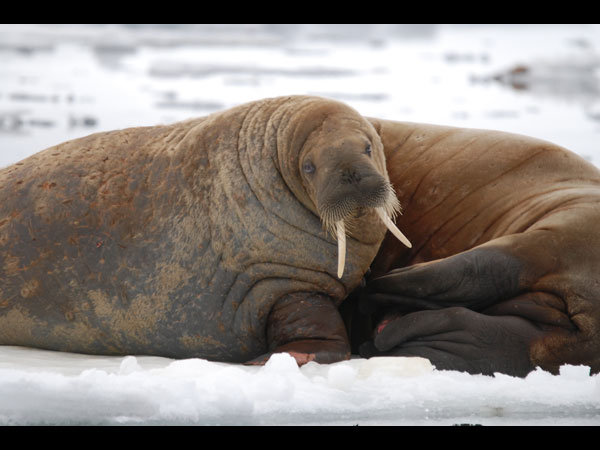
Ice blink

 Photo by Sara Wheeler, Slate

There was a brief period, between the Russian visa debacle and the other horrors of 2006, when I meant to go to Spitsbergen on the Watson. This is presumably what it would have been like:
Puffins, pink-footed geese, long-tailed ducks, ivory gulls, dunlins, king eiders, sanderlings, and red-throated divers shrieked and squawked around lime-stained fissures. It was startling to see species familiar in dowdy British winter coats resplendent in summer plumage. Gray phalaropes in Arctic carmine, snow buntings transformed from dusty slate into dazzling black and white, golden plovers with refulgent breast feathers.
I'd never heard of "ice blink":
Big wind-sock-shaped clouds hung in the sky below a layer of cirrostratus. Richard lay down to photograph ribs of driftwood. I picked among beluga tusks and rusted barrel hoops in the yard-high ice foot, a weak and unstable wall of ice and snow left on the shore when the winter sea ice broke up. We looked out for bears and listened to small waves slap the pebbles. Out in the open sea at the end of the fjord, a dazzling stripe on the underside of distant clouds mapped the sea ice. In a polar phenomenon called ice blink, clouds are lit from underneath by sunlight reflected up from a patch of pack ice in a contrasting dark area of water. When Nansen first came upon ice blink, he wrote, "I felt instinctively that I stood on the threshold of a new world."

The article also mentions the wild fluctuations in the numbers of barnacle geese in Spitsbergen; perhaps because the ecosystems are both younger and more sensitive, this appears to be a recurring theme. I remember hearing in Shetland five years ago that the population of fulmars had grown to almost dangerous levels.

Saturday, February 26, 2011

Yeats and the sea-horse

I was looking for a Yeats concordance online to see if he had done much with sea-horses (of which more below), but found Peter Ure's old review of a Yeats concordance [Rev. Eng. Stud. XVI, 221 (1965)] :
The golden smithies of the Emperor, Yeats might disapprovingly have noted, could not have contrived anything remotely resembling this volume, from which we can learn that he used Emperor twice, smithy five, and golden sixty-four times. Yeats has been chosen as the second poet (the first was Arnold) to submit his vocabulary to the IBM 704 Electronic Data Processing Machine at Cornell. An impressive compilation is the result: a total of 10,666 words (the text used being the Variorum edition), recorded with an accuracy utterly out of reach of the nonelectronic scholar. One can ramble about in it discovering all sorts of facts, such as the numbers of 'savage or noxious animals', as Mr. Parrish puts it, of birds of prey, of 'circus animals', of goats and monkeys (four of the former, only one of the latter). Perhaps the first temptation that it offers to its user is of a rather simple-minded kind: there are no demons in Yeats's verse after 1892 (14 of the 16 are in The Wanderings of Oisin), nor does dim occur after 1913; moon is nearly twice as frequent as sun, and king as queen; dream and its derivatives occupies three pages; there are six and a half pages of old and only two of young; shame occurs five times and glory twenty-eight; Coole and die have twice as many entries as, respectively, Sligo and live; England has two entries, Greece five, and Ireland thirty-nine; Oxford and Cambridge do not occur at all, but Liverpool gains a toe-hold.

How far we've come -- I ended up running Ctrl-F on the Project Gutenberg text (one has always to remember that this is case-sensitive) and finding out that sea-horses only occur in the poem that I was originally thinking of, "High Talk":

PROCESSIONS that lack high stilts have nothing that catches the eye.
What if my great-granddad had a pair that were twenty foot high,
And mine were but fifteen foot, no modern stalks upon higher,
Some rogue of the world stole them to patch up a fence or a fire.

Because piebald ponies, led bears, caged lions, make but poor shows,
Because children demand Daddy-long-legs upon his timber toes,
Because women in the upper storeys demand a face at the pane,
That patching old heels they may shriek, I take to chisel and plane.

Malachi Stilt-Jack am I, whatever I learned has run wild,
From collar to collar, from stilt to stilt, from father to child.

All metaphor, Malachi, stilts and all.  A barnacle goose
Far up in the stretches of night; night splits and the dawn breaks loose;
I, through the terrible novelty of light, stalk on, stalk on;
Those great sea-horses bare their teeth and laugh at the dawn. 

This is a very late poem that was written at about the same time as the "Circus animals' desertion," which also mentions "stilted boys." The narrator here is one of the deserting circus animals I suppose. The poem has stuck with me because of the sestet (it is a sonnet of sorts); the stilts bit is fine but the sea-horse image really comes out of nowhere as far as I can tell -- presumably the point is that sea-horses, qua photosensitive force of nature, can go back out of the light unlike Malachi; that life in the modern era is hard and mostly inglorious work, and that this is so partly because of the "broken hierarchies" (of which more in a later post) that connected life with art with death; there must also an underworld aspect to all of this (the primary sea-creatures in Yeats being dolphins, but of course Neptune was both a sea-god and a horse-god), which was what I was trying to get at from the concordance. But in the event the sea-horses seem to be a one-off and probably have to be taken on their own terms.