Showing posts with label empson. Show all posts

Sunday, April 29, 2012

Grog-blossomed

Robert Graves -- whose work I hadn't thought about in years, and never, except for Goodbye to All That, took seriously -- has been forcing himself on my attention from all sides. (I wonder, is a Graves revival in the works?) Snippets follow:

1. A marvelous piece by Graves on L'Allegro (Verdict: "[with Shakespeare] the probing cold-chisel of criticism rings against the true rock of poetry. With L’Allegro, the plaster flakes away and the rubble tumbles out." Elsewhere, he speaks of "jolly old father Zeus himself, with a thunderbolt in his fist and a grog-blossom on his nose.") I have never liked these poems, which must have something to do why I enjoyed the Graves piece so much.

(It occurs to me that I haven't made full use of the newly-free TNR archive.)

2. Geoffrey Hill, in a lecture (nominally on war poetry) that Calista sent me, has much to say about Graves. The glib summary of the first 10-15 mins of the talk is that Seven Types, and its interest in verbal tensions and ambiguities, was ultimately the fruit of Graves's interest in psychology after WW1. (I'd known, of course, about Empson picking up the idea from the Graves/Riding analysis of "the expense of spirit(s)", but Hill pushes the chronology back a decade. I'm not sure this has more than bibliographical interest, though.) Later in the lecture, Hill quotes a short and really very good Graves poem that I hadn't prev. seen:
On Portents

If strange things happen where she is,
So that men say that graves open
And the dead walk, or that futurity
Becomes a womb and the unborn are shed,
Such portents are not to be wondered at,
Being tourbillions in Time made
By the strong pulling of her bladed mind
Through that ever-reluctant element.
It is almost free of Graves's signature tweeness, except possibly for "tourbillions" which I can't make up my mind on; Hill, to his credit(?), treats the word as a serious literary choice rather than a symptom. (Obviously he is really drawn to the poem by that "ever-reluctant element"; recalcitrance of any kind seems always to have had an irresistible romance for him -- his first book begins with the line, "Against the burly air I strode" -- but this is all a story for another time.)

(As a note to self, if one ever finds the elementary excitation responsible for turbulence, "tourbillion" is a good name as it sounds international and has the "-on" ending.)

3. Speaking of Graves's style, Richard Wilbur on Graves, in the relevant PR interview:
Still, it can be useful and safe to read someone like Robert Graves who, as John Holmes said, is a great starter. You read Graves and he reminds you how delightful poetry can be at its best, and what a fine game it is—and it makes you want to write a poem. Not, however, a poem by Robert Graves, but one of your own.
Symptomatic, perhaps, of his own not-unrelated tweeness, that he should say this? Elsewhere, Randall Jarrell remarks about some of the Auden poems in Nones, 'If you see such a poem, what can you say except, "Ah, Graves, poor dear Robert Graves! Inimitable, isn't he?" But how extraordinary that Auden [should have written it].' I must also confess that few things set my teeth on edge as effectively as hearing Graves read his poems.

4. And, before burying this topic, I should recall that marvelous bit in Goodbye to All That where he meets Thomas Hardy:
[Hardy] said that he regarded professional critics as parasites no less noxious than autograph hunters, and wished the world rid of them. He also wished that he had not listened to them when he was a young man; on their advice he had cut out dialect-words from his early poems, though they had no exact synonyms to fit the context. And still the critics were plaguing him. One of them recently complained of a poem of his where he had written `his shape smalled in the distance'. Now what in the world else could he have written? Hardy then laughed a little and said that once or twice recently he had looked up a word in the dictionary for fear of being again accused of coining, and had found it there right enough — only to read on and find that the sole authority quoted was himself in a half-forgotten novel! He talked of early literary influences, and said that he had none at all, for he did not come of literary stock. Then he corrected himself and said that a friend, a fellow-apprentice in the architect's office where he worked as a young man, used to lend him books. (His taste in literature was certainly most unexpected. Once when Lawrence had ventured to say something disparaging against Homer's Iliad, he protested: `Oh, but I admire the Iliad greatly. Why, it's in the Marmion class!' Lawrence could not at first believe that Hardy was not making a little joke.)

Sunday, January 15, 2012

"It does seem what you need to be told"

Interesting bit of Empsoniana, via pseudopodium: an exchange of letters between E. and Rosemund Tuve, occasioned by a disagreement re George Herbert's "Sacrifice" (readers of 7 types might remember an allusion to this in the preface to the 1949-ish edition). [Grouchy aside: the introduction is awful. Says E. went to Magdalen College, Oxford -- really it was Magdalene, Cambridge -- and astoundingly asserts that "neither [E. nor T.] is noted for style".] The longer letter by Tuve is interesting for its stylistic reasons; it is arch and benignant, and also unaccountably difficult to read. Empson's letters are Empsonian to the point of self-parody -- as so much of his work is -- but I enjoyed this remark (my emphases):
I was rather shocked at your saying that I neednt rewrite my bit posted to you because it is always a nuisance to rewrite. I rewrite everything I print about twelve times, mainly in the interests of intelligibility, and I think you had much better do that too. Checking references always seems to me a trivial duty compared to checking style. I think that your style has greatly improved in your last book but is still very bad, simply from failure of communication. I also think that if you tried to write more clearly you would find your own ideas are a great deal more muddled than you suppose. So I hope very much that you will write another book, but as a labour of love, intended to be agreeable in itself – the distinction between the writer and the reader becomes unreal (because the same thing pleases both) if you take your own style as seriously as you take the style of the authors you are describing. One can imagine this doctrine working out wrong, but it does seem what you need to be told.
Tuve (whom I am more sympathetic to on the merits, and to whom E. is occasionally condescending) also has some good moments in her second letter:
how am I not to snort at you if you plant your feet wide apart and say ‘I refuse to see concordance!’ Then you must not know what you would know if you saw concordance. [...] A scholar isn’t a fetcher and carry-er so that others haven’t to trouble; it wouldn’t even be safe.

I honestly think (or did, and am pretty sure I still would; it’s a long question) that the book gives proper and sufficient data for any claim that is therein made, as far as a quite tender and delicate scholarly conscience can watch such things – there are always ways in which the mind, being fallible, goes astray. But the only way you can be sure whether I have is, is to just go and read what I had.
Another note: Tuve wants to construe Empson as saying that scholarship is of no value to literary critics, which is a straw-man version of Empson's position, but not too much of one. Empson is infuriating about not checking his quotations, etc. As for the broader point about whether relevant scholarship helps one understand texts better -- I suppose some of the New Critics denied this; that this New Critical position was ever respectable now seems mysterious.

Thursday, May 5, 2011

Autumn in the kingdom of heaven

Also from that sermon of Donne's I quoted earlier:
God hath made no decree to distinguish the seasons of his mercies; In paradise, the fruits were ripe, the first minute, and in heaven it is alwaies Autumne, his mercies are ever in their maturity.

From context he doesn't seem to be implying a pun on fall; I found the conceit rather striking, but if one imagines autumn as the season of "mellow fruitfulness," or as Horace's "pomifer autumnus," there is nothing implausible about its having been autumn in Eden. There's something very 17th-century, very characteristic of Donne and Webster and Browne, in the idea, though (cf. Donne's elegy "The Autumnall"); the best work of the period is both rich and somber, like autumn. I have always liked Empson's theory of the basis of this sentiment (in the Pastoral book):
Since the world has grown small, and the sun near its end, we are set free with a sort of cosiness, an irresponsible concentration, to be happy while we may. [...] The belief that the world was soon coming to an end, found in Donne, Chapman, and Sir Thomas Browne, seems important to them and is not easily explained. Samuel Butler the elder laughs at it as based on a passage in Copernicus about two determinations of the distance of the sun, of which the second made the sun nearer, so that we seemed to be falling into it ; this would provide the last fire. I suspect that there was some astronomical pamphlet which they had all read, but Hakewill's refutation of the belief does not put one on to it. At any rate the belief was respectable but not certain and had proofs from astronomy rather than religion.

Saturday, April 23, 2011

"A straggling appendage...like a false beard that had slipped"


Again via Calista, a delightful reminiscence about Empson's year teaching at Kenyon College [see here for previous coverage of Empson's habits]

The Remarkable Mr. Empson

Empson was, hands down, the star of that summer. He chose, for instance, to live in the student dormitory, so that we saw a lot of him. He was friendly and accessible. Even if one did not know who he was, one knew that he was the man with the yellowed cigarette holder in his lips, even when he was the captain of the Ambiguities playing softball, as I have said; or when walking around the campus reading a book as he walked--and I would swear I saw him dive into a swimming pool with it. Once when I asked if it wasn't difficult to read while he was walking, he replied, "It's much harder on a bicycle."

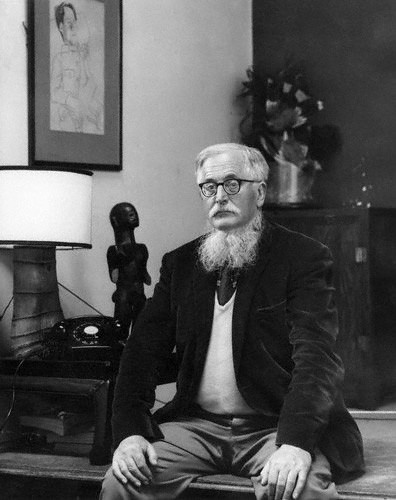
He was odd enough just to look at. He was of slight build, but sturdy and vigorous. His dark eyes were magnified by thick lenses. But one's attention was drawn immediately to a most unfortunate beard, which the writer and critic John Gross once described as "a straggling appendage which began below his jaw line and looked like a false beard that had slipped." He was extraordinarily nervous, and ran his fingers through it when speaking. (I remember an amusing conversation with Robert Lowell, comparing beards: Lowell had worn one during his time as a conscientious objector and complained that he had a hard time keeping it clean: ketchup, he said, was the worst.) But Empson's nervousness was that of a person who was over-energetic and preoccupied, not fidgeting.

He wore whitish suits, unkempt, discolored, loose. His belts did not run through the loops of his trousers but ran around the trousers below the loops. And, in addition to that yellowed cigarette holder, he sometimes smoked a gross yellow pipe.

As his clothes suggested, he was not tidy. At the Lowells' afternoons, he smoked, of course, incessantly, thumping the ashes on the floor. When he finished a cigarette, he absent-mindedly threw the extinguished butt toward a window, usually having it bounce back from the screen. After a moment of startled indecision, he seemed to contemplate whether he should pick it up, but turned his back instead.

To the swimming pool he wore a flowing Chinese robe with a dragon on the back. He would walk, silently, to the diving board, stand on it several minutes, clasping his hands behind his head like a bearded fakir doing penance on a mountain, then suddenly he would dash forward, give one brusque hop, dive into the water, swim to the end underwater, clamber out, repeat the whole procedure one more time, then leave the pool.

Friday, March 18, 2011

Balloons, drowning, iridescence, and pastoral

The Germans must have a word for the pleasure one gets from this kind of thing:


There is a very famous Heaney poem on precisely this conceit:

Lightenings viii

The annals say: when the monks of Clonmacnoise
Were all at prayers inside the oratory
A ship appeared above them in the air.

The anchor dragged along behind so deep
It hooked itself into the altar rails
And then, as the big hull rocked to a standstill,

A crewman shinned and grappled down the rope
And struggled to release it. But in vain.
'This man can't bear our life here and will drown,'

The abbot said, 'unless we help him.' So
They did, the freed ship sailed, and the man climbed back
Out of the marvellous as he had known it.
One should distinguish this effect from the subtly different one in Auden's line about an island being "a lake turned inside out" or Thom Gunn's image of a gas poker as a "backwards flute." There is nothing odd about the pleasure one gets from negatives that look like something quite different from the original photograph; this is just "wit" of the usual kind. There is a lot of local wit in the New Yorker cartoon (one is reminded, e.g., of the Piranha brothers, though these fish are evidently not piranhas) and the Heaney poem leans very heavily on its last line, but I think there's something intrinsically appealing about the situation. I'm reminded of Empson's reading of Donne as a Copernican:
if you take the world not as the universe but as this planet it becomes something one might conceivably get outside but which it would be absurd to try to get outside; there are more than one of them, but each creature is right in giving an absurd importance to his own.

This is from the Pastoral book, and the "move" of creating a set of precise set of correspondences between the everyday world and some entirely foreign world is like pastoral (the chapter on "Marvell's Garden" goes on about this, "the mind, that ocean where each kind / doth straight its own resemblance find" etc.) -- but the suffocation motif is important, I think, and emphasizes the sense that people are limited, trapped in some particular element... Anthropomorphizing the fish (or alien) serves a double purpose as it allows the reader to see the situation from both points of view at once; it's an acceptance of one's limitations from a point of view that evades the limitations by not being fixed, and this is satisfying for the same obscure reason that the verbal ambiguities are. 

Like the ambiguities, this doubleness of perspective is necessary because perception, like language, is not polyphonic, and can only achieve polyphony through instability. I've always felt that a better term than "ambiguity" for what Empson meant is iridescence. (D.H. Lawrence was here first: "how boring, how small Shakespeare's characters are! / But the language so lovely, like the dyes from gas-tar.") Why one finds this appealing is a little obscure to me, but at least it's a familiar mystery rather than a new one.

Saturday, January 29, 2011

"Rotting oranges, used tissues and odd socks"

Maybe Empson and Auden are my favorite literary personalities because I can "identify" (dread word!) with their lifestyles. For instance, here is Frank Kermode reviewing a biography of Empson:
His victims were usually confident that his habits in controversy were in some measure aspects of a more general eccentricity: the strangled, oddly inflected voice or voices, the peculiar beard, the use of drink to lubricate all argument, to get something started. [...] Money worries in the final years required him to spend time at American universities, teaching, lecturing, and reinforcing his reputation for bizarre or clownish behaviour. A colleague at Penn State notes that ‘he went back at night to a place full of rotting oranges, used tissues and odd socks’, and records that ‘he once, for some minutes, watched my neighbour’s door lamp through my telescope, thinking it Mars.’ Dining with Marshall McLuhan, ‘I thought I had to explain to him that he was worshipping the devil, being a Roman Catholic. It was at his own dinner table, but the ladies had gone for their pee, so it wasn’t really rude.’ On a visit to Harvard he was ‘truculent and contradictory’ towards Richards.

There is something heartening about all the drunkenness and especially the squalor. (Remember the Auden martini?) Both W.E. and W.H.A. had Robert Lowell as a gleeful describer of their living habits; Kermode quotes Lowell on Empson:
Not that conditions in their Hampstead house were very different from those of the Sheffield ‘burrow’ – they were described by Robert Lowell as having ‘a weird, sordid nobility’
And there is a wonderful passage in one of Lowell's letters to Elizabeth Bishop -- collected in Words in Air, which btw is a must-read, but is in storage like most of my other books -- on Auden's Manhattan parties. (I find it interesting how much more natural it seems for nobility to be sordid than to be, say, hygienic: is it that we associate the aristocracy with decline or that we associate it with antiquity, which is automatically dirty [1]?  Empson is very "gentry" -- the legend has pushed this angle, referring to him as a squire etc. And isn't there a thing about bad teeth as well?)

I went back to the Kermode articles because Empson's been "in the news" lately, at least to the extent that my feed represents "the news" -- first of all there was that Michael Wood article on True Grit:
If traditional pastoral often idealises the simple life, it never quite chases the shadows of cruelty and corruption away, and what William Empson called the trick of simplification was always the thing. The mode kept remembering what it was ostensibly getting rid of.

The "trick of simplification" is a notion I'd like to associate with Empson's prehistory as a mathematician though I'm not sure this is right; certainly the Pastoral book is preoccupied with a kind of structural question that lends itself to "modeling," and I have sometimes wondered whether what one does as a theoretical physicist isn't related to pastoral in the sense that, instead of attacking a complex and idiosyncratic problem directly, one takes an entirely different, heavily simplified, and more "conventional" situation, treats it, and points out that the relations between certain entities in the original problem and the (asserted-to-be) analogous ones in the simplified one are -- unexpectedly as it were -- the same [2]. Mathematics is in this telling the individual or collective unconscious; it has many of the right properties for this role, and I suppose one can think of complex things like the weather as perversions of some submerged mathematical inclination. Of course none of this is useful as an account because there is no moral significance to the complexity of nature.

And then there was an article on "six types of clarity" that Marina sent me in response to my saying that something was an ambiguity of the second kind. ("I like it that you clarify which kind of ambiguity you're talking about." Admittedly an odd thing to do, but I do think Empson's types 1, 2, and 4 describe specific effects for which I don't know of any other terminology.) It's a very nice article and has some insightful things to say about an issue I blogged about sometime ago re "primitive" poetry. Of which more later.

---

[1] One is tempted to assume an association between messiness and vitality, but this falls apart after say the 17th century. The Rochester character in The Man of Mode doesn't use deodorant but is irresistible -- the expected pattern -- but generally the bourgeoisie and esp. the nonconformists are (a) on the rise, (b) not notably filthy, (c) not irresistible, at least qua bourgeoisie, (d) [possibly] breeding like rabbits. (Not sure about (d) in popular perception. Might be projecting backwards from the Mormons. Not sure either how far northern accents would stand in for filthiness -- the Chatterley line of reasoning, though gamekeepers were not bourgeois.) There's something odd about the fact that neatness is perceived as a diminishing virtue, even as far back as Johnson's comparison of Dryden and Pope. I suppose this is all linked in some tenuous way to the dissociation-of-sensibility thesis and the idea that poetry has never come to terms with modern life, has never found the right things poetical, etc.

[2] There are some areas, like string theory, to which this paradigm doesn't evidently apply. One probably wants to think of the Standard Model as the idiosyncratic, complicated system that is being simplified. But there isn't really a notion of "universality" there as there is elsewhere, so this isn't a natural description.