Showing posts sorted by relevance for query lydia davis. Sort by date Show all posts

Saturday, September 3, 2011

Davis and Moore, Jonson and Johnson

A Very Short Story from the Lydia Davis volume Samuel Johnson is Indignant which for some reason has fetched up on my bedside table (and which, consequently, I have been rereading):

Almost Over: Separate Bedrooms

They have moved into separate bedrooms now.
That night she dreams she is holding him in her arms. He dreams he is having dinner with Ben Jonson.

(But I always thought it was supper!) Looking for a pastable text I came upon this excellent review by Richard Locke, which ends with an apt and unexpected comparison between Davis and Marianne Moore. Locke quotes Randall Jarrell on Moore:
the intricate and artificial elaboration not only does not conflict with the emotion but is its vehicle.

Which brings to mind that wonderful remark of Moore's:
rectitude has a ring that is implicative, I would say.
(Cf. Davis's abnormally strict views on literalness in translations.) Googling which -- this process being rife with serendipity -- I came upon Denis Donoghue's essay about Moore, which makes the point slightly better than Jarrell:
for Marianne Moore the supreme poetic virtue is beyond morality, though decently attentive to it. The merit of a poem, a novel, a book about landscape gardening, The Magic Flute, or a sculpture by Malvina Hoffman consists in the personality it discloses when disclosure is not intended and the artist is minding his proper business.

(Why this appeals to me will be obvious to regular readers.) The part that follows applies much more to Moore than to Davis:
Moore's common word for the flare of personality, the unity of being in which one's action is a true epitome of one's self, was rhythm. [...] Moore liked to quote Coleridge's remark that "our admiration of a great poet is for a continuous undercurrent of feeling everywhere present, but seldom anywhere a separate excitement." But she loved to find a separate excitement, like a whirlpool, verifying the undercurrent and at last returning to it. Often she found it in English writers of the seventeenth century, Bacon, Donne, Moore, the King James translators of the Bible; later in Defoe, and in Johnson, in whose work she noticed "a nicety and point, a pride and pith of utterance"

(Re "pride and pith" -- this slightly off-kilter way of ordering nouns is characteristic of Moore. (It is a similar trick to the unemphatic rhymes.) It is said that Ezra Pound changed the last line of her poem "A Grave" from "neither with volition nor consciousness" to "neither with consciousness nor volition" and she immediately changed it back.)

What Donoghue is paraphrasing re "flare of personality" is that Hopkins poem:
As kingfishers catch fire, dragonflies draw flame;
As tumbled over rim in roundy wells
Stones ring; like each tucked string tells, each hung bell's
Bow swung finds tongue to fling out broad its name;
Each mortal thing does one thing and the same:
Deals out that being indoors each one dwells;
Selves — goes itself; myself it speaks and spells,
Crying Whát I dó is me: for that I came.
I think one of the drawbacks of the poetics of subtraction -- the Beckett/Davis line -- vs. the poetics of clutter is that it is in a sense too transparently theatrical; a bare stage draws attention to itself in a way that an overcrowded stage does not -- the artist is not "minding his proper business," he's designing to be looked at. Davis's way around this is to have her "proper business" be sentence-articulation but this is not always a satisfactory substitute for irrelevant detail.


Tuesday, September 30, 2008

Lydia Davis on Auden's Sleeping Habits

From her short story collection Break it Down. Link.

How W. H. Auden Spends the Night in a Friend's House
Lydia Davis

The only one awake, the house quiet, the streets darkened, the cold pressing down through his covers, he is unwilling to disturb his hosts and thus, first, his fetal curl, his search for a warm hollow in the mattress . . .

Then his stealthy excursion over the floor for a chair to stand on and his unsteady reach for the curtains, which he lays over the coverings on his bed . . .

His satisfaction in the new weight pressing down upon him, then his peaceful sleep . . .

On another occasion this wakeful visitor, cold again and finding no curtain in his room, steals out and takes up the hall carpet for the same purpose, bending and straightening in the dim hallway . . .

How its heaviness is a heavy hand on him and the dust choking his nostrils is nothing to how that carpet stifles his uneasiness . . .

Friday, May 6, 2011

The horizon as a spit


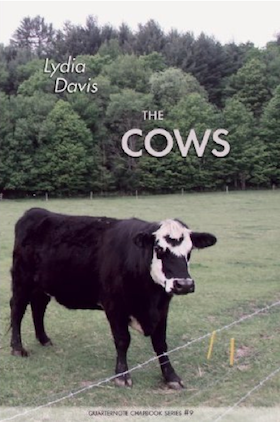
I'm intrigued by Lydia Davis's chapbook The Cows, though it seems daft to pay $10 for 32pp. of observations about cows. A snippet from the Amazon page:
Forms of play: head butting; mounting, either at the back or at the front; trotting away by yourself; trotting together; going off bucking and prancing by yourself; resting your head and chest on the ground until they notice and trot toward you; circling each other; taking the position for head-butting and then not doing it.

I was reminded of a snippet from a Davis interview in the FT a couple of years ago, which I thought I'd blogged at the time but apparently didn't:
a photograph of two cows – standing in the snow like black cut-outs on white paper, staring flatly at the camera. Something about the picture is irresistibly funny.

She sent the photo, she tells me, to her friend Rae Armantrout, a poet, who called her afterwards. “She asked me why I had sent her a picture of two pigs strung up on a spit,” says Davis – and then turns the picture upside down.

I can see what she means; the line of horizon does resemble a wire, and the cows do look a bit like pigs. “It was just one of those confusions,” she says, shrugging.

Friday, June 10, 2011

"They must be read in order as they lie"

1. Lydia Davis reviews Ashbery's new version of Rimbaud (NYT). I admire Davis's stories and can see how her sensibility informs her theory of translation, but the theory itself is pointlessly austere, and I cannot see that the lines she particularly admires in Ashbery's translation are unusually good. (She doesn't say that in one of the lines she quotes, "Let someone finally rent me this tomb, whited with quicklime," the prosody -- dactylic hexameter -- and the punning antithesis on quick/tomb probably had as much to do with the choice as the KJV.)

2. While on the topic of translation, a passage from Dryden's preface to his translation of the Aeneid. (I went through an obscurely motivated obsession with Dryden a few years ago; could not bring myself to read very many of the plays but read all the poems and prefaces. There is a lot of appealingly specific nuts-and-bolts talk, as well as chutzpah, in his critical writing.)
What [Virgil] says of the Sibyl's prophecies may be as properly applied to every word of his--they must be read in order as they lie; the least breath discomposes them, and somewhat of their divinity is lost. [...] 
I have shunned the caesura as much as possibly I could; for wherever that is used, it gives a roughness to the verse, of which we can have little need in a language which is overstocked with consonants. Such is not the Latin where the vowels and consonants are mixed in proportion to each other; yet Virgil judged the vowels to have somewhat of an over-balance, and therefore tempers their sweetness with caesuras. ... On the other side, for the reason already named, it is all we can do to give sufficient sweetness to our language; we must not only choose our words for elegance, but for sound--to perform which a mastery in the language is required; the poet must have a magazine of words, and have the art to manage his few vowels to the best advantage, that they may go the farther. [...]


You may please also to observe that there is not, to the best of my remembrance, one vowel gaping on another for want of a caesura in this whole poem. But where a vowel ends a word the next begins either with a consonant or what is its equivalent; for our w and h aspirate, and our diphthongs, are plainly such. The greatest latitude I take is in the letter y when it concludes a word and the first syllable of the next begins with a vowel. Neither need I have called this a latitude, which is only an explanation of this general rule--that no vowel can be cut off before another when we cannot sink the pronunciation of it, as he, she, me, I, &c. [...]

I am sure there are few who make verses have observed the sweetness of these two lines in "Cooper's Hill" -
"Though deep, yet clear; though gentle, yet not dull;
Strong without rage; without o'erflowing, full" -

and there are yet fewer who can find the reason of that sweetness. I have given it to some of my friends in conversation, and they have allowed the criticism to be just. But since the evil of false quantities is difficult to be cured in any modern language; since the French and the Italians, as well as we, are yet ignorant what feet are to be used in heroic poetry; since I have not strictly observed those rules myself which I can teach others; since I pretend to no dictatorship among my fellow-poets; since, if I should instruct some of them to make well-running verses, they want genius to give them strength as well as sweetness; and, above all, since your lordship has advised me not to publish that little which I know, I look on your counsel as your command, which I shall observe inviolably till you shall please to revoke it and leave me at liberty to make my thoughts public. [...] Spenser has also given me the boldness to make use sometimes of his Alexandrine line, which we call, though improperly, the Pindaric, because Mr. Cowley has often employed it in his odes. It adds a certain majesty to the verse when it is used with judgment, and stops the sense from overflowing into another line. [...]

The want of genius, of which I have accused the French, is laid to their charge by one of their own great authors, though I have forgotten his name, and where I read it.

Saturday, December 31, 2011

"'Tis well an old age is out, / And time to begin a new"

I thought of putting together a year-in-reading post but was confounded by the apparent length of this year, the sense that events in the psychological far past -- acquisition of Kindle, acquaintance with Cobbett -- really took place this March or April (the Kindle came about Apr. 15, I remember this because when I went home to collect it in the afternoon I found my landlady downstairs and said something about having to file my taxes). And it hasn't been a year that's defined by stuff I've read -- if anything, a year with swaths of mental paralysis cut through it, long intervals of staring at books and not registering a word -- although I discovered Thomas Bernhard [just noticed, and was amused by, his initials being TB] and Teju Cole. (Also: Cobbett, Saintsbury on prose rhythm, Flaubert's Parrot, Vertigo, The Ambassadors, two of Gissing's novels.)

Anyhow, it is a good time for a broader retrospective post, esp. because the year-end coincides with a "natural" break: I have just accepted a postdoc at Harvard, which I'll begin in the fall; while the thesis must still be written, I suppose I'm well into the home stretch. On this front at least, "things have turned out better / than I once expected or ever deserved"; I had multiple good options. Nevertheless, when I think back on the past five years or so the chief impression is one of waste, of time that I could have spent on various kinds of growth but did not, the sense that owing to my laziness I've been coming 

                                              to resemble
The beasts who repeat themselves, or a thing like water
Or stone whose conduct can be predicted,

and that my immediate recourse to these lines -- which I might also have cited for similar reasons five years ago -- is further depressing evidence that they apply to me. But enough of this, it cannot be helped: one is less impressionable than one used to be -- people are -- and attempts to fight this are inherently limited. (One's memory is also less vivid than it used to be: it is appalling to think how little I remember of Proust. What else have I read as a grad student that really sticks in the memory? Lydia Davis, Thomas Browne, Urquhart's Rabelais, Sabbath's Theater, Hollinghurst. Muldoon's recent poetry -- especially this -- and fragments of Geoffrey Hill and Charles Wright. I went through a phase, in 2008 perhaps, when I bought a large amount of contemporary poetry; seems to me now that I only remember the titles of the books. Reading this list, I suspect that one thing I should definitely have read more of is literary criticism and/or philosophy.)

I am glad on the whole that I went to grad school in physics, and a little surprised that I've enjoyed the "work" aspect of it. (I cannot say much in defense of life in central Illinois, though.) I was fortunate to stumble quite blindly into an area -- in a field that I had been drawn to for its difficulty and lack of obvious correspondence with my strengths -- where taste and wide reading mattered as much as analytical ability, and to have an advisor who let me pick my own problems. I was fortunate to pick up the learning on the cheap, by going to talks rather than reading papers -- UIUC being fairly central in my field -- and especially by getting to spend fall 2010 in Santa Barbara where I was deluged with information at workshops and conferences. And I was fortunate, above all, that innumerable things did not go wrong that anyone acquainted with many grad students knows can easily go wrong. (I suppose some of this text will be reused in thesis acknowledgments.)

Which brings us to 2011, which was a strange year. (As a coherent unit it began Dec 18 2010 when I arrived in Chicago without an overcoat.) I had finished the paper that will presumably be most of my thesis in July 2010, and had spent the fall thinking of other things but mostly going to talks and meeting people; meanwhile the advisor decided to move to Atlanta, so when I came back I was in effect in the position of a postdoc without a group. I couldn't at that point have applied for any of the really nice fellowships -- deadlines tend to be Oct/Nov -- so the choices were (a) get a temporary postdoc and apply for fellowships in a year; (b) move to Atlanta; (c) stay on in Urbana and soldier on. Option (c) was the most appealing as it didn't involve moving, but also the most sensible as it turns out: really the imperative was to position myself optimally for the job market this year, and moving/completing thesis were much less useful than getting as much research done and published as I could. (Did not quite meet expectations but didn't fail completely either.) Esp. with the departure of two good friends in the summer and the encroachment on a third of child-rearing duties, I've had a wealth of solitude that I'm afraid I've mostly spent drifting about the internet, tweeting maniacally, and -- esp. in the fall -- inspecting the publication record of everyone who ever got a postdoc I wanted. I do not know if it was the solitude or the anxiety, but I have never had such an infertile year intellectually -- I cannot think of a single good idea.

But that's all over for now, and I can return, I hope, to attacking various things like a shark. I don't know when I'll be defending/moving yet, but it won't be until the summer: long enough to kippleize my surroundings a little further, write two or three papers, fill out some reimbursement forms, and figure out how to format a thesis according to UIUC registrar's specs. For the moment at least, I vaguely look forward to it.

(Previous, similar posts here and here.)

Friday, November 11, 2011

"The ambiguity of the apple"

Alan Garner remembers Alan Turing (Guardian):

He was stocky, barrel-chested, with a high-pitched, donnish voice and the aerodynamics of a brick. He was funny and witty and he talked endlessly, but I understood very little of what he was saying, and it became clear that he ran in order to think. He seemed to be obsessed by mathematics and biology. That much I could work out.

We had one thing in common: a fascination with Disney's Snow White and the Seven Dwarfs, especially the transformation of the Wicked Queen into the Witch. He used to go over the scene in detail, dwelling on the ambiguity of the apple, red on one side, green on the other, one of which gave death. We had both been traumatised by Walt.
Also an appealing piece in Nature News, casting doubt on the claim (which I missed at the time) that cows are magnetic:
Three years ago, Hynek Burda, a zoologist at the University of Duisburg-Essen, Germany, and his colleagues added cattle to the magnetic family with a paper in Proceedings of the National Academy of Sciences. The team used data from Google Earth to show that domestic cattle seem to prefer to align their bodies along Earth’s magnetic field lines1, and showed a similar phenomenon in field observations of deer. [...] Burda and his colleagues reanalysed the replication attempt by Jelinek and his colleagues4. Burda says that half of the Jelinek team's data should be excluded because some of the pastures are on slopes or near high-voltage power lines, for example, or because the images are too poor to make out cattle, or appear to contain hay bales or sheep instead. “One half of their data is just noise,” says Burda.
I wonder if Lydia Davis reads Nature News.

Monday, October 10, 2011

"Unjoynt that bittern!" Etc.

A link-dump:

1. James Wood reviews the new Hollinghurst novel in the NY'er, with more irritation than liking (nevertheless it sounds very much worth reading); here is his takedown of the Henry James pastiche:
In Hollinghurst’s new novel, “The Stranger’s Child” (Knopf; $27.95), the Jamesian cadences come in peristaltic waves: “This large claim seemed rather to evaporate in its later clauses.” “This was exactly Dudley’s version too, though the cool nerve of ‘improving’ made Daphne laugh.” [...] Sex itself—specifically, gay sex—is feared by one character as “the unimagined and yet vaguely dreaded thing.” It does a writer as talented as Hollinghurst few favors to be fossicking in fustian in this way; I spent too much time, while reading this often beautiful novel, itching to write a parody of Hollinghurst’s Jamesianism. (“Ralph’s cock was small but sincere; in the afternoon’s fading light, thinned by winter’s quick transit, it seemed to Hugh almost shyly noble. The two men could hear Lady Soames’s little lacquered laugh, somewhere downstairs. . . .” And so on.)

2. Teju Cole reviews Andre Aciman's Essays on Elsewhere (Aciman is v. much a personality in my imagination thanks to Lydia Davis's story "The Walk"). Here is Aciman on the kinds of lavender:
There were light, ethereal lavenders; some were mild and timid; others lush and overbearing; some tart, as if picked from the field and left to parch in large vats of vinegar; others were overwhelmingly sweet. Some lavenders ended up smelling like an herb garden; others, with hints of so many spices, were blended beyond recognition.

3. Jeff Gordinier (who?) ends up in the Hebridean island of Luing thanks to a Don Paterson poem:
What I found tantalizing about “our unsung innermost isle,” as Mr. Paterson put it, was the very obscurity of the place. It was obscure not because it was theatrically desolate and raw, but because it was the opposite of that. It was an island that just sat there and gazed out at all the more famous islands.
I didn't know the poem -- I ought to know Paterson's work much better than I do -- and wasn't bowled over by it (the ending, I think, is off-key) but I thought this bit was rhythmically very nice:
Kilda's antithesis,
yet still with its own tiny stubborn anthem,
its yellow milkwort and its stunted kye.

4. A wonderful list of nonce words from the 17th cent. for carving specific kinds of meat. Birds, for some reason, have many of the best ones (virtually all of these have potential euphemistic uses btw):
Rear that Goose.
Lift that Swan.
Spoil that Hen.
Frust that Chicken.
Unbrace that Duck or Mallard.
Dismember that Hern.
Display that Crane.
Disfigure that Peacock.
Unjoynt that Bittern.
Allay that Pheasant.
Mince that Plover.

I also liked "tame that crab" and "splat that pike" though.

5. Two strange news stories, about sharks invading a golf course in Brisbane and about a supposed Saddam Hussein lookalike being pursued by a supposed porn gang.

---

In other news, work is in a heightened degree of disarray because our automatic spam filter has gone rogue, marking (e.g.) correspondence with journals as spam! I can't figure out how to turn the filtering off...

Calista reminded me yesterday of an intriguingly nasty Rochester poem that I had blogged a long time ago (scroll 2/3 of the way down) as a bridge between Herrick and Pope. (It is a post that is quite needlessly tl;dr and badly organized, I don't remember what I was thinking at the time.)

Saturday, March 26, 2011

Cobbett, etc.

1. I was reading William Cobbett's Rural Rides on the flight back from Dallas; was hooked by this passage on p. 1:
All Middlesex is ugly , notwithstanding the millions upon millions which it is continually sucking up from the rest of the kingdom; and, though the Thames and its meadows now and then are seen from the road, the country is not less ugly from Richmond to Chertsey bridge, through Twickenham, Hampton, Sunbury and Shepperton, than it is elsewhere. The soil is a gravel at bottom with a black loam at top near the Thames; further back it is a sort of spewy gravel; and the buildings consist generally of tax-eaters’ showy, tea-garden-like boxes, and of shabby dwellings of labouring people who, in this part of the country, look to be about half Saint Giles’s: dirty, and have every appearance of drinking gin.

There is a great deal to like -- lists of place-names and soil, "local color"... -- but on the whole it makes for atrocious in-flight reading as there is no narrative to it. I read fitfully and got through about 70pp. Disappointed he didn't do East Anglia as I sort of wanted to read Cobbett in parallel with Sebald. I'm always baffled by the things I choose to pack... this is why one should own a Kindle I suppose.

2. Speaking of Cobbett, I had not heard of Tom Paine's afterlife (Wikipedia):
A plan to return to England with the remains of [...] Thomas Paine (died 1809) for a proper burial led to the ultimate loss of Paine's remains. The plan was to give Paine a heroic reburial on his native soil, but the bones were still among Cobbett's effects when he died over twenty years later. There is no confirmed story about what happened to them after that, although down the years various people have claimed to own parts of Paine's remains such as his skull and right hand.

This is, of course, coheres with everything else one does know about Cobbett.

And some tab-closing:

3. From Randall Jarrell's review of The Shield of Achilles: "Auden [...] lies back in himself as if he were an unmade bed." (Cf. Lydia Davis's prose poem on Auden's sleeping habits.) I think most people who still read Auden today would be a little puzzled at Jarrell's claim that the very earliest work was the best. One is fond of "The Watershed," "1929," etc., but they are neither the anthology pieces nor the poems that have actually had influence.

4. Jeremy Harding on Hitch's "strong, almost gamey opinions" [LRB]. Trilling remarked somewhere that Orwell should be thought of an essayist in the tradition of Cobbett and Hazlitt; Hitchens, of course, is in the tradition of Orwell, and this is a transitive relation. Harding manages to squeeze in a swipe at Martin Amis, as a sidekick "with a frozen alcopop in one hand and an unread novel by Victor Serge in the other" who isn't as clever/fastidious/etc. as Hitchens. True in relative terms, perhaps, but reading Hitch in parallel with Orwell -- or Cobbett -- reminds you of what a self-indulgent poseur he is by comparison, how shallow and improvisatory his crotchets have always seemed.

Tuesday, November 1, 2011

Of mice and shoes

1. from Marianne Moore, "Silence":
Self reliant like the cat 
that takes its prey to privacy,
the mouse's limp tail hanging like a shoelace from its mouth --
they sometimes enjoy solitude,
and can be robbed of speech
by speech which has delighted them.
2. "Mice" in A.J. Snijders's Very Short Animal Stories (trans. Lydia Davis, in Asymptote):
A mouse inside a shoe is not a primal fear, not a trauma, but I do pay attention, all the same. It's because of the open roofs. I have a house with three tile roofs. They used to be haylofts, they were not timbered, the wind had to be allowed to blow through freely, against the heat and damp. Time and objectives change, I timbered one roof, gas was installed, the electricity went underground, drainage pipes were laid, but the mice stayed. The house is in the fields, there are mice everywhere. [...] Yesterday in a forgotten cupboard I found two pairs of shoes. I recognized them, old, but still useable. First I hold them by the tips, and I shake them—to be absolutely sure, I even poke them with a little piece of wood. Then I put them on; once my feet are inside them, I feel ten years younger, but that doesn't help, I'm still thinking about the oil, the energy, the mice, the people and the water.
---

I have a Google-reader-shaped hole in my heart, now that their latest shitty "update" has excised not only the social features but the "share with note" feature I used to make clippings. For now I've made a new tumblr that should serve some of the same purposes (via GReader's "send to" feature), but it is more work and doesn't work nearly as well. The malign Google+, which is cannibalizing all of Google's other "social" features in a futile attempt to compete with Facebook, is apparently to blame... I fear for the future of Google chat.

Monday, May 23, 2011

"A black Irish beer that disappears in the course of the creative process"

Brodsky describes the daily routines of Auden, with whom he briefly stayed in Austria (I assume in Kirchstetten though the article doesn't specify) after being kicked out of the USSR:
W. H. Auden drinks his first martini dry at 7:30 in the morning, after which he sorts his mail and reads the paper, marking the occasion with a mix of sherry and scotch. After this he has breakfast, which can consist of anything so long as it’s accompanied by the local dry pink and white, I don’t remember in which order. At this point he sets to work. Probably because he uses a ballpoint pen, he keeps on the desk next to him, instead of an inkwell, a bottle or can of Guinness, which is a black Irish beer that disappears in the course of the creative process. At around 1 o’clock he has lunch. Depending on the menu, this lunch is decorated by this or that rooster’s tail, or cocktail. After lunch, a nap, which is, I think, the only dry point of the day.
This is from a New Yorker profile of Brodsky (who apparently wasn't gay; for some reason I had always assumed he was). There are some vaguely pleasant renderings of Brodsky's poems; I must say that, although he has technically been fortunate in his translators (Richard Wilbur, Anthony Hecht, ...), they have tended to overdo the house-training; I've never managed to get a handle on the idiosyncrasy (in the Fowlerian sense) of Brodsky's work. 

Cf. Lydia Davis on Auden's sleeping habits.

Saturday, April 30, 2011

"Adam, his internal fluids, 18"

It hadn't occurred to me that one of the funnier parts of an anthology of bad verse, if done right, would be the subject index. E.g., via Futility Closet, snippets from the index of D.B. Wyndham-Lewis's anthology The Stuffed Owl --
Adam, his internal fluids, 18
Bagpipes, their silence regretted, 151
Bards, dead, common objects of the sea-shore, 66
Beef, death-dealing, 239
Cabbage, true-hearted, 22
Fire, wetness not an attribute of, 28
Maiden, feathered, uncontrolled appetites of, 59
Woman, useful as a protection against lions, 118

This entry is almost a standalone Beckett (or Lydia Davis) story, or a story-of-Alan's-life:
Muse, reformed by a pension, 5; fooled by grovelling sons of verse, 73; the manurial, 91; invited to celebrate Mr. Baker’s return to health, 109; proves unequal to the task, 110