Like a giant kid who's been holding a fart in during a three week elevator ride, Beijing has apparently relaxed its many industrial sphincters and let a big one rip.
Sunday, September 21, 2008
Big Boy Beijing
A wonderful simile from Imagethief via James Fallows:

Friday, September 19, 2008
L.E.J. Brouwer for President?
Jonathan Rauch satirizes the McCain campaign's recent antics in an amusing dialogue between McCain and Steve Schmidt. He has Schmidt make this entirely valid point:
That's intuitionism we can believe in."We've figured out something. The law of the excluded middle is not in the Constitution. We looked. It's not in any contract our party ever signed. It wasn't even written by Republicans. It was written by left-wing academics."
Thursday, September 18, 2008
In Which I Agree with Brad DeLong
He says:
All of which is succinct and irrefutable.
John McCain needs to retire, immediately. Joe Lieberman needs to retire, immediately. Howard Fineman needs to retire, immediately. Honest people don't vote Republican. Friends don't let friends read Newsweek or buy goods made by its advertisers.
All of which is succinct and irrefutable.
What psychologists think they know about math
This is appallingly dumb and uninformed:
Fermi problems are entirely symbolic. You work them out something like this -- you estimate the number density of fish in the ocean, then you look up how big the ocean is, then you make a crude model of how often fish fart and how much energy that releases, and then you multiply everything -- all your estimates are powers of ten, so this step is just addition.
The point is, your estimates are generally based on either knowledge or a certain kind of abstract deductive cleverness. You virtually never know enough about the problem to have a "gut instinct."
As for the general thesis of the article:
“When mathematicians and physicists are left alone in a room, one of the games they’ll play is called a Fermi problem, in which they try to figure out the approximate answer to an arbitrary problem,” said Rebecca Saxe, a cognitive neuroscientist at the Massachusetts Institute of Technology who is married to a physicist. “They’ll ask, how many piano tuners are there in Chicago, or what contribution to the ocean’s
temperature do fish make, and they’ll try to come up with a plausible answer.”“What this suggests to me,” she added, “is that the people whom we think of as being the most involved in the symbolic part of math intuitively know that they have to practice those other, nonsymbolic, approximating skills.”
Fermi problems are entirely symbolic. You work them out something like this -- you estimate the number density of fish in the ocean, then you look up how big the ocean is, then you make a crude model of how often fish fart and how much energy that releases, and then you multiply everything -- all your estimates are powers of ten, so this step is just addition.
The point is, your estimates are generally based on either knowledge or a certain kind of abstract deductive cleverness. You virtually never know enough about the problem to have a "gut instinct."
As for the general thesis of the article:
- I imagine there are strong correlations between basic math instinct and intelligence, and between intelligence and formal math. One really ought to control for IQ in these studies.
- They seem to have stopped testing at 14. At this point, most people other than math prodigies are still basically multiplying and dividing numbers; translating this into, say, serious group theoretic ability is a stretch. Who knows, some people might use an innate approximating sense to figure out if their results make sense. But it seems like you could also use general intelligence for this purpose.
- Their "philosophical implications" are bunk. (Surprising isn't it.) Incidentally -- if, as they claim, Fermi problems are related to gut instinct -- neither Einstein nor Heisenberg (and almost certainly not Hawking, though I don't know for a fact) was much good at Fermi problems. In fact, Heisenberg's incompetence at this sort of reasoning had a lot to do with the failure of the German nuclear program.
- To reason from positive correlations in the general populace to high prevalence in the tails is to forget about Bayes' rule.
- I've never heard of a mathematician with an interest in Fermi problems. Math is generally one of the least quantitative disciplines.
I generally do not read the Times's neuroscience/psychology articles. Whenever I do, I promptly regret it.
Tuesday, September 16, 2008
Kennings
I've been reading Egil's Saga, which is about a poet, and Snorri's Prose Edda, a medieval treatise on Icelandic verse. The best thing about Icelandic verse is the profusion of kennings; to quote Brad Leithauser:
Admittedly, this poetry is often deeply hermetic stuff, laced with recondite or remote kennings—those little conundrums by which, say, an "ocean horse" stands in for a ship. Heavily annotated texts are the result, translations that effectively require a further translation—as when we're given a line like "of wound-wasps' sweat," and a gloss explaining that "wound-wasps" refer to arrows and "sweat" to blood. These verses can be maddeningly elusive, and it's probably true that no reader will respond wholeheartedly to the sagas who doesn't enjoy riddles. For those who do, the frustrations inherent in not-always-explicable texts will be compensated by numerous little pleasures, as where a "prow's meadow" turns out to be the sea; "scabbard-icicles," swords; "love-hair's island," a vagina; "dark beer," blood; and the "drink of the giant's kin," poetry itself.
Monday, September 15, 2008

Sunday, September 14, 2008
Green on Warhol on Jagger
Mick Jagger

from Warhol's Portraits
He is in my opinion past his prime
already in this print, and he and Keith
are fast becoming tacky little skanks
and sherry-slurping, chicken-headed whores.
They shake their butts and sweat in leather pants,
like ancient drag queens high on Angel dust.
-- George Green
Here's the portrait (link):

On Buying Books
When should a starving grad student with access to a large library buy a book? There's an ethical issue here as well as the prudential one -- university libraries let you borrow arbitrarily many books, and you can usually keep them for a long time. In principle your renewals run out at some point, but you can always hand in the book and borrow it again in a day, or have someone else borrow it for you. Nevertheless it seems wrong to hog the library's copy of, say, a novel that you could buy for $10-15 on Amazon, just because you sometimes unpredictably feel like rereading it. And there are also the books you -- at least if you're me -- haven't read and like to have lying around in case you're ever in a mood to read them. I remember running out of renewals on Halldor Laxness's large novel Independent People (strongly recommended, btw) before I read it, and finishing it about five minutes before Frost library closed. If I owned my copy I might never have read it; on the other hand I had no business keeping the library's copy for eight months.
Apart from textbooks, which one always ends up buying regardless of price, the following seem like well-motivated purchases:
Apart from textbooks, which one always ends up buying regardless of price, the following seem like well-motivated purchases:
- Books to travel with. Three library hardcovers are a lot heavier than three paperbacks. Besides, you can't slough library books.
- Books with passages I return to. Poetry, of course; but also the more aphoristic types of nonfiction. Montaigne or Johnson, say. Some literary criticism -- W.H. Auden's The Dyer's Hand, William Empson's Some Versions of Pastoral. Some picaresque novels, like Tom Jones or Don Quixote, that are readable in sections. Not Dostoevsky or especially Tolstoy; if I were to reread War and Peace, I would probably have to reread the whole thing. It follows that I don't need a copy, since I can borrow it whenever I want to reread it.
- Of course, one's very favorite books are always rereadable in parts.
- Remaindered books. The bargain/remaindered books at most bookshops are, of course, there for a reason -- there are very few masterpieces, but a lot of the lesser works of good writers.
- Books perpetually checked out of the library. Camus, for instance, or Arendt or anyone else of that sort. I tend to avoid these except when I can get them cheap. Which isn't always possible.
Of course, I often make stupid purchases, like buying books I probably won't reread because they're on sale.
Given that one wants a book, there's a decision to be made about whether one should hang on until one finds it at a bookshop or use Amazon. I like to support what Mary Beard calls "Real Bookshops," i.e. independent bookshops with better collections than Borders/B&N. I don't mind the big-box stores, but they tend not to have what you're looking for, and, more importantly, not to have anything you didn't know you were looking for. I don't think these bookshops serve a useful purpose, except as pretentious cafes; I would rather support Amazon, which tends to have better prices and more books in the long tail, where most of my reading list is. I especially like shops with medium-sized, idiosyncratic collections; there's something to be said for the acres-of-random-stuff model, but one tends to zone out and miss things one isn't specifically looking for.
Apart from the social responsibility high, I guess there's the rationing effect of saying something like, that's a book I want to own, but I'll wait until I find it at a bookshop.
[These reflections were triggered by seeing the name Alcock somewhere in a news story, and remembering this observation in Littlewood's Miscellany p. 128:
At a Scholarship Examination, Dykes pointed out to me that the list had the consecutives Alchin and Alcock.]
In Which DFW Kills Himself
Link.
I wonder if this makes it less or more probable that I'll read him. Less, because the formerly unlikely prospect of his writing an inviting novel is now quite impossible. More, because his shorter pieces will be all over the internet.
Amherst faculty were ambivalent about DFW [who, of course, was an Amherst alum and near-classmate of Dan Brown] pre-suicide. I remember Norton Starr ranting about the garbled math in Infinite Jest. Andy Parker reputedly said that I reminded him of DFW. Bear in mind that the one time I took a class with Parker -- "Big Books," my first semester at Amherst -- he called me into his office and lectured me on how my behavior in class "could do with some improvement."
I wonder if this makes it less or more probable that I'll read him. Less, because the formerly unlikely prospect of his writing an inviting novel is now quite impossible. More, because his shorter pieces will be all over the internet.
Amherst faculty were ambivalent about DFW [who, of course, was an Amherst alum and near-classmate of Dan Brown] pre-suicide. I remember Norton Starr ranting about the garbled math in Infinite Jest. Andy Parker reputedly said that I reminded him of DFW. Bear in mind that the one time I took a class with Parker -- "Big Books," my first semester at Amherst -- he called me into his office and lectured me on how my behavior in class "could do with some improvement."
Thursday, September 11, 2008
Obama Backwards, Me Forwards
The classicist Mary Beard is, astonishingly, the first person I know or read to observe that Obama backwards is "amabo," which, of course, is Latin for "I will love." Along w/ the East African connection, this means that I have two unexpected things in common with Obama: my name also means love in an unintended language -- Korean in this case.
No wonder I don't like him very much.
PS The plot thickens. There's an urbandictionary entry for "Sarang" that's clearly meant to refer to someone named Sarang.
No wonder I don't like him very much.
PS The plot thickens. There's an urbandictionary entry for "Sarang" that's clearly meant to refer to someone named Sarang.
Horace, Probability Theorist
Anything Can Happen
Seamus Heaney
after Horace Odes I.34
Anything can happen. You know how Jupiter
Will mostly wait for clouds to gather head
Before he hurls the lightning? Well just now
He galloped his thunder cart and his horses
Across a clear blue sky. It shook the earth
And the clogged underearth, the River Styx,
The winding streams, the Atlantic shore itself.
Anything can happen, the tallest towers
Be overturned, those in high places daunted,
Those overlooked regarded. Stropped-beak Fortune
Swoops, making the air gasp, tearing the crest off one,
Setting it down bleeding on the next.
Ground gives. The heaven’s weight
Lifts up off Atlas like a kettle lid.
Capstones shift. Nothing resettles right.
Telluric ash and fire-spores boil away.
(from District and Circle)
Seamus Heaney
after Horace Odes I.34
Anything can happen. You know how Jupiter
Will mostly wait for clouds to gather head
Before he hurls the lightning? Well just now
He galloped his thunder cart and his horses
Across a clear blue sky. It shook the earth
And the clogged underearth, the River Styx,
The winding streams, the Atlantic shore itself.
Anything can happen, the tallest towers
Be overturned, those in high places daunted,
Those overlooked regarded. Stropped-beak Fortune
Swoops, making the air gasp, tearing the crest off one,
Setting it down bleeding on the next.
Ground gives. The heaven’s weight
Lifts up off Atlas like a kettle lid.
Capstones shift. Nothing resettles right.
Telluric ash and fire-spores boil away.
(from District and Circle)

Jagu on the LHC
Interviewed for some Amherst PR gig:
If you think of any thing that might happen, like Tony Marx opening his kitchen faucet tomorrow and a dragon coming out and biting him, you can calculate the probability of that process. It is probably non-zero because it’s not forbidden by any known conservation laws. But we wouldn’t say, therefore, that Tony Marx should not go near his kitchen faucet tomorrow.
Two groups of independent experts have looked in detail at the risks posed by the LHC and have concluded that there is no reasonable risk (of the exotic kind). Moreover, experience with cosmic ray events lends some empirical support to the assessment that the risk is well below the threshold of rational concern. As the inimitable Ashton Kutcher says in Dude, Where’s My Car?, “I don’t want to go down in history as the dude who destroyed the Universe”.
Wednesday, September 10, 2008
Massachusetts Governors Suck
Another former Massachusetts governor is an idiot:
Speaking on behalf of the McCain campaign, former Massachusetts Gov. Jane Swift tonight flatly stated that Obama had called Palin a pig.
"[T]he formation of the Palin Truth Squad couldn't have happened too soon, as we saw when Sen. Obama in Lebanon, Va., this evening uttered what I can only deem to be disgraceful comments comparing our vice presidential nominee Gov. Palin to a pig," Swift said. "Sen. Obama owes Gov. Palin an apology," she said.
Asked why she was so confident Obama was "comparing" Palin to a pig, she said Palin was the only one of the four candidates on both parties' tickets who wears lipstick.
"She is the only one of the four candidates for president, or the only vice presidential candidate who wears lipstick," Swift said. "I mean, it seemed to me a very gendered comment."
But, Swift added, if "as part of his apology Sen. Obama wants to say, no, he was calling Sen. McCain -- who is a true hero in our country -- a pig, then I suppose we could wait en masse for an apology to that, as well."
It was pointed out to Swift that, after the line about the pig, Obama had said, "You can wrap an old fish in a piece of paper called 'change,' it's still gonna stink after eight years."
Swift then suggested that Obama was calling McCain a fish."
I have a fourth-grader and two second-graders at home," she said. "I would not teach them that this is sort of a high-minded debate on policy issues when they are calling people rotten old fish or a pig. In fact, it sounds a lot like some of the least intelligent debates on the playground sound like at our elementary school."
Mystery Mitt
It still seems weird that they let that clown become governor of Massachusetts. I know he was less right-wing and all that, but surely he was just as lacking in basic political skills.
Here he is, from the Republican convention via Hendrik Hertzberg.
Here he is, from the Republican convention via Hendrik Hertzberg.
Last week, the Democrats talked about change. But let me ask you—what do you think Washington is right now, liberal or conservative? ... We need change all right—change from a liberal Washington to a conservative Washington!
Sunday, September 7, 2008
The fist is more romantic than the sword
Jenny Factor once did a reading at Amherst, which I remember best for the purported "canzone about fisting," which sounded bizarre and unsatisfactory. I came across the text today; the poem, it turns out, is less bizarre and more unsatisfactory -- quite awful, in fact -- than I remembered. The canzone is a sort of sestina on steroids; there are five endwords, and each stanza has a featured endword, which is repeated over and over and over. I am not aware of any canzones that are actually worth reading.
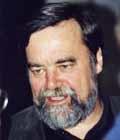
While on the topic -- not of canzones -- I would like to introduce you to Professor Manfred Pfister, Lowell's German translator and a distinguished scholar of Romance languages:
Saturday, September 6, 2008
Bait
From Steven Weinberg's Harvard Phi Beta Kappa lecture "Without God," reprinted in the NYRB [and gated]:
I look forward to the letters. Of course it's silly to attribute the weakness of Iranian physics to the tension between science and Islam; there are many more obvious things -- some religion-related, some not -- holding the Middle East back.
in the past forty years I have not seen any paper in the areas of physics or astronomy that I follow that was written in an Islamic country and was worth reading. Thousands of scientific papers are turned out in these countries, and perhaps I missed something. Still, in 2002 the periodical Nature carried out a survey of science in Islamic countries, and found just three areas in which the Islamic world produced excellent science, all three directed toward applications rather than basic science. They were desalination, falconry, and camel breeding.
I look forward to the letters. Of course it's silly to attribute the weakness of Iranian physics to the tension between science and Islam; there are many more obvious things -- some religion-related, some not -- holding the Middle East back.
Thursday, September 4, 2008
Public Opinion on Abortion
Here is Gallup's summary of attitudes towards abortion. It's clear that abortion is not, at this point, a major issue in this election -- though this is at least partly because most people take their cues on what issues are important from the media and the parties, and no one is campaigning on abortion. It's also notable that people generally support a ban on partial-birth abortions. (Which is understandable. I support all abortions; people who feel like aborting their fetuses eight months in have no business having kids. However, there is obviously a thin line between partial-birth abortion and infanticide.) This is problematic for Obama, who's broadly in favor of killing fetuses.
It still seems like a good idea to use culture-war issues to tie Palin (and the ticket) to Bush -- esp. because there are other issues, like stem cell research, that are substantially less popular than abortion. But it might take a little more care than I assumed. The majorities simply aren't big or firm enough.
It still seems like a good idea to use culture-war issues to tie Palin (and the ticket) to Bush -- esp. because there are other issues, like stem cell research, that are substantially less popular than abortion. But it might take a little more care than I assumed. The majorities simply aren't big or firm enough.
Palin and the Culture Wars
I don't like Froma Harrop, but I think -- or at least hope -- she's onto something here. I get the sense that the conservative base is at least as far from the mainstream on a lot of cultural issues as the liberal base; as long as one focuses on Palin's political views as opposed to the bogus "experience" argument (which is really about optics -- she's a she and not Hillary, hence unfit to be president -- and should work better if not mentioned), she's obviously very weird and far-right. The left seems to think cultural issues are losing issues by definition, but this isn't actually true; public opinion was distinctly with Schiavo's husband, and stem-cell research helped the Democrats win the MO senate race in 2006.
What a McCain presidency now promises is another four years of Terri Schiavo and other artifacts of the cultural right. You remember Schiavo's husband having to fight the Bush administration and Republican Congress to remove his wife -- in a vegetative state for 15 years -- from life support. It's four more years of national humiliation as our leadership undermines the teaching of evolutionary science, and if something happens to John McCain, opposes stem-cell research.
One tries to untangle McCain's political calculations. The Schiavo case, creationism and similar excesses appeal to a passionate but small slice of the electorate. They are one reason voters are booting Republicans out of power. So while some religious conservatives may be "energized" by the Palin pick, most everyone else is revolted.
Wednesday, September 3, 2008
An Anthology of Fuck-you Poems
Some of these are quite good. The translation from Catullus (pedicabo ego vos et irrumabo) isn't. I tried quite hard, and very unsuccessfully, to make something of that poem a couple of years ago; it's probably impossible to translate, at least into modern English, because there really isn't that much emotional force to shouting "faggot" any more.
I've always been a fan of that Ammons poem:
Their Sex Life
One failure
On top of another.
-- A.R. Ammons
I've always been a fan of that Ammons poem:
Their Sex Life
One failure
On top of another.
-- A.R. Ammons
Peggy Noonan Scares Me
I have a lot of respect for Peggy Noonan as a writer, but she makes my flesh creep. Consider this comment, quoted in Fallows's long Atlantic piece on the debates:
It's brilliant, but you can feel the vicious sexism just beneath the surface.
I remember always having the sense that Obama couldn’t land a punch. And then kind of respecting the fact that he wouldn’t land a punch. Hillary was flailing away like a midget boxer and he was holding her off with his long arm and then saying something boring about alternative energy sources.
It's brilliant, but you can feel the vicious sexism just beneath the surface.
Tuesday, September 2, 2008
First Sentences
Halldor Laxness, in The Fish Can Sing:
Brad Leithauser is apparently a huge fan of this opening sentence. Alice Munro has a similarly good one in the current New Yorker:
A wise man once said that next to losing its mother, there is nothing more healthy for a child than to lose its father.
Brad Leithauser is apparently a huge fan of this opening sentence. Alice Munro has a similarly good one in the current New Yorker:
I am convinced that my father looked at me, really saw me, only once. After that, he knew what was there. ("Face")
Geoffrey Hill: In Ipsley Church Lane 1
(New Criterion Jan 2006, collected in Without Title.)
In Ipsley Church Lane 1
Geoffrey Hill
More than ever I see through painters’ eyes.
The white hedge-parsleys pall, the soot is on them.
Clogged thorn-blossom sticks, like burnt cauliflower,
to the festered hedge-rim. More than I care to think
I am as one coarsened by feckless grief.
Storm cloud and sun together bring out the yellow of stone.
But that’s lyricism, as Father Guardini
equably names it: autosuggestion, mania,
working off a chagrin close to despair,
ridden by jealousy of all self-healed
in sexual love, each selving each, the gift
of that necessity their elect choice.
Later, as in late autumn, there will be
the mass-produced wax berries, and perhaps
an unearthed wasps’ nest like a paper skull,
where fragile cauls of cobweb start to shine.
Where the quick spider mummifies its dead
rage shall move somnolent yet unappeased.
In Ipsley Church Lane 1
Geoffrey Hill
More than ever I see through painters’ eyes.
The white hedge-parsleys pall, the soot is on them.
Clogged thorn-blossom sticks, like burnt cauliflower,
to the festered hedge-rim. More than I care to think
I am as one coarsened by feckless grief.
Storm cloud and sun together bring out the yellow of stone.
But that’s lyricism, as Father Guardini
equably names it: autosuggestion, mania,
working off a chagrin close to despair,
ridden by jealousy of all self-healed
in sexual love, each selving each, the gift
of that necessity their elect choice.
Later, as in late autumn, there will be
the mass-produced wax berries, and perhaps
an unearthed wasps’ nest like a paper skull,
where fragile cauls of cobweb start to shine.
Where the quick spider mummifies its dead
rage shall move somnolent yet unappeased.
Monday, September 1, 2008
Prison Rehabilitation Policies: Map
(Source.) It's interesting that -- while the south has disproportionately harsh policies -- the overall picture is fairly patchy and random. For the record, while I don't believe in disenfranchising prisoners, I could live with the no-inmates, or the no-inmates-or-parolees, policy. Disenfranchising people on probation seems like a bit much.

Prisons and Black Turnout
Andrew Hacker has a very insightful article in the New York Review about the things that keep black people from the polls. He is especially good on the issue of rehabilitation for convicted and released felons:
Virginia takes an especially harsh view of drug offenses, which is mainly why so many black Americans are imprisoned there, not least because it’s so easy to make such arrests. Released offenders must wait seven years before they can file a petition for their vote, which must be accompanied by seven documents and several supporting letters, plus another to the governor detailing “how your life has changed” and specifying “why you feel your rights should be restored.”
Mississippi has a similar regimen: with 155,127 men and women released between 1992 and 2004, only 107 petitions to have the right to vote restored were approved. The disenfranchisement of former felons in Kentucky has reduced its potential black electorate by 24 percent.
According to the Brennan Center report, only Maine and Vermont allow inmates to vote (as they can in Israel and Canada). Thirteen states, including Pennsylvania and Michigan, allow former convicts to vote upon their release from prison, while twenty-five bar voting until such ex-prisoners have completed their probation or parole. The other ten, like Alabama and Virginia, make the process of reattaining the right to vote so arduous that most people don’t try. Nor does there seem to be much sentiment in those states for removing the bans or lowering the barriers.
Subscribe to:
Posts (Atom)