Showing posts with label johnson. Show all posts

Saturday, September 8, 2012

Borges and Browne; style and solitude


I have been thinking about Sir Thomas Browne lately. This has to do with stumbling upon a remark in Edmund Gosse's book, quoted in Lytton Strachey's essay, quoted in turn in Enemies of Promise [re which see also]:
The study of Sir Thomas Browne, Mr. Gosse says, 'encouraged Johnson, and with him a whole school of rhetorical writers in the eighteenth century, to avoid circumlocution by the invention of superfluous words, learned but pedantic, in which darkness was concentrated without being dispelled.'
It is difficult, nowadays, to imagine that those last clauses were ever an indictment; one can hardly think of a more inviting description. (This is a coincidence; "darkness" is a poorly chosen word, it is quite wrong for the gong-like "pedantries" of Johnson, but by a sort of hypallage it fits Browne, who cared, like Donne, for the "echoes and recesses" of words.)

Browne initially seemed to me a less dynamic and therefore less interesting writer than Donne (whose special effects are every bit as good); they are similarly metaphysical -- Johnson partially defends both on the grounds that they said strange things because they had strange minds; their illustrations were "far-fetched but worth the carriage" -- but Donne is a more wide-ranging (even within the scope of a paragraph) and therefore less distinct figure. I am coming to realize, however, that it's possible to find Browne more interesting because his work is so much more "deliberate" and his range so much narrower. Two notes on this:

1. The direct influence of Browne on twentieth-century literature (much greater than that of Donne, I feel): the three figures that immediately come to mind are Borges, Sebald, and the Moore-Clampitt tradition of (American, mostly female) essayistic poets. That Browne's influence has been strongest on non-Anglophone writers is puzzling if you see him chiefly as a master of cadence and "brushwork," as Strachey does. It is, or ought to be, a truism that good work is more translatable than you think. Or perhaps it is better to put it this way: the part of someone's work that's likely to have a direct influence on others, i.e., whatever is imitable, can usually be translated; moments of high intensity, or of ineffable prettiness as in Campion, can neither be imitated nor translated.

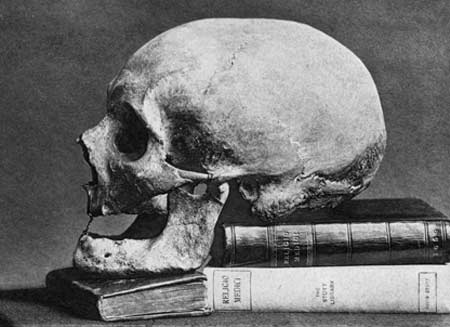
It is not surprising that Borges was fond of Browne; the Pseudodoxia -- qua anti-encyclopedia -- is like something out of a Borges story, and the dottiness re quincunxes in the Garden of Cyrus is of a piece with this (see also: the garden of forking paths, where the quincunx, I suppose, has been retrenched to a Mercedes-Benz sign). Gosse's remark is relevant, too; "darkness was concentrated without being dispelled," if anywhere, in that sentence about the man who disembarked unseen in the "unanimous night." With Sebald the affinities are too many to mention -- both lived in Norfolk; both were interested in skulls and mazes; both achieve a sense of autumnal repleteness and desolate fulfillment to which their accumulations of fact, the overflowing larders and cozy lumber-rooms of their minds, are essential (Donne, like the weather in the midwest, is neither cozy nor predictable enough).

2. As for Moore and Clampitt, there are echoes of Browne (as there allegedly are in Rae Armantrout), and there's also some commonness of purpose. There is, in particular, the shared naturalism; as Lytton Strachey says about Browne:
this strongly marked taste for curious details was one of the symptoms of the scientific bent of his mind. For Browne was scientific just up to the point where the examination of detail ends, and its coordination begins. He knew little or nothing of general laws; but his interest in isolated phenomena was intense. ... He cannot help wondering: ‘Whether great-ear’d persons have short necks, long feet, and loose bellies?’ ... Browne, however, used his love of details for another purpose: he co-ordinated them, not into a scientific theory, but into a work of art.
This is, I think, part of what many Moore and Clampitt poems attempt to do, but it is also quite close to what the Metaphysical poets were striving for. Why Browne rather than Donne, though; why cunctation over celerity? I think Virginia Woolf makes the essential point:
the publicity of the stage and the perpetual presence of a second person were hostile to that growing consciousness of one’s self, that brooding in solitude over the mysteries of the soul, which, as the years went by, sought expression and found a champion in the sublime genius of Sir Thomas Browne. His immense egotism has paved the way for all psychological novelists, auto-biographers, confession-mongers, and dealers in the curious shades of our private life. He it was who first turned from the contacts of men with men to their lonely life within. “The world that I regard is myself; it is the microcosm of my own frame that I cast mine eye on; for the other I use it but like my globe, and turn it round sometimes for my recreation.”
Donne never does this for long; even in the poems, the voice tends to imply a dramatic context in which it is performing. But then Donne was not an eccentric, a recluse, or a marginal figure, as many of the great female poets have been; it is natural to be self-absorbed when one has no audience, and it is natural, when writing to oneself, to accrete and elaborate. Clampitt is explicit about her preferences:
precision and attention to detail are what Marianne Moore’s work is all about. And that is what I found attractive: a clear and principled opposition to the dictum of Dr. Johnson that poetry ought not to “number the streaks on the tulip.”
And the other thing poss. worth saying is that Browne's approach to autobiography -- I am thinking  mostly of the Garden and the Pseudodoxia, though perhaps Urn-Burial counts -- is an indirect one, the burden of self-disclosure is absorbed into the texture of the prose, and never explicitly assumed or answerably fulfilled. (I doubt that this was intentional on Browne's part, he would surely have asked to see the glass flowers at Harvard -- which, by the way, I have not.) I can't remember if I ever posted about the bowerbird aspects of blogging, but for some types of people there is something very satisfying about an approach to self-definition that is so thoroughly externalized.

Thursday, May 5, 2011

Mystified moontrotters, etc.

Jonathon Green reads the 19th cent. Australian papers:
As ever violence is OK but sex problematic. The women are almost invariably prostitutes. Heaven forfend that such a term should sully the readers’  breakfast tables. Instead we find angel, blowen, chicken, Cyprian, frail sister, moontrotter, nymph of the pave, Pitt-street promenaderquean,  and vestal. We get the point. Drink is euphemized: both sexes  are variously baked, cut, elevated, foggy, glorious, mystified and pot-valiant; they have malt above the meal and rum above the water; they are malty.

(Via Sue Walder on twitter.) Some tangentially related observations: (1) I recently learned that using "Kiwis" to mean "New Zealanders" is "deeply naff." (2) Do read Dialect Blog on Aus/NZ/South African accents and on the vowel shift in NZ English. And (inevitably!) Johnson on the "all hands on dick" phenomenon. (It is perhaps worth noting that "dick" is, at least among non-sailors, a much more commonly used word than "deck.")

Sunday, February 20, 2011

A plug, a blague, and a bleg

Colin Burrow's new LRB piece on Samuel Johnson's Lives of the Poets -- unfortunately gated -- is very good; it says many clever things and a lot of it is written in an enjoyable pastiche of Johnson's style. I particularly liked Burrow's remarks on Johnson's "not unpriggish" moral psychology [attn. ADL]:
Johnson believed that the intellect without sociable interchange or occasional enforced periods of reflection will rust into melancholy. Experience has a general tendency to become a chaotic and unregulated sequence of ideas, and ideas received in the past tend to fade unless regularly refreshed. Each person is subject to these general laws of the mind, and each person also has a disposition to decline into his particular set of vices. Each of us, however, has a sluggish but voluntary power to arouse ourselves from both our collective and our individual weakness.

And the application to Pope and Swift:
Pope was ‘fretful, and easily displeased, and allowed himself to be capriciously resentful’. That phrase ‘allowed himself’ is absolute Johnson: Pope’s failure to correct his own inclination to be fretful turns his natural disposition into a moral failing. In a similar way Swift, towards whom Johnson is generally hostile, condemned himself to eventual madness by his refusal to participate in society: ‘His asperity continually increasing, condemned him to solitude; and his resentment of solitude sharpened his asperity.’ The sentence is so damning because it makes no reference to Swift’s own agency. He failed to prevent himself from becoming an isolated curmudgeon because he allowed his passions to drive his behaviour into a loop of decline, and that way madness lay: ‘His ideas, therefore, being neither renovated by discourse, nor increased by reading, wore gradually away, and left his mind vacant to the vexations of the hour, till at last his anger was heightened into madness.’ 

On Johnson's criticisms of the metaphysical poets, Burrow has this to say:
He believed that a heterogeneity of elements – the method of metaphysical poetry according to Johnson – was intrinsically prone to cause corruption and impermanence in poems as it was thought to do in physical bodies. Hence modes which bring together contrasting registers – notably burlesque and mock epic – are not of permanent value: ‘Burlesque consists in a disproportion between the style and the sentiments … It, therefore, like all bodies compounded of heterogeneous parts, contains in it a principle of corruption.’ 

I am not so sure about this. After all, Johnson explicitly praises heterogeneity of a kind in the Preface to Shakespeare:
The end of writing is to instruct; the end of poetry is to instruct by pleasing. That the mingled drama may convey all the instruction of tragedy or comedy cannot be denied, because it includes both in its alterations of exhibition, and approaches nearer than either to the appearance of life, by shewing how great machinations and slender designs may promote or obviate one another, and the high and the low co-operate in the general system by unavoidable concatenation. [...] let it be considered likewise, that melancholy is often not pleasing, and that the disturbance of one man may be the relief of another; that different auditors have different habitudes; and that, upon the whole, all pleasure consists in variety.

A play isn't a poem but this cannot be the relevant distinction. I think the principle of corruption is a red herring; Johnson's objection to the metaphysical poets is that their metaphors do not approach "the appearance of life" and are frigidly artificial, the metaphor is one of desiccation rather than rot. And Johnson's praise of the mock-epic Rape of the Lock is, as far as I remember, unreserved. As Johnson remarks about the Metaphysicals, "if their conceits were far-fetched, they are often worth the carriage"; it is better to understand his objections to Cowley and Donne were as being of a piece with his objections to "academic" poetry more generally, for being (in Burrow's phrase) "mean, donnish and unnatural."

---

While looking up the Rape in the life of Pope I came upon this delightful paragraph that I had unaccountably never noticed before:

[340] The purpose of the Poet is, as he tells us, to laugh at "the little unguarded follies of the female sex." It is therefore without justice that Dennis charges The Rape of the Lock with the want of a moral, and for that reason sets it below The Lutrin, which exposes the pride and discord of the clergy. Perhaps neither Pope nor Boileau has made the world much better than he found it; but if they had both succeeded, it were easy to tell who would have deserved most from publick gratitude. The freaks, and humours, and spleen, and vanity of women, as they embroil families in discord and fill houses with disquiet, do more to obstruct the happiness of life in a year than the ambition of the clergy in many centuries. It has been well observed that the misery of man proceeds not from any single crush of overwhelming evil, but from small vexations continually repeated.

And I think that one aspect of Johnson's lives that Burrow doesn't stress enough is that they are full of good technical criticism. The now-well-known observation that Pope's poems have too many adjacent couplets with similar rhymes, for instance, or this remark about Dryden's use of rhyme:
The rhymes of Dryden are commonly just, and he valued himself for his readiness in finding them; but he is sometimes open to objection.
It is the common practice of our poets to end the second line with a weak or grave syllable:
Together o'er the Alps methinks we fly,
  Fill'd with ideas of fair Italy.
Dryden sometimes puts the weak rhyme in the first:
Laugh all the powers that favour tyranny,
  And all the standing army of the sky.

It is absolutely true that there is a difference between the two patterns, but I have never seen anybody else point this out.

---

I'd like to conclude this overlong post with a bleg. My friend Calista is looking for passages in novels, poems, etc. that involve grease-smeared or food-encrusted books. The purpose, as I understand it, is to endow her frequent book-besmirchings with literary associations. I can barely think of anything; examples would be welcome.

Monday, January 31, 2011

Peregrine pickles, comic crits, Johnsoniana

1. Charmingly my trip to Virginia this Wed. will coincide with the tail end of an area-wide two-day snowstorm. I'm flying out of O'Hare which can only make things worse... though getting to O'Hare might in fact be the greater challenge. In a sensible world, one might expect the trains to be less affected than the buses, but Amtrak in the Midwest is always unreliable.

1'. At least the "wintry mix," which started about half an hour ago, has been snow rather than ice so far. Update Nope it's ice pellets now.

2. Via Mary Roach on twitter, a new blog of note: Comic Crits does comic-strip book reviews that are -- so far at least -- quite good.

2'. John Bonner, the Comic Critic, is from Marblehead, MA. This place name is, I suspect, associated with why I always misremember a line from Lowell's "Quaker Graveyard" poem as "light / flashed from his marble head and matted feet."

3. In the early days of The Economist's language blog, Johnson, the founding members realized that there was, well, an ambiguity in the title. The blog has tended to live up to its ambiguous title, with "deniable" dick jokes being a recurring theme that you have to be a regular reader to pick up on. Often they're pretty sly; for instance, you might not have realized that today's post titled "astronomically inadequate" was one of these if you hadn't been paying attention.

4. There is a literary device, which I associate with "Arrested Development" and Gail Collins's columns, in which a detail that had seemed accidental, or a throwaway joke, is suddenly revealed to be an essential part of the plot. Buster getting maimed by a loose seal is I think the defining example of this genre, which for want of a better term I call the "loose seal." With Kenner's monograph on rhyme at the back of one's mind, one is tempted to think of this as being analogous to a comic rhyme of the "vacancy/they can see" kind, but this analogy breaks down because you know exactly when the rhyme is going to happen with its attendant satisfying click. In the loose seal, something that you didn't expect to click into place suddenly does so. I believe this is a comic analogue of a Virgilian/Proustian effect that Kenner discusses:

Virgil’s little local intricacies of sound seem akin to rhymes the moment after we have heard them. Having had no reason to expect a consonance, we notice it just when it has gone by. This effect […] is used so discreetly it whets no special appetite for itself; in our experience of the Aeneid it lies always in the immediate past, as indeed for Virgil all good things tend to do.
There is something Proustian in this gratification for which there is no craving, perceived only when it is over. Milton himself when he composed Lycidas meant that we should enjoy the expectation of rhymes without ever knowing when they were going to occur.