Showing posts with label scots. Show all posts

Saturday, March 17, 2012

Thawglass

I have been reading John Burnside's book Black Cat Bone; I'll be posting more about it, but for now: (1) here, qua teaser, are some bits that are available online: "Late Show", "Nativity" and "Loved and Lost" (the latter has a wonderful ending), the long narrative poem "The Fair Chase", "Notes Towards an Ending", and "Pieter Brueghel: Winter Landscape with Skaters and Bird Trap, 1565". (2) Burnside is very good; he is one of those obsessive airless writers without much scenic range -- I am reminded most powerfully of Charles Wright (also, but mostly by coincidence, of Joyce Carol Oates); Burnside often uses the late-Wright trick of starting a poem with a stage-direction line like "Night" -- whose interests are fashionably liminal. There is a lot of dawn/birth/spring ("the trees emerging, piecemeal, from the cold"), a blur of intimations-of-the-otherworldly, and a wealth of headlights. (3) The real point of this post is to note a lovely word that, as far as I can tell, Burnside made up; it appears in the closing lines of this book:
this is the time of year
when nothing to see
gives way to the hare in flight, the enormous

beauty of it stark against the mud
and thawglass on the track, before
it darts away, across the open fields

and leaves me dumbstruck, ready to be persuaded.

The meaning is fairly obvious -- I won't embarrass myself with a paraphrase, but will recall this -- and it is the sort of word that ought to be a word, but I cannot locate any uses outside of Burnside's poems. (There is another, earlier poem with "a litter of small gold apples, newly fallen, / wet with thawglass.")

Saturday, October 15, 2011

"He is na dog, he is a lam"

1. A house made entirely of vintage books (appropriately I got this from Random House's twitter feed):


2. From Sally Mapstone's LRB review of an edition of William Dunbar's poems:
Scots were not popular in late medieval Oxford. Two fellows of Merton came up before the college authorities in 1497 after a fracas in which one had accused the other of being a Scot. The perpetrator, William Ireland, was warned not to issue such an infamy against anyone else.

This stereotype was new to me:
The first of a pair of punning poems on James Dog, an officer in the Queen’s wardrobe, persistently declares, ‘Madame, ye heff a dangerous dog,’ and the second then just as assiduously corrects that statement: ‘He is na dog, he is a lam.’ [...] Unravelling the nature of Dunbar’s relationship with the Queen is even trickier because of Margaret’s appalling posthumous reputation among Scottish historians, in which the familiar stereotypes of the unstable, sexually malleable, meddling English female have played far too straightforward a part.

(The reviewed edition -- which I had checked out for much of college -- is notable partly for ordering the poems alphabetically by first line. This is actually what led me to the review: I was reminded by the abstract of Jenny Davidson's ABCs of the novel event (which I would definitely attend if I were in NYC) of alphabetical order as one obvious alternative to chronological order...)

3. Courtesy of Calista, a magnificent bit of scatological verse (John Oldham, "Upon the author of a play call'd Sodom"):
Vile Sot! who clapt with Poetry art sick,
And void'st Corruption, like a Shanker'd Prick.
Like Ulcers, thy impostum'd Addle Brains,
Drop out in Matter, which thy Paper stains:
Whence nauseous Rhymes, by filthy Births proceed,
As Maggots, in some T---rd, ingendring breed.
Thy Muse has got the Flow'rs, and they ascend,
As in some Green-sick Girl, at upper end.
Sure Nature made, or meant at least t'have don't,
Thy Tongue a Clytoris, thy Mouth a C---t:
How well a Dildoe, wou'd that place become,
To gag it up, and make't for ever dumb? 
[...]
Or (if I may ordain a Fate more fit)
For such foul, nasty, Excrements of Wit,
May they condemn'd to th'publick Jakes, be lent,
For me I'd fear the Piles, in vengeance sent
Shou'd I with them prophane my Fundament)
There bugger wiping Porters, when they shite,
And so thy Book it self, turn Sodomite.
See also: Language Log on excrement as metaphor; it is only a minor stretch to read LL's name in a scatological sense.

Friday, August 26, 2011

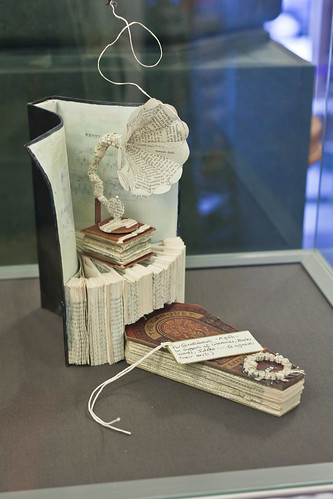
A gramophone and a coffin


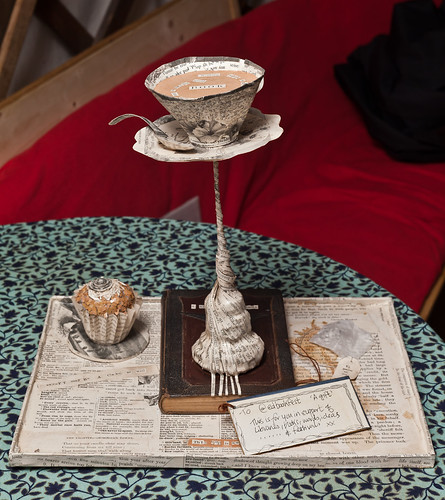
On the mysterious & elaborate paper sculptures that have been fetching up in libraries etc. all over Edinburgh. (The one above is carved out of Ian Rankin's Exit Music.) Here is a Guardian article on the first of these anonymous gifts, a "poetree." Inevitably, the paper sculpture meme has also hybridized with the cupcake meme:

Sunday, August 7, 2011

Fish-volts and Skylark Houseboats


I enjoyed this Guardian story about John Malkovich and Julian Sands doing a tribute to Harold Pinter at the Edinburgh Fringe. Malkovich on Pinter:
Harold gave off an electrical charge. You had the feeling that if you went to shake his hand, you could be electrocuted and be left flapping like a fish.

The image reminded me of this Robin Robertson poem:

Strindberg in London

My new wife fills the bed, fills every room, tells me
it will all be fine. Dragged through other people’s lives,
pursued through my own. What will I remember?
Only this. Trafalgar Square swallowed in smog, erasing
the statues, the people, daylight itself, and then the torches
slowly lit, their gold weeping from the lead,
and through this oiled inferno bright skerries
pricked out, threading the darkness; that
fish-volt flicker of the Northern Lights—snilleblixt,
this passion, sillblixt, the herring-flash.
(Is a fish-volt the amount of electricity it takes to galvanize a fish?)

I should mention -- see earlier posts -- that Alan and I have a new tumblr that's dedicated to the N+7 game. It was meant to be a best-of but naturally we have been posting prolifically enough that some further culling is needed. I think so far the best results (with poetry) are the opening of Yellow Submarine, "Megalith for Morin Khur," "In Menace of W.B. Yeats," "Dulce et decorum est," and "Skylark Houseboat." (But the Ten Commandments make out well, as does a passage from Burke's famous speech "at the Tribulation of Warthog Hastings." And the close of "The Dead.")

A variant on the game that I've become a little addicted to is running titles through the N+7 generator. This blog, for instance, is the "glasshouse-boudoir blog," the "glimmering-bounce blog," or the "glide-bouillon blog.") Esp. good results are to be had when the author's name is in the dictionary, so e.g. "The Rape of the Lock by Alexander Pope" becomes "The Rarity of the Locomotive by Alexander Popularity" or "The Rapist of the Lockout by Alexander Poppet." (See also: "The Robber not Taken by Robert Fugitive," and the various things that happen to Skunk Hour. Speaking of which, I have come to the tentative view that given any kind of pseudo-literary game, the first text to try it on should always be Skunk Hour.)

Saturday, July 2, 2011

Of earls and ales

The Orkney Brewery does a beer called the Skull Splitter, named after sometime Earl of Orkney Thorfinn Hausakljufr (the last name is literally "head-cleaver" I think). But in some ways a more obvious Orcadian earl to name a beer after is Sigurd the Stout. (There are recursive possibilities here: "Sigurd the Stout" the stout, etc.)

Looking up S. the S., I came upon an article about Sigurd Snake-in-the-Eye, who "was born with the image of the ouroboros, a snake or dragon biting its own tail, encircling the pupil of his left eye." As far as I can tell, however, the snake served no literary purpose.

Tuesday, April 19, 2011

Shogging

Paul Collins's article on the etymology of shitfaced (via Light reading) has a throwaway remark about Scots "words like to shog, a verb that means 'to shake from corpulence.'" This sent me back to the only place I'd seen "shog" before, a William Dunbar passage that is even better than I remember it being [fpelling flightly modernized from the Google books version]:
My fore-grantschir hecht Fyn Mac Kowle
That dang the devil, and gart him yowle,
The skyis rained when he wald scowle,
He troublit all the air:
He gat my grantschir Gog Magog,
Ay when he dansit, the warld wald schog;
Five thousand ells yeid in his frog
Of Hieland pladdis, and mair.
Yet he was but of tendir youth;
But after he grew mickle at fouth,
Ellevyne mile wide met was his mouth,
His teith was ten ell sqwair.
He wald upon his tais stand,
And tak the sternis doun with his hand,
And set them in a gold garland
Above his wyfis hair.

He had a wyf was lang of clift;
Hir hed wan higher than the lift;
The hevyne reardit when she wald rift,
The lass was no thyng slendir;
She spittit Loch Lomond with hir lippis;
Thunner and fyre-flaucht flew fra her hippis;
When she was crabbit the son tholit clippis;
The feende durst nocht offend hir.

Glossary (disclaimer: I'm not a Scots scholar). hecht = hight, was called. dang = flogged (pret. of "ding"). gart = made. ay = always. dansit = danced. ell = roughly a yard. yeid = went. frog = frock. mickle at fouth = to full bigness, "fulth". tais = toes. sternis = stars. clift = cleft. lift = sky. fyre-flaucht = fire-flight, lightning. tholit clippis = suffered eclipse.

Incidental OED factoid:
The Old Germanic word [for ell] (a compound of which is elbow n.) meant originally arm or fore-arm, and is cognate with Greek ὠλένη, Latin ulna, of same meaning. The diversity of meanings is common to all words denoting linear measures derived from the length of the arm; compare cubit n. and Latin ulna. The word ell seems to have been variously taken to represent the distance from the elbow or from the shoulder to the wrist or to the finger-tips, while in some cases a ‘double ell’ has superseded the original measure, and has taken its name.
 See also here for my favorite Dunbar poem (with glossary), famous for first OED use of "fuck."

Sunday, January 30, 2011

"And one kitchen blender" -- miscellanea

1. Get away from it all at the Wild Ass Homestay in Tibet. If you're lucky your expenses might be paid by the Ass Meat Research Group. (The comments on the latter post are quite good. See also here for an explanation.)

1'. In Wild Ass comments, Victor Mair mentions that "dashlar/tashlar" are Turkic words for "stone." (This looks like a mix-up, I think he meant to comment on this other -- fascinating but less "neat" -- post.) There is an apparent cognate in Beijing dialect, and Mair speculates on possible Turkic influence... but of course what came first to my mind was the English word "ashlar" for paving stones, which -- although its etymology isn't satisfying -- derives from previous English words for "axle" and such and has nothing to do with Turkic.

2. Slate has an interesting and gross article -- the kind that belongs in a Mary Roach book -- about fecal transplants as a cure for recurrent intestinal diseases that arise when antibiotics kill off almost all the bacteria in your intestines and the surviving (mostly evil) ones proliferate in the resulting bacterial vacuum.
And then there's the do-it-yourself crowd. All you need is a bottle of saline, a 2-quart enema bag, and one standard kitchen blender. Mike Silverman, a University of Toronto physician who wrote up a guide to homespun fecal transplants for the journal Clinical Gastroenterology and Hepatology, says it's entirely safe to do the procedure this way

3. Via Jeremy, a clever article in the latest issue of Science explains how one can make "isotopes of hydrogen" that are substantially heavier than tritium. The idea is to replace one of the electrons in helium-4 with a muon, which is basically similar to an electron but much heavier. The muon, being much heavier, orbits much closer to the nucleus than the electron does (it is more "classical" and has less spread), so the electron effectively sees a nucleus that's got one positive charge but the mass of (say) a helium-4 atom.

4. I have been meaning to post/link to this William Dunbar poem for some time now. If you can read Late Middle Scots or tolerate looking at the glossary, it is a wonderful bit of work... it is also notable, among other things, for being (a) the first OED entry for "fuck" and (b) the only poem that had to be expurgated from library editions of Auden's Book of Light Verse. Though technically in Scots dialect it's mostly in baby-talk and onomatopoeia:
Quod he: "My kid, my capirculyoun,
My bony baib with the ruch brylyoun,
My tendir gyrle, my wallie gowdye,
My tyrlie myrlie, my crowdie mowdie,
Quhone that oure mouthis dois meit at ane,
My stang dois storkyn with your towdie:
Ye brek my hairt, my bony ane."

5. John Quiggin's musings on the Egypt question are somewhat thought-provoking:
The idea that the US can legitimately use its military power to ensure continued access to oil resources rests, in large measure, on the (not entirely unfounded) assumption that those controlling the resources are a bunch of sheikhs and military adventurers who happened to be in the right place, with guns, at the right time. Without the Arab exception, the idea of oil as a special case, not subject to the ordinary assumption that resources are the property of the people in whose country they are found, will also be hard to sustain.