Showing posts with label glasses. Show all posts

Friday, May 25, 2012

"A sadder hue then the powder of Venice glass"


Sorry about the nonexistent blogging lately; I have been slightly more active on tumblr, but a combination of post-thesis work and lassitude and the thought of a few substantive posts I've been putting off writing have combined to keep things very quiet. (A rule of thumb is that quotes offered w/o comment go there unless they are about Coleridge's drug use.) This is not a substantive post, just a few snippets of early modern science. First, I stumbled upon a piece on the "solar microscope" ca. 1816; the list it ends with is particularly worthwhile if one likes lists:


Another good bit (apart from the food-related one) is on the breeding habits of lice:


And the crystallization of salts reminded me of the bit in Browne's Pseudodoxia Epidemica on whether all crystals are forms of ice. I am not sure anyone will find this bit as charming as I did, but it is of lexicographical interest ("the stillicidous dependencies of ice"!), and then solidity-the-concept is one of my very oldest obsessions (I even wrote a dreadful term paper my freshman year on Locke and solidity...):
Pliny is positive in this Opinion: Crystallus fit gelu vehementius concreto: [...] Neither doth there any thing properly conglaciate but water, or watery humidity; for the determination of quick-silver is properly fixation, that of milk coagulation, and that of oyl and unctuous bodies, only incrassation [...]

[...] Ice although it seemeth as transparent and compact as Crystal, yet is it short in either; for its atoms are not concreted into continuity, which doth diminish its translucency; it is also full of spumes and bubbles, which may abate its gravity. And therefore waters frozen in Pans, and open Glasses, after their dissolution do commonly leave a froth and spume upon them, which are caused by the airy parts diffused in the congealable mixture which uniting themselves and finding no passage at the surface, do elevate the mass, and make the liquor take up a greater place then before: as may be observed in Glasses filled with water, which being frozen, will seem to swell above the brim.

[...] As for colour, although Crystal in his pellucid body seems to have none at all, yet in its reduction into powder, it hath a vail and shadow of blew; and in its courser pieces, is of a sadder hue then the powder of Venice glass; and this complexion it will maintain although it long endure the fire. [...]

that continuity of parts is the cause of perspicuity, it is made perspicuous by two ways of experiment. That is, either in effecting transparency in those bodies which were not so before, or at least far short of the additional degree: So Snow becomes transparent upon liquation, so Horns and Bodies resolvable into continued parts or gelly. The like is observable in oyled paper, wherein the interstitial divisions being continuated by the accession of oyl, it becometh more transparent, and admits the visible rayes with less umbrosity. Or else the same is effected by rendering those bodies opacous, which were before pellucid and perspicuous.

So Glass which was before diaphanous, being by powder reduced into multiplicity of superficies, becomes an opacous body, and will not transmit the light. So it is in Crystal powdered, and so it is also before; for if it be made hot in a crucible, and presently projected upon water, it will grow dim, and abate its diaphanity; for the water entering the body, begets a division of parts, and a termination of Atoms united before unto continuity.

The ground of this Opinion might be, first the conclusions of some men from experience; for as much as Crystal is found sometimes in rocks, and in some places not much unlike the stirrious[14] or stillicidious dependencies of Ice. Which notwithstanding may happen either in places which have been forsaken or left bare by the earth, or may be petrifications, or Mineral indurations, like other gemms, proceeding from percolations of the earth disposed unto such concretions.

Sunday, June 19, 2011

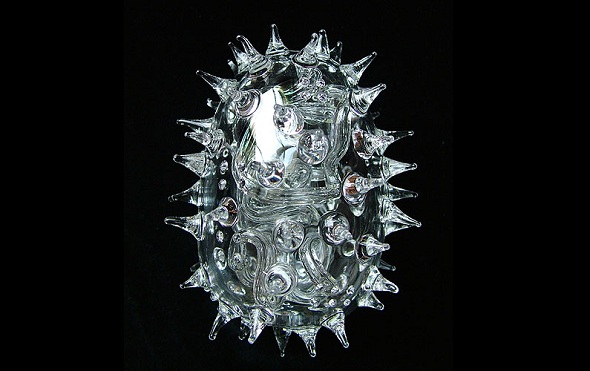
"Le souffleur de verre"


I'm amused by Luke Jerram's project of making glass sculptures of viruses, and perhaps by the artifacts themselves, but chiefly -- as someone who speaks no French -- by the French term "souffleur de verre" for "glassblower."

Friday, February 18, 2011

Recreational physics roundup

I have always enjoyed work on pattern formation on the everyday scale; it is heartening (a word I overuse, perhaps revealingly) to see that there is still so much in front of one's nose that bears closer inspection. (See here and here for previous local coverage.) The past few days have been abnormally rich on this front -- three worthwhile stories! -- and I wanted to blog about them, partly for ease of future reference.

---
Bubbles and memory


There's a new story in Phys. Rev. Focus about hysteresis in soap bubbles. (Like most Focus articles it seems to have been written by a journalist. I also find it irritating that they publish Focus articles a while before the paper comes out, because you've typically forgotten all about the work by the time it's published.) Soap bubbles grown on a triangular-prism-shaped frame form dipyramids that either intersect at a triangle -- for a squat prism -- or are joined by a thin vertical strand of soapy water -- for a skinny prism. For a certain range of aspect ratios both solutions are possible, so as you stretch or contract the sides of the prism, the bubble can take either form depending on which way you were tuning the length (i.e., on the bubble's "past"). This is interesting primarily -- from a physics point of view -- as the most purely geometrical example of hysteresis that I know of: the films try to minimize their area, and in this range the two lowest-area configurations look substantially different.

It is also an excuse to replug a beautiful old paper by the Chicago group on a much more nontrivial example of memory in bubbles -- viz. how air bubbles blown through a nozzle "remember" irregularities in the shape of the nozzle.

---
"Nonideal icicles"


Stephen Morris at the University of Toronto does a lot of beautiful work on pattern formation in systems that are "fluid" in some sense. (My favorite thing on his website is the fluid mechanical sewing machine, but irritatingly that link is broken.) Morris's group has a new paper out in Phys. Rev. E, featured in Physics, on the growth of icicles. They grew large numbers of icicles in their lab and studied how the quality of water, the wind speed, etc. affect the growth of icicles. A result that jumped out at me: lab-grown icicles often have bifurcated tips as in (c) and (d) of the figure, but this seems to happen most often when the fan in the experiment is turned off. The implication is that wind somehow straightens out icicles.

---
Huddles of tetrahedra


This is somewhat older work that Ross McKenzie recently linked to. Here's an NYT piece on the race to find ever-closer packings of regular tetrahedra. I recommend reading the linked Nature article (journal link here, ungated arxiv here), which is pretty accessible. There is some back-story to this: Stanislaw Ulam conjectured a long time ago that it should be possible to pack any kind of convex shape more closely than hard spheres. As far as I know there is no proof of this, but it's plausible and known to be true for lots of shapes including M&M's (another NYT story) and more recently tetrahedra. How tetrahedra pack is of particular interest as there is a theory of glassiness (see an old post here) that depends rather crucially on the fact that you cannot tile three-dimensional space with tetrahedra. The theory is basically that particles in an incipient solid like to clump into tetrahedra (each particle is exactly as far away as it wants to be from every other) but the tetrahedra can't line up, so that on large scales you have a jammed amorphous mess: here is a PRB paper by David Nelson related to this theory. The Nature paper is prima facie a beautiful application of ideas from physics to solve a purely mathematical problem -- a project that's close to the formalist, interdisciplinary lump of matter I sometimes refer to as my heart -- but its really surprising finding is that one of the best ways to put the tetrahedra together is to have them form a quasicrystal. This actually makes it a little surprising that 3D quasicrystals aren't common in nature, unless tetrahedra are a much less central motif than the Kleman-Sadoc-Nelson line of thinking about glasses would suggest.