Showing posts with label translation and its discontents. Show all posts

Saturday, February 11, 2012

Frightening inaction


An assortment of quotes with links attached:

1. Michel Houellebecq on blogging (I should like to declare him entirely mistaken, but he is not):
You can always microblog, Houellebecq had told him [...]; but to launch yourself into the writing of a blog post you have to wait for all of that to become compact and irrefutable. You have to wait for the appearance of an authentic core of necessity. You never decide to write a blog post, he had added; a blog post, according to him, was like a block of concrete that had decided to set, and the blogger’s freedom to act was limited to the fact of being there, and of waiting in frightening inaction, for the process to start by itself.

2. Auden on songs/"words-for-music" (linked site is not without interest -- HT Conor Leahy!):
The song ... is, of all kinds of poetry, the one in which the formal verbal elements play the greatest role.... In the world of the song, one might say, the important relationship between the inhabitants is not any community of concern or action so much as family kinship. The satisfaction I get from reading a poem by Campion, for example, is similar to the satisfaction I get from studying a well worked out genealogical tree. (A wet afternoon could be pleasantly spent developing this analogy. Starting with the notion that masculine rhymes represent brothers, feminine rhymes sisters, refrains identical twins, one could ask what verbal relationship would be equivalent to a second cousin once removed. From there one could go on to consider what discords correspond to marriage within the prohibited degrees, e.g., to marrying one's deceased wife's sister.)

3. Jay Rayner, on adventurous cooking (HT Sarah Duff):
Modern techniques are great. They’re brilliant. If you want to cook my steak by banging it round the Large Hadron Collider, be my guest. Dehydrate my pig cheeks. Spherify my nuts. But only do so if the result tastes nicer.

4. Graffiti from Pompeii:
Herculaneum (on the exterior wall of a house); 10619: Apollinaris, the doctor of the emperor Titus, defecated well here 
5. On relocating detective stories from Portsmouth to Le Havre:
There is no translation for "mush" (a Pompey term of affection), "scrote" (the opposite) or "scummer" (anyone from Southampton). Can the city be exported? "I was intrigued by the move to Le Havre," said Hurley. "But they have done a good job. What holds true for Portsmouth also holds true for Le Havre. There are similarities: neither city is fashionable, they are both at the end of the railway line, relatively uncursed by money. Sharp-elbowed places, robust." Could you move other English detectives – Morse to Rouen, say, or Rebus to Marseille? "Rebus, maybe yes. But I'm not sure about Morse. You can't get away from those dreaming spires."

6. Much to like in this review of Dickens's letters (via Light Reading). I particularly liked
the pile of clean spittoons in the corner of a country inn “looking like a collection of petrified three-cornered hats”
(In Ulysses, Joyce has "a hogo you could hang your hat on" and also "what a man looks like with his two bags full and his other thing hanging down out of him or sticking up at you like a hatrack.")

Thursday, January 19, 2012

Torschlusspanik

From yet another list of untranslatable words (cf.):
Torschlusspanik
From German, this word literally means “gate-closing panic” and is used to describe the fear of diminishing opportunities as one ages. This word is most frequently applied to women who race the “biological clock” to wed and bear children.
This is high up on my list of frequently-felt emotions, a little behind schadenfreude and buyer's remorse, and perhaps slightly ahead of envy. Also provides an excuse to quote Auden:
Certain it became while we were still incomplete
There were certain prizes for which we would never compete:
A choice was killed by every childish illness,
The boiling tears among the hothouse plants,
The rigid promise fractured in the garden,
And the long aunts.

And every day there bolted from the field
Desires to which we could not yield;
Fewer and clearer grew the plans,
Schemes for a life and sketches for a hatred,
And early among my interesting scrawls
Appeared your portrait. 

(Another worthwhile untranslatable is "tartle" -- "a Scottish verb meaning to hesitate while introducing someone due to having forgotten his/her name.") 

Thursday, October 6, 2011

"Domkyrkoklocklang"

Robin Robertson, whose translation of the Transtromer book The Deleted World I will have to buy when it appears (being favorably disposed to both translator and translatee), records a delightfully untranslatable Swedish word:
the plosive musicality of Swedish words like “domkyrkoklocklang” lose all their aural resonance when they become a “peal of cathedral bells.”
[Cf. hottentottententententoonstelling] I take it the way the word parses is "clock-clang in the doom-church" (i.e., the church of judgments and decisions, the cathedral); nevertheless I am struck by the aural similarity to "ku klux klan" -- itself of apparently onomatopoeic origins -- as well as the perhaps more obvious similarity to Donkey Kong.

Related: the Guardian's selection of poems by Forward-Prize-winning poets is worth looking at.

Wednesday, July 20, 2011

Parallel passages redux

(It was clever of the LRB to juxtapose Alan Bennett's piece on libraries -- "Baffled at a bookcase" -- with Eliot Weinberger's vaguely Borgesian list of books, "The Cloud Bookcase.")

I. From Eliot Weinberger, "The Cloud Bookcase":
The Identity of Both
by Lo Yin (833-910)
Often confused with The Identity of Both by Wu Yün (d. 778).
II. Guy Davenport on Wittgenstein:
It is questionable if when he died he had ever come to any understanding of the number 2. Two what? Two things would have to be identical, which is absurd if identity has any meaning. 
(The parallels between W. and D. go fairly deep. Perhaps this is a quirk of my reading history but I know Weinberger best from 19 Ways of Looking at Wang Wei, and Davenport from 7 Greeks. That seven and nineteen are both prime is not a separate coincidence, as numbers in this context always are.)

Friday, June 10, 2011

"They must be read in order as they lie"

1. Lydia Davis reviews Ashbery's new version of Rimbaud (NYT). I admire Davis's stories and can see how her sensibility informs her theory of translation, but the theory itself is pointlessly austere, and I cannot see that the lines she particularly admires in Ashbery's translation are unusually good. (She doesn't say that in one of the lines she quotes, "Let someone finally rent me this tomb, whited with quicklime," the prosody -- dactylic hexameter -- and the punning antithesis on quick/tomb probably had as much to do with the choice as the KJV.)

2. While on the topic of translation, a passage from Dryden's preface to his translation of the Aeneid. (I went through an obscurely motivated obsession with Dryden a few years ago; could not bring myself to read very many of the plays but read all the poems and prefaces. There is a lot of appealingly specific nuts-and-bolts talk, as well as chutzpah, in his critical writing.)
What [Virgil] says of the Sibyl's prophecies may be as properly applied to every word of his--they must be read in order as they lie; the least breath discomposes them, and somewhat of their divinity is lost. [...] 
I have shunned the caesura as much as possibly I could; for wherever that is used, it gives a roughness to the verse, of which we can have little need in a language which is overstocked with consonants. Such is not the Latin where the vowels and consonants are mixed in proportion to each other; yet Virgil judged the vowels to have somewhat of an over-balance, and therefore tempers their sweetness with caesuras. ... On the other side, for the reason already named, it is all we can do to give sufficient sweetness to our language; we must not only choose our words for elegance, but for sound--to perform which a mastery in the language is required; the poet must have a magazine of words, and have the art to manage his few vowels to the best advantage, that they may go the farther. [...]


You may please also to observe that there is not, to the best of my remembrance, one vowel gaping on another for want of a caesura in this whole poem. But where a vowel ends a word the next begins either with a consonant or what is its equivalent; for our w and h aspirate, and our diphthongs, are plainly such. The greatest latitude I take is in the letter y when it concludes a word and the first syllable of the next begins with a vowel. Neither need I have called this a latitude, which is only an explanation of this general rule--that no vowel can be cut off before another when we cannot sink the pronunciation of it, as he, she, me, I, &c. [...]

I am sure there are few who make verses have observed the sweetness of these two lines in "Cooper's Hill" -
"Though deep, yet clear; though gentle, yet not dull;
Strong without rage; without o'erflowing, full" -

and there are yet fewer who can find the reason of that sweetness. I have given it to some of my friends in conversation, and they have allowed the criticism to be just. But since the evil of false quantities is difficult to be cured in any modern language; since the French and the Italians, as well as we, are yet ignorant what feet are to be used in heroic poetry; since I have not strictly observed those rules myself which I can teach others; since I pretend to no dictatorship among my fellow-poets; since, if I should instruct some of them to make well-running verses, they want genius to give them strength as well as sweetness; and, above all, since your lordship has advised me not to publish that little which I know, I look on your counsel as your command, which I shall observe inviolably till you shall please to revoke it and leave me at liberty to make my thoughts public. [...] Spenser has also given me the boldness to make use sometimes of his Alexandrine line, which we call, though improperly, the Pindaric, because Mr. Cowley has often employed it in his odes. It adds a certain majesty to the verse when it is used with judgment, and stops the sense from overflowing into another line. [...]

The want of genius, of which I have accused the French, is laid to their charge by one of their own great authors, though I have forgotten his name, and where I read it.

Monday, June 6, 2011

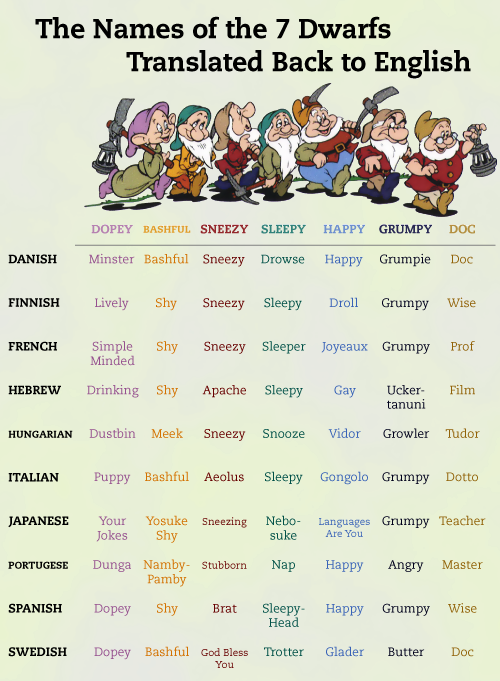
"Drinking, Namby-pamby, Aeolus, Droll..."

The names of the Seven Dwarfs translated out of English by Disney and back into English by Google:


It is surprising how many of these are correct; for instance, one hardly expects a machine to translate anything as "dopey." The algorithm is probably trained re the dwarfs. Some of the odd ones are false friends (Tudor, Trotter, etc.) -- see e.g. here for the foreign-lang. versions. Then there are the expected, vaguely charming, mistakes (listed above, also "God Bless You").

(Admin note. In addition to the Brazilian blog dump that ended up losing me a few subscribers, Blogger has lately been very unreliable with embedded images.)

Monday, May 23, 2011

"A black Irish beer that disappears in the course of the creative process"

Brodsky describes the daily routines of Auden, with whom he briefly stayed in Austria (I assume in Kirchstetten though the article doesn't specify) after being kicked out of the USSR:
W. H. Auden drinks his first martini dry at 7:30 in the morning, after which he sorts his mail and reads the paper, marking the occasion with a mix of sherry and scotch. After this he has breakfast, which can consist of anything so long as it’s accompanied by the local dry pink and white, I don’t remember in which order. At this point he sets to work. Probably because he uses a ballpoint pen, he keeps on the desk next to him, instead of an inkwell, a bottle or can of Guinness, which is a black Irish beer that disappears in the course of the creative process. At around 1 o’clock he has lunch. Depending on the menu, this lunch is decorated by this or that rooster’s tail, or cocktail. After lunch, a nap, which is, I think, the only dry point of the day.
This is from a New Yorker profile of Brodsky (who apparently wasn't gay; for some reason I had always assumed he was). There are some vaguely pleasant renderings of Brodsky's poems; I must say that, although he has technically been fortunate in his translators (Richard Wilbur, Anthony Hecht, ...), they have tended to overdo the house-training; I've never managed to get a handle on the idiosyncrasy (in the Fowlerian sense) of Brodsky's work. 

Cf. Lydia Davis on Auden's sleeping habits.