Showing posts with label nonce words. Show all posts

Saturday, June 16, 2012

Corkscrewing, cheesiness

Back after a very pleasant trip to NYC and Princeton -- my spirits survived my body's weak attempts to depress them with a cold. Highlights included gin and marmalade (!), and a crawl through the Met, where I was particularly struck by these two pictures. (Unfortunately I missed the Edward Gorey exhibit at Columbia...) The workshop was great too -- I wish I hadn't let my old physics blog fall into such utter desuetude; I would have had material for it... I mean to get back to a more normal blogging schedule, but disruptions associated with moving and paper-completion are likely to persist for another few weeks.

A smattering of links:

1. Illustrations from a 1925 Japanese edition of Aesop.

2. David Crystal on Dickens's language (parts 1, 2, and 3). Part 3 is especially good I think; esp. the precursors of Chuzzlewit, and this bit from Oliver Twist, which I do not remember at all (having read the book only as a child):
Mrs Mann: How comes he to have any name at all, then?
Bumble: I inwented it.
Mrs Mann: You, Mr. Bumble!
Bumble: I, Mrs. Mann. We name our fondlings in alphabetical order. The last was a S,- Swubble, I named him. This was a T,- Twist, I named him. The next one as comes will be Unwin, and the next Vilkins. I have got names ready made to the end of the alphabet, and all the way through it again, when we come to Z.
Mrs Mann: Why, you're quite a literary character, sir! 
For Swubble cf. "swabbling." And the list of words that might have been coined by Dickens has some remarkable entries...

3. Mary Beard recently alluded to the duck's ditty in Wind in the Willows; I'd forgotten about it, was happy to be reminded, and was thoroughly cheered up to find that "Up tails all" is an old folk song to which the lyrics have apparently been lost (?), although the refrain survives in allusions by Jonson, Herrick, and Vanbrugh:
Ras. The Matter?—why, Uptails All's the Matter... My Lady has Cuckolded my Master.

Saturday, May 5, 2012

"He also liked to lick tree sap"

On the dietary habits of the Romantic poets (really, just read the entire thing):
Wordsworth paid scant attention to gustatory matters [...] He did, however, accept edible gifts from admirers, and was once given an entire calf’s head. [...]

Two decades of opium addiction wreaked havoc on Samuel Taylor Coleridge’s digestion (one of its chief side-effects was an awful, binding constipation). Subject to frequent and recurring “bowel attacks” that made him “weep and sweat and moan and scream,” he was off solid food for weeks at a time, and accordingly ate a lot of broth. He even dabbled in vegetarianism for a while, but believed it gave him insomnia. When he was well, Coleridge loved to go out to dinner [...] he could also be a handful. At one dinner party, encouraged by the host, he smashed a window and several wine glasses, and started pitching the cutlery at the tumblers. Coleridge particularly loved apple dumplings.

[...] Lord Byron, scarred by being a “fat school-boy,” had transformed himself into a “leguminous-eating Ascetic” by the time he went up to Cambridge in 1805. But the fat wanted him, and he spent his entire life dieting, caught up in a vomitous cycle of binge and purge, fasting all week and then gorging himself on “a pint of bucelles [Portuguese wine] and fish.” [...] Byron rarely accepted dinner invitations and claimed to be especially repulsed by the sight of women eating [...]
Elsewhere: Jonathon Green on gin-talk, includes revelation that "Piss quick – either from its resemblance to urine or its possible micturative effects – is gin mixed with marmalade topped up with boiling water."

Blogging has been light partly because of impending defense on Wednesday and partly because I have been warding off anxiety by taking on as much work as I can find. (I have between ten and thirteen projects "on the go" at the moment; one paper just finished and arxived...) After the defense I shall have a fairly untrammeled summer; the only pre-move travel is a trip to NYC and Princeton ca. June 9-14.

Thursday, April 19, 2012

Charging like a tusked brute, gnawing like a bear

1. Flannery O'Connor on "Living with a peacock". If, like me, you had forgotten about O'Connor somewhat, this is a useful reminder of how good she is. It is hard to know what to excerpt but here is one bit:
Frequently the cock combines the lifting of his tail with the raising of his voice. He appears to receive through his feet some shock from the center of the earth, which travels upward through him and is released: Eee-ooo-ii! Eee-­ooo-ii! To the melancholy this sound is melancholy and to the hysterical it is hysterical. To me it has always sounded like a cheer for an invisible parade.
Also, here is the video of the v. young O'Connor and the backward-walking chicken. (Via Sean Costello.) Here is a stunningly ugly bird that is not a peachicken but will do:


And finally, in the spirit of "parallel passages," compare Flannery O'Connor's peacock description to Geoffrey Hill's ("his fulgent cloak a gathering of the dark" &c. Oh, and also (postultimately?), there is Robert Lowell on her face, "formless at times, then very strong and young and right."

2. "Anatiferous trees" in Browne. I really should find a copy of Pseudodoxia and read it through.

3. "Deep in clear lake / The lolling bridegroom, beautiful, there."

4. "Forest Service may blow up frozen cows" (via clusterflock, I suspect).

5. Amy Clampitt's poem "Thermopylae," which was new to me, and where the post title is from.

(I found the Clampitt while looking around -- unsuccessfully -- in her work for chapter epigraphs for the thesis, which was dispatched earlier today to the committee.)

Saturday, March 17, 2012

Thawglass

I have been reading John Burnside's book Black Cat Bone; I'll be posting more about it, but for now: (1) here, qua teaser, are some bits that are available online: "Late Show", "Nativity" and "Loved and Lost" (the latter has a wonderful ending), the long narrative poem "The Fair Chase", "Notes Towards an Ending", and "Pieter Brueghel: Winter Landscape with Skaters and Bird Trap, 1565". (2) Burnside is very good; he is one of those obsessive airless writers without much scenic range -- I am reminded most powerfully of Charles Wright (also, but mostly by coincidence, of Joyce Carol Oates); Burnside often uses the late-Wright trick of starting a poem with a stage-direction line like "Night" -- whose interests are fashionably liminal. There is a lot of dawn/birth/spring ("the trees emerging, piecemeal, from the cold"), a blur of intimations-of-the-otherworldly, and a wealth of headlights. (3) The real point of this post is to note a lovely word that, as far as I can tell, Burnside made up; it appears in the closing lines of this book:
this is the time of year
when nothing to see
gives way to the hare in flight, the enormous

beauty of it stark against the mud
and thawglass on the track, before
it darts away, across the open fields

and leaves me dumbstruck, ready to be persuaded.

The meaning is fairly obvious -- I won't embarrass myself with a paraphrase, but will recall this -- and it is the sort of word that ought to be a word, but I cannot locate any uses outside of Burnside's poems. (There is another, earlier poem with "a litter of small gold apples, newly fallen, / wet with thawglass.")

Thursday, January 19, 2012

Torschlusspanik

From yet another list of untranslatable words (cf.):
Torschlusspanik
From German, this word literally means “gate-closing panic” and is used to describe the fear of diminishing opportunities as one ages. This word is most frequently applied to women who race the “biological clock” to wed and bear children.
This is high up on my list of frequently-felt emotions, a little behind schadenfreude and buyer's remorse, and perhaps slightly ahead of envy. Also provides an excuse to quote Auden:
Certain it became while we were still incomplete
There were certain prizes for which we would never compete:
A choice was killed by every childish illness,
The boiling tears among the hothouse plants,
The rigid promise fractured in the garden,
And the long aunts.

And every day there bolted from the field
Desires to which we could not yield;
Fewer and clearer grew the plans,
Schemes for a life and sketches for a hatred,
And early among my interesting scrawls
Appeared your portrait. 

(Another worthwhile untranslatable is "tartle" -- "a Scottish verb meaning to hesitate while introducing someone due to having forgotten his/her name.") 

Thursday, January 12, 2012

Word-hoards and lard-hoards

1. In the wake of this exchange, Calista and I have been trading literary sightings of lard, pigs, and/or gross food broadly construed; we've recently started a new tumblr (currently titled "A Child's Larder of Verse" though really there isn't much verse there) dedicated to these. No by-lines as these would be purely embarrassing for me. Swift (Jonathan, not Tom) is the genius of the place.

2. A fascinating Language Log post about the writer Paul West who "emerged from [a] stroke with a near-total obliteration of language" and how he made the best of his way back to language:
Oddly, it was often the most obscure words that were easiest to recover. He struggled with words like blanket or bed, or his wife's name Diane, words that you would think over time should have seeped into his genes. Nevertheless, he could recruit words like postillion or tardigrades to get an idea across. This led to some counter-productive interactions with a speech therapist. Since aphasics often produce nonsense words without realizing that they aren't real words, one of the goals of therapy is to give the patient feedback on which words are real. But West would often produce bona fide words that were unknown to the therapist.  [...]
The intimate wordplay between West and [his wife Diane] Ackerman also eventually resumed, with West fashioning novel terms of endearment as gifts to his wife. The offerings were delightful. Deprived of the usual routes to language, and along with them, the common clichés that many of us struggle to shed, West bestowed on his wife exquisite pet names such as: My Little Bucket of Hair; Commendatore de le Pavane Mistletoe; Dark-Eyed Junco, My Little Bunko; Diligent Apostle of Classic Stanzas.  And at one point, the man uttered what has to be the most searingly romantic sentence ever uttered in history, by anyone, in any language:

"You are the hapax legomenon of my life."

Thursday, October 6, 2011

"Domkyrkoklocklang"

Robin Robertson, whose translation of the Transtromer book The Deleted World I will have to buy when it appears (being favorably disposed to both translator and translatee), records a delightfully untranslatable Swedish word:
the plosive musicality of Swedish words like “domkyrkoklocklang” lose all their aural resonance when they become a “peal of cathedral bells.”
[Cf. hottentottententententoonstelling] I take it the way the word parses is "clock-clang in the doom-church" (i.e., the church of judgments and decisions, the cathedral); nevertheless I am struck by the aural similarity to "ku klux klan" -- itself of apparently onomatopoeic origins -- as well as the perhaps more obvious similarity to Donkey Kong.

Related: the Guardian's selection of poems by Forward-Prize-winning poets is worth looking at.

Thursday, September 8, 2011

O Murse! The causes and the crimes relate

This WSJ article on the words for men's fashions is very good.

Men can also wear "mandals" (male sandals), "murses" (purses), "mantyhose" (pantyhose) and "mankinis" (swimsuit variants)—though not necessarily all at the same time.
A few expressions deal with the less glamorous side of fashion. Some male models are said to suffer from "manorexia." Several words describe grooming more than fashion, such as "guyliner" (eyeliner for guys) and "manscaping" (the removal of hair from men's limbs and loins).
[...]

To the consternation of the fashion industry, the new terms are redefining fashion faux pas. The British beach town of Newquay has witnessed a rise in mankini violations, according to chief of Newquay Police Ian Drummond-Smith. This summer, for example, a man was reprimanded on an English beach for wearing a thong-like suit with a halter strap similar to the one made famous by Borat, the fictional Kazak journalist.
Mr. Drummond-Smith said the slinky one-piece breached Britain's Section 5 of Public Order Act 1986, "which prohibits the display of items likely to cause harassment, alarm & distress."
"Alarm" really is the mot juste here. See also: mancakes. (Bit of a misnomer, these have nothing to do with pancakes.) The "bro" version of this punning trend is also quite fertile -- see bromance, broetry, Broseph Stalin, brwned, etc.

Re mankinis: there is a distracting association with the name Mancini. Similarly, the word "burkini" always makes me think of Edmund Burke.

Tuesday, August 16, 2011

Nonrepresentationalism

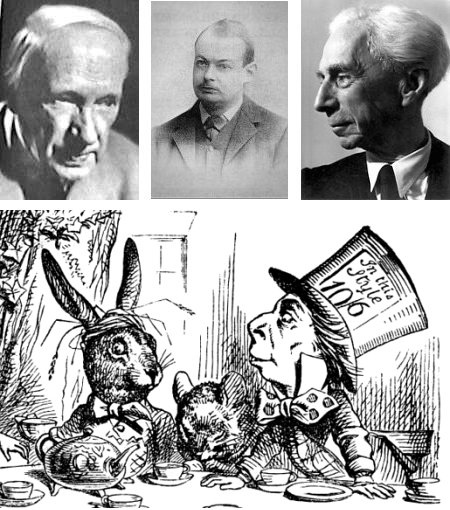
I. Futility Closet provides a handy picture of the philosophers' mad tea party:

Relevant quote is from Norbert Wiener (although I think Russell's resemblance to the mad hatter had been noted even earlier):
It is impossible to describe Bertrand Russell except by saying that he looks like the Mad Hatter. … [J.M.E.] McTaggart … with his pudgy hands, his innocent, sleepy air, and his sidelong walk, could only be the Dormouse. The third, G.E. Moore, was a perfect March Hare. His gown was always covered with chalk, his cap was in rags or missing, and his hair was a tangle which had never known the brush within man’s memory.
(See also, inevitably: Mr Apollinax. Eliot's juvenilia eventually got published as Inventions of the March Hare but there's no real connection. Also, Moore is not very satisfactory in the pic above. I am unable to find a more tangle-haired G.E. Moore but would welcome links in comments.)

II. Via Fritinancy, a list of words that can be spelled using letter-sequences from the periodic table. (This is not as easy as you might think -- I remember trying it once when I was looking for plausibly-deniable four-letter chemical-formula puns -- as letters that are not elemental symbols include A, D, E, G, and T.) The longest so far is "nonrepresentationalism."

(File under: words with unusual properties.)

Thursday, June 2, 2011

The Fractal Geometry of Wrinkles


The folds of a curtain tend to grow larger and smoother as you move away from the fixed end; this behavior is generally true of suspended sheets -- they tend to form wrinkles near the fixed ends that turn into larger smoother billows as you move away from the edge. (The picture above, L, is a sheet of two-layer graphene suspended over a trench.) A natural question that this sort of recurring structure brings up is whether, if you took a picture of the region near the surface (i.e., the region with small wrinkles) and blew it up, you'd get something that looked exactly like the region with larger wrinkles -- whether the joints at which wrinkles join and split look the same at all scales, in other words. A nice new paper in PRL ["Wrinkling Hierarchy in Constrained Thin Sheets from Suspended Graphene to Curtains,"  PRL 106, 224301 (2011)] shows that this is indeed the case, and that -- under some weak assumptions -- the average wavelength (crest-crest distance) of the folds scales as the distance from the fixed end as x^(2/3) for light sheets and as x^(1/2) for heavy sheets. ("Light" and "heavy" are defined somewhere in the article...) Here are some of the results:

So wrinkling is one of those "universal" phenomena that people in statistical physics are obsessed with (see prev.) -- as evidence for the anti-reductionist view that you can't really explain macroscopic effects in terms of what things are made of, because (e.g.) every large sheet-like object behaves in much the same way and so the microscopic details don't add anything significant to the story.

Two notes:

(1) The new PRL is closely related to a paper that was featured in Phys. Rev. Focus a couple of months ago on the crumpling of paper. The first author on the crumpling paper was the aptly named Robert Schroll.

(2) The new PRL introduces the semi-charming term "wrinklon" for the site at which a wrinkle forks. (Any clump-like or singular feature is a [blank]-on as per standard naming practice, which I think began with "soliton.") One of the experiments they did to study wrinklons was, I thought, very elegant: they took a plastic sheet, clamped one end of it to a surface with serrations at wavelength lambda, and the other to a surface with serrations at twice the wavelength. (So the folds at one end should be twice as tight as at the other; see figure below.)


This trick allowed them to isolate and study single layers of "wrinklons."