Showing posts with label lydia davis. Show all posts

Friday, November 11, 2011

"The ambiguity of the apple"

Alan Garner remembers Alan Turing (Guardian):

He was stocky, barrel-chested, with a high-pitched, donnish voice and the aerodynamics of a brick. He was funny and witty and he talked endlessly, but I understood very little of what he was saying, and it became clear that he ran in order to think. He seemed to be obsessed by mathematics and biology. That much I could work out.

We had one thing in common: a fascination with Disney's Snow White and the Seven Dwarfs, especially the transformation of the Wicked Queen into the Witch. He used to go over the scene in detail, dwelling on the ambiguity of the apple, red on one side, green on the other, one of which gave death. We had both been traumatised by Walt.
Also an appealing piece in Nature News, casting doubt on the claim (which I missed at the time) that cows are magnetic:
Three years ago, Hynek Burda, a zoologist at the University of Duisburg-Essen, Germany, and his colleagues added cattle to the magnetic family with a paper in Proceedings of the National Academy of Sciences. The team used data from Google Earth to show that domestic cattle seem to prefer to align their bodies along Earth’s magnetic field lines1, and showed a similar phenomenon in field observations of deer. [...] Burda and his colleagues reanalysed the replication attempt by Jelinek and his colleagues4. Burda says that half of the Jelinek team's data should be excluded because some of the pastures are on slopes or near high-voltage power lines, for example, or because the images are too poor to make out cattle, or appear to contain hay bales or sheep instead. “One half of their data is just noise,” says Burda.
I wonder if Lydia Davis reads Nature News.

Tuesday, November 1, 2011

Of mice and shoes

1. from Marianne Moore, "Silence":
Self reliant like the cat 
that takes its prey to privacy,
the mouse's limp tail hanging like a shoelace from its mouth --
they sometimes enjoy solitude,
and can be robbed of speech
by speech which has delighted them.
2. "Mice" in A.J. Snijders's Very Short Animal Stories (trans. Lydia Davis, in Asymptote):
A mouse inside a shoe is not a primal fear, not a trauma, but I do pay attention, all the same. It's because of the open roofs. I have a house with three tile roofs. They used to be haylofts, they were not timbered, the wind had to be allowed to blow through freely, against the heat and damp. Time and objectives change, I timbered one roof, gas was installed, the electricity went underground, drainage pipes were laid, but the mice stayed. The house is in the fields, there are mice everywhere. [...] Yesterday in a forgotten cupboard I found two pairs of shoes. I recognized them, old, but still useable. First I hold them by the tips, and I shake them—to be absolutely sure, I even poke them with a little piece of wood. Then I put them on; once my feet are inside them, I feel ten years younger, but that doesn't help, I'm still thinking about the oil, the energy, the mice, the people and the water.
---

I have a Google-reader-shaped hole in my heart, now that their latest shitty "update" has excised not only the social features but the "share with note" feature I used to make clippings. For now I've made a new tumblr that should serve some of the same purposes (via GReader's "send to" feature), but it is more work and doesn't work nearly as well. The malign Google+, which is cannibalizing all of Google's other "social" features in a futile attempt to compete with Facebook, is apparently to blame... I fear for the future of Google chat.

Monday, October 10, 2011

"Unjoynt that bittern!" Etc.

A link-dump:

1. James Wood reviews the new Hollinghurst novel in the NY'er, with more irritation than liking (nevertheless it sounds very much worth reading); here is his takedown of the Henry James pastiche:
In Hollinghurst’s new novel, “The Stranger’s Child” (Knopf; $27.95), the Jamesian cadences come in peristaltic waves: “This large claim seemed rather to evaporate in its later clauses.” “This was exactly Dudley’s version too, though the cool nerve of ‘improving’ made Daphne laugh.” [...] Sex itself—specifically, gay sex—is feared by one character as “the unimagined and yet vaguely dreaded thing.” It does a writer as talented as Hollinghurst few favors to be fossicking in fustian in this way; I spent too much time, while reading this often beautiful novel, itching to write a parody of Hollinghurst’s Jamesianism. (“Ralph’s cock was small but sincere; in the afternoon’s fading light, thinned by winter’s quick transit, it seemed to Hugh almost shyly noble. The two men could hear Lady Soames’s little lacquered laugh, somewhere downstairs. . . .” And so on.)

2. Teju Cole reviews Andre Aciman's Essays on Elsewhere (Aciman is v. much a personality in my imagination thanks to Lydia Davis's story "The Walk"). Here is Aciman on the kinds of lavender:
There were light, ethereal lavenders; some were mild and timid; others lush and overbearing; some tart, as if picked from the field and left to parch in large vats of vinegar; others were overwhelmingly sweet. Some lavenders ended up smelling like an herb garden; others, with hints of so many spices, were blended beyond recognition.

3. Jeff Gordinier (who?) ends up in the Hebridean island of Luing thanks to a Don Paterson poem:
What I found tantalizing about “our unsung innermost isle,” as Mr. Paterson put it, was the very obscurity of the place. It was obscure not because it was theatrically desolate and raw, but because it was the opposite of that. It was an island that just sat there and gazed out at all the more famous islands.
I didn't know the poem -- I ought to know Paterson's work much better than I do -- and wasn't bowled over by it (the ending, I think, is off-key) but I thought this bit was rhythmically very nice:
Kilda's antithesis,
yet still with its own tiny stubborn anthem,
its yellow milkwort and its stunted kye.

4. A wonderful list of nonce words from the 17th cent. for carving specific kinds of meat. Birds, for some reason, have many of the best ones (virtually all of these have potential euphemistic uses btw):
Rear that Goose.
Lift that Swan.
Spoil that Hen.
Frust that Chicken.
Unbrace that Duck or Mallard.
Dismember that Hern.
Display that Crane.
Disfigure that Peacock.
Unjoynt that Bittern.
Allay that Pheasant.
Mince that Plover.

I also liked "tame that crab" and "splat that pike" though.

5. Two strange news stories, about sharks invading a golf course in Brisbane and about a supposed Saddam Hussein lookalike being pursued by a supposed porn gang.

---

In other news, work is in a heightened degree of disarray because our automatic spam filter has gone rogue, marking (e.g.) correspondence with journals as spam! I can't figure out how to turn the filtering off...

Calista reminded me yesterday of an intriguingly nasty Rochester poem that I had blogged a long time ago (scroll 2/3 of the way down) as a bridge between Herrick and Pope. (It is a post that is quite needlessly tl;dr and badly organized, I don't remember what I was thinking at the time.)

Saturday, September 3, 2011

Davis and Moore, Jonson and Johnson

A Very Short Story from the Lydia Davis volume Samuel Johnson is Indignant which for some reason has fetched up on my bedside table (and which, consequently, I have been rereading):

Almost Over: Separate Bedrooms

They have moved into separate bedrooms now.
That night she dreams she is holding him in her arms. He dreams he is having dinner with Ben Jonson.

(But I always thought it was supper!) Looking for a pastable text I came upon this excellent review by Richard Locke, which ends with an apt and unexpected comparison between Davis and Marianne Moore. Locke quotes Randall Jarrell on Moore:
the intricate and artificial elaboration not only does not conflict with the emotion but is its vehicle.

Which brings to mind that wonderful remark of Moore's:
rectitude has a ring that is implicative, I would say.
(Cf. Davis's abnormally strict views on literalness in translations.) Googling which -- this process being rife with serendipity -- I came upon Denis Donoghue's essay about Moore, which makes the point slightly better than Jarrell:
for Marianne Moore the supreme poetic virtue is beyond morality, though decently attentive to it. The merit of a poem, a novel, a book about landscape gardening, The Magic Flute, or a sculpture by Malvina Hoffman consists in the personality it discloses when disclosure is not intended and the artist is minding his proper business.

(Why this appeals to me will be obvious to regular readers.) The part that follows applies much more to Moore than to Davis:
Moore's common word for the flare of personality, the unity of being in which one's action is a true epitome of one's self, was rhythm. [...] Moore liked to quote Coleridge's remark that "our admiration of a great poet is for a continuous undercurrent of feeling everywhere present, but seldom anywhere a separate excitement." But she loved to find a separate excitement, like a whirlpool, verifying the undercurrent and at last returning to it. Often she found it in English writers of the seventeenth century, Bacon, Donne, Moore, the King James translators of the Bible; later in Defoe, and in Johnson, in whose work she noticed "a nicety and point, a pride and pith of utterance"

(Re "pride and pith" -- this slightly off-kilter way of ordering nouns is characteristic of Moore. (It is a similar trick to the unemphatic rhymes.) It is said that Ezra Pound changed the last line of her poem "A Grave" from "neither with volition nor consciousness" to "neither with consciousness nor volition" and she immediately changed it back.)

What Donoghue is paraphrasing re "flare of personality" is that Hopkins poem:
As kingfishers catch fire, dragonflies draw flame;
As tumbled over rim in roundy wells
Stones ring; like each tucked string tells, each hung bell's
Bow swung finds tongue to fling out broad its name;
Each mortal thing does one thing and the same:
Deals out that being indoors each one dwells;
Selves — goes itself; myself it speaks and spells,
Crying Whát I dó is me: for that I came.
I think one of the drawbacks of the poetics of subtraction -- the Beckett/Davis line -- vs. the poetics of clutter is that it is in a sense too transparently theatrical; a bare stage draws attention to itself in a way that an overcrowded stage does not -- the artist is not "minding his proper business," he's designing to be looked at. Davis's way around this is to have her "proper business" be sentence-articulation but this is not always a satisfactory substitute for irrelevant detail.

Friday, May 6, 2011

The horizon as a spit


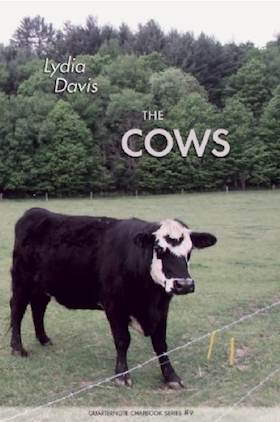
I'm intrigued by Lydia Davis's chapbook The Cows, though it seems daft to pay $10 for 32pp. of observations about cows. A snippet from the Amazon page:
Forms of play: head butting; mounting, either at the back or at the front; trotting away by yourself; trotting together; going off bucking and prancing by yourself; resting your head and chest on the ground until they notice and trot toward you; circling each other; taking the position for head-butting and then not doing it.

I was reminded of a snippet from a Davis interview in the FT a couple of years ago, which I thought I'd blogged at the time but apparently didn't:
a photograph of two cows – standing in the snow like black cut-outs on white paper, staring flatly at the camera. Something about the picture is irresistibly funny.

She sent the photo, she tells me, to her friend Rae Armantrout, a poet, who called her afterwards. “She asked me why I had sent her a picture of two pigs strung up on a spit,” says Davis – and then turns the picture upside down.

I can see what she means; the line of horizon does resemble a wire, and the cows do look a bit like pigs. “It was just one of those confusions,” she says, shrugging.