Wednesday, March 21, 2012

Another kind of backwards flute

(Because this post is about Craig Raine, I should pass on the information that "the last words of Larkin's last ever poem were 'Raine (Craig)'. Rhyming with 'dumb and vague'.")

I had posted last year about Craig Raine's view that '“Asshole” is a possible translation of “arsehole” but it isn’t the right translation,' but did not know then, as I know now, that the word plays the same central role in Raine's poetics as "gleam" does in Tennyson's or "greazy" in Swift's. A couple of exhibits: (1) From his novel Heartbreak: "The beautiful blot of her arsehole. A dark-pink peach-stone. An astonishment of lips". (2) This poem, Verlainesque but -- and this is why I cannot avoid posting it -- ending with the word "ambergris" (also, inevitably, evocative of Gas-Poker -- cf. "the pucker that she held up"):

Arsehole 

It is shy as a gathered eyelet
neatly worked in shrinking violet;
it is the dilating iris, tucked
away, a tightening throb when fucked.

It is a soiled and puckered hem,
the golden treasury’s privy purse.
With all the colours of a bruise,
it is the fleck of blood in albumen.

I dreamed your body was an instrument
and this was the worn mouthpiece
to which my breathing lips were bent.

Each note pleaded to love a little longer,
longer, as though it was dying of hunger.
I fed that famished mouth my ambergris.

Saturday, March 17, 2012

Thawglass

I have been reading John Burnside's book Black Cat Bone; I'll be posting more about it, but for now: (1) here, qua teaser, are some bits that are available online: "Late Show", "Nativity" and "Loved and Lost" (the latter has a wonderful ending), the long narrative poem "The Fair Chase", "Notes Towards an Ending", and "Pieter Brueghel: Winter Landscape with Skaters and Bird Trap, 1565". (2) Burnside is very good; he is one of those obsessive airless writers without much scenic range -- I am reminded most powerfully of Charles Wright (also, but mostly by coincidence, of Joyce Carol Oates); Burnside often uses the late-Wright trick of starting a poem with a stage-direction line like "Night" -- whose interests are fashionably liminal. There is a lot of dawn/birth/spring ("the trees emerging, piecemeal, from the cold"), a blur of intimations-of-the-otherworldly, and a wealth of headlights. (3) The real point of this post is to note a lovely word that, as far as I can tell, Burnside made up; it appears in the closing lines of this book:
this is the time of year
when nothing to see
gives way to the hare in flight, the enormous

beauty of it stark against the mud
and thawglass on the track, before
it darts away, across the open fields

and leaves me dumbstruck, ready to be persuaded.

The meaning is fairly obvious -- I won't embarrass myself with a paraphrase, but will recall this -- and it is the sort of word that ought to be a word, but I cannot locate any uses outside of Burnside's poems. (There is another, earlier poem with "a litter of small gold apples, newly fallen, / wet with thawglass.")

"Hisses, treadlings, clunks and saw-edged whines"

Some clippings from Francis Spufford's Red Plenty, while I wait for the dryer downstairs to free up. (My Kindle and my computer are rarely in the same place at the same time.) First, an overall note: it starts off wonderfully but runs out of steam, mimetically I guess. The book is about Russia between Stalin and Brezhnev; Spufford is interested in fairy tales, and wants to think of the Khrushchev era in terms of the Russian fairytale trope of the "self-victualling tablecloth"; the shoe doesn't quite fit, but comes close enough that the book isn't entirely silly. It is arranged in groups of vignettes that are each supposed to illustrate daily life in some part of this era; each group is introduced by a brief historical overview. The social range extends from low-level party workers to Khrushchev. Because the fairy tale was supposed to be powered by science, there is a lot of writing about mathematical economics and genetics and the like. I thought this was variable in quality and generally suffered from Spufford's preference for metaphors over explanations. A chapter about a scientist dying of lung cancer, in particular, narrates the progress of cancer through one's genes cells at inordinate length and with a hideous overreliance on the word "gloop." It is probably the worst science writing I have ever read -- esp. because, as I hope the clippings here and in prev. posts indicate, it's written by a remarkable prose stylist -- and deserves an award of some kind.

Nevertheless, here are the clippings:
a discordant symphony of hisses, treadlings, clunks and saw-edged whines

(about a plywood factory)
The train passed through Baltimore, Philadelphia and Jersey City, America turning its back view to him as the carriages slid athwart streets and behind rows of red-brick buildings. He gazed and speculated. It was like looking at a man facing away from you, and trying to guess what was in his pockets. He saw rusted fire-escapes clamped to the back of buildings and bundles of electrical wires in fat festoons looping from wall to wall. He saw oil storage tanks, he saw rubber tyres burning on a wasteland in a black smeech of smoke, he saw billboards advertising trinkets and cigarettes. The Americans seemed keen on neon signs, not just for important or official purposes, but everywhere they could be fitted in, violet and green and red, in humming sputtering anarchy. Troyanovsky translated some for him: MOTEL, CRAZY GOLF, JACK’S VALUE AUTO. Sometimes the view turned disconcertingly to blank virgin forest, as if America had tendrils of Siberia reaching right up into its metropolises.
(Re fire escapes, cf.)
Outside, the late summer day had become one of those evenings where the sky has the pure, clear colour of darkening water, moving to black through deeper and deeper blues.

And:
an expression of bafflement on a face like a sweating cheese

And:
Ask the computer and it would obey, as ready as a genie in a bottle – and as intolerant of badly-framed wishes.

And:
What has come over me? thought Sasha. He remembered a joke. What is a question mark? An exclamation mark in middle age.

And:
The closer a science was to practicality, the more it was co-opted into serving the practical needs of power. The closer it was to the dangerous ground of social science, on the other hand, the more distorted by ideology it tended to become. And the more abstract it was, the more intellectually uncorrupted it was likely to remain. The result was a landscape of intellectual lives laid out very differently from its counterparts abroad. Where the United States (for example) was a society ruled by lawyers, with a deep well of campus idealism among literature professors and sociologists, the Soviet Union was a society ruled by engineers, with a well of idealism among mathematicians and physicists. Law, economics, history were sterile, insignificant fiefdoms, ruled by ‘little Stalins’

And:
The car was not in good shape. The muffler banged and the gears stridulated as it lurched off the snowbank and away. Also, someone had been sick in the back and the mess had been incompletely cleaned up. Chekuskin pulled the tails of his overcoat up and sat as far as he could from it.

And:
Alexei Nikolaevich Kosygin was a neat old, solid old, dry old pol, with deep lines running from his nose to the outside corners of his upper lip, which lifted his cheeks, when he smiled, into little sardonic bunches of muscle as round as billiard balls.

And, amid the wreckage of the lung cancer chapter:
True, it is a disgusting noise he makes. It begins as a commonplace wheeze in his throat, but tumbles down into his chest where it hacks and rattles and audibly moves clots of viscous wet stuff around, till the wet stuff has been dragged up into his airway, and he’s in a gasping, gargling struggle to get it off his epiglottis, and out, so that he can breathe again. He spits into his handkerchief, clean this morning, now stiff and crusty, stained with nameless emulsions. He’s been bringing up the traditional jade mayonnaise of bronchitis every winter for as long as he can remember, but this is something different, something thicker and redder and meatier, like liquescent liver. He folds the handkerchief away, and tries to muster his persuasive powers.

Saturday, March 3, 2012

Pearls-for-eyes redux

Francis Spufford, I may be some time:
The ice had preserved John Torrington, John Hartnell, and William Braine as yellowed revenants from 1846. Their lips had drawn back from their teeth, and their eyes, oysters of water-ice when the coffins were first opened, proved to have sunk back beneath the lids [...] the preserving ice does something curious to history. It does not distinguish between the recent dead and the remote dead; all are glazed over alike.
I am returning to this book after a week's travel, exigencies of packing for which have left me with a number of half-read books that I must now try to finish.

Friday, March 2, 2012

"By the time Collins was being pursued by a woman with green tusks, you sense he was in big trouble"

Back from Boston, where I had a pleasant few days, to "fyre and flete and candlelight," and the (more urgent than I had realized) task of finishing up my thesis. Some linkage:

1. Engaging review of Peter Ackroyd's (apparently dull) biog. of Wilkie Collins.

2. Geoff Dyer on porn and Thomas Ruff. Inter alia I am grateful to GD for teasing out the pun in "coming to our senses." (Which also enriches that Frost line, "going home / From company means coming to our senses.")

3. From Guy Davenport's diary in The Hunter Gracchus:
The white frost that made the fire feel so good, and the quilt so comfortable, had also reddened the maples and mellowed the persimmons. Cloth shoes stink by the fire. Foxes bark in the deep of the wind.

Opossum:persimmon::moth:mulberry. Christmas Island (South Pacific): imperial pigeon, noddy, glossy swiftlet, reef heron. 

Friday, February 24, 2012

The executive sublime

Francis Spufford, in I may be some time: Ice and the English imagination (best title + subtitle ever), quotes Burke on sublimity (I have never read Burke and absolutely must):
Chuse a day on which to represent the most sublime and affecting tragedy we have; appoint the most favourite actors; spare no cost upon the scenes and decorations; unite the greatest efforts of poetry, painting and music; and when you have collected your audience, just at the moment when their minds are erect with expectation, let it be reported that a state criminal of high rank is on the point of being executed in the adjoining square; in a moment the emptiness of the theatre would demonstrate the comparative weakness of the imitative arts, and proclaim the triumph of the real sympathy.
He goes on to quote Richard Payne Knight on Burke's views of sublimity (which seem, at least in broad outline, to be conventional enough nowadays that the point of the joke is self-evident):
If . . . [Burke] had walked up St. James’s street without his breeches, it would have occasioned great and universal astonishment; and if he had, at the same time, carried a loaded blunderbuss in his hands, the astonishment would have been mixed with no small portion of terror: but I do not believe that the united effects of these two powerful passions would have produced any sentiment or sensation approaching the sublime, even in the breasts of those who had the strongest sense of self-preservation, and the quickest sensibility of danger.
I found this quote in an essay by Eve Tushnet, who goes on to ask, "From the Burkean point of view, of course the gun-toting underpants man couldn’t be sublime. But what if the author of this scene weren’t Edmund Burke, but Flannery O’Connor? What if the unclad man was not a deranged Burke wielding a blunderbuss, but an ecstatic Francis enraptured by Christ?" (Here again -- and reading Spufford one is consistently struck by this -- we are in Auden country; see esp. chapter(s) on Don Quixote in the Dyer's Hand.) See also: the case of the six-year-old girl with the character of Churchill.

Tushnet has an interesting blog; see, in particular, the Dostoevsky drinking game.

Finally, I enjoyed Theo Tait's review of the new Lanchester novel. In particular, his praise of Mr Phillips -- "an inspired daydream about sex, statistics and the strangeness of ordinary London life" -- is spot-on; Mr. P was the novel that got me interested in Lanchester in the first place; if the chapter that made it to the New Yorker is representative, the new book is almost certainly as drab as he says it is. Tait's comments on the Large Contemporary Novel are sensible:
There is a constant clamour for novelists to "take on big contemporary questions", as a recent Guardian opinion piece put it – to leave the Hampstead dinner parties and the safe historical settings behind, and write the Novel For Our Times. Actually, these books get written all the time, from Margaret Drabble's schematic portraits of the 1970s to Jonathan Coe's of the 1980s and Blake Morrison or Richard T Kelly's uneven sagas of the New Labour years, right up to the recent flood of credit crunch literature. The problem is that they're not usually very good, for quite straightforward reasons: creating and managing a large, varied and realistic cast of characters is very hard for an individual novelist to do, particularly now that society is so diverse. When working outside their own experience, novelists tend to fall back on recycled journalism, contrivance and cartoon.
I agree with these assessments, but the general question is more puzzling than Tait makes it out to be. My sense has always been that the people who try to write Large Contemporary Novels are bad at characterization anyway; it would fit most of the data to say these novels are bad because the wrong people are writing them. The question is not why novels like Middlemarch are so rare nowadays, but why novels like Pickwick are: characters needn't be lifelike to be alive, or rounded to be memorable. Where are the Micawbers and Miss Havishams of the 21st century?

Thursday, February 23, 2012

"Like bacon in the chimney"

More snoutage, this time from dolphin chapter in Pseudodoxia Epidemica:


Regarding storms, recall the cardinal in Webster who "lifts up's nose, like a foul porpoise before a storm"

(Quote courtesy of Calista)

Herring-hog and helegug


Regular readers might remember previous posts about snouts, esp. this one. (Quick summary is that a porpoise is a pork-fish.) Today, while trying to establish the age of the term "puffer fish" on OED, I learned some more hoggish synonyms for "the common porpoise":
1. Puffer (3c.) Quot. from 1911: Porpoise (Phocæna communis).—A cetacean found on the north Atlantic and north Pacific coasts, ascending rivers. It is known as ‘harbor porpoise’, ‘herring-hog’, ‘puffer’, [etc.].

2. Puffing pig. chiefly US. Quot. from 2004: Harbour porpoises are sometimes called the puffing pig as the creatures can be heard making puffing noises from the shoreline as they take a breath on the surface.

3. Puff-pig. Newfoundland, obs. the common porpoise. Quot. from 1861: At the mention of the puff-pig, the local name for the common porpoise, we indulged ourselves in a childish laugh.

There is also a puff-shark:
puff-shark. now rare, the swell shark, Cephaloscyllium ventriosum. Quot. from SciAm, 1902: The curious puff shark uttered a deep grunt when it was taken from the water.

Also discovered, as part of this excursion, some obsolete synonyms for puffin:
(1678) The Bird called Coulterneb at the Farn Islands, Puffin in North-Wales, in South-Wales Gulden-head, Bottle-nose, and Helegug, at Scarburgh Mullet, in Cornwal Pope.

Tuesday, February 21, 2012

Tales and Tayles; ideas of ordure

I have been bad about closing tabs -- have also been meaning to do some posts that involve writing rather than linking, but this term has been overwhelming. NB I'll be in Boston next week for the APS meeting. Anyway here are some links:

1. 30 photos of a Chinese sex toy factory (via clusterflock)

2. Harold Bloom reminisces about Auden (birthday today, as was DFW's apparently):
The poet arrived in a frayed, buttonless overcoat, which my wife insisted on mending. His luggage was an attaché case containing a large bottle of gin, a small one of vermouth, a plastic drinking cup, and a sheaf of poems. After being supplied with ice, he requested that I remind him of the amount of his reading fee. A thousand dollars had been the agreed sum, a respectable honorarium more than forty years ago. He shook his head and said that as a prima donna he could not perform, despite the prior arrangement. Charmed by this, I phoned the college master--a good friend--who cursed heartily but doubled the sum when I assured him that the poet was as obdurate as Lady Bracknell in The Importance of Being Earnest. Informed of this yielding, Auden smiled sweetly and was benign and brilliant at dinner, then at the reading, and as he went to bed after we got home.

(A few addenda: i. I should really have a separate tag for this sort of Auden post as opposed to the posts that quote him. ii. A good source for more stories of this kind, seen from a glancing angle, is the Lowell-Bishop correspondence. iii. Bloom is not fond of Auden's work, but has always seemed to me a pretty good judge of the relative merits of different Auden poems; in particular, he correctly rates Letter to Lord Byron and the limestone poem as among A's best. (Re which, see also Anthony Hecht.))

3. From the lardr, animal-specific terms for tails and excrement (unearthed by Calista):
THe tayle of Harte, Bucke, Rowe, or any other Deare, is to be called the Syngle. The Tayle of a Goate, is plain∣ly called his Tayle. The tayle of a Bore, is to be termed his wreath. The tayle of an Hare and Conney, is called their Skut. The tayle of a Foxe is called his Bush, or (as some vse to say) his hollywater sprinkle. The tayle of a Wolfe is to be called his Stearne. Of the rest I haue not read.
and

The termes proper for the ordure and naturall excrements of chaces.

IT is a thing highly obserued and not here to be omitted, that the ordure of euery beaste of chace & Uenerie hath his proper terme. The reason is, by cause theyr ordure and excrements are one principall marke whereby we know the place of their feede, and their estate. So that a Huntesman in talke or makyng of his reportes shall be often constreyned to rehearse the same. Of an Harte therfore, and of all Deare the ordure is called Fewmets or Fewmishing: Of a Gote, and of an Hare the Crotising or Crot∣tels: Of a Bore the Lesses: Of a Foxe, and all other vermine, The Fyaunts: Of an Otter the Spraynts. And I haue neyther readde nor heard what it is termed of a Wolfe or a Beare: neyther is it greatly materiall.
See also: animal-specific verbs for slicing-up

Sunday, February 12, 2012

"Cankles and haunch"

I have been somewhat sloppy of late about reading Poetry Daily but fortunately did not miss this gem:


Sex Rubenesque
 
           Unleash the excess!
     Bring me cleavage and rumpage,
one heftable breast, then another,
     a buttock untrussed
and rhapsodic for humpage.
     Begin the maneuvers,

  purge girdles and covers; undress
    each strumpet of frumpage
  that revolts a fat lover. Release the noblesse,
the cankles and haunch, trot out the lumpage—
            Deliver the flesh!

 ---
Naturally delighted to find a contemporary poet so precisely to my taste. Among other good poems of Leithauser's that I have dug up are: "The Old Woman Gets Drunk with the Moon", "O, She Says", "Frostbite", "UFOs", "Was you ever bit by a dead bee?", and "Guidelines: Writing the Sonnet." (Some of these are perhaps a little too much like Kay Ryan -- "Tiger Shark" absolutely is -- but there are worse things.) There isn't, as far as I can tell, a book of any kind out yet, but I hope there will soon be one.

---
While I'm at it, I should link to the (very slightly related) youtube clip of MacNeice reading "Bagpipe Music."

Saturday, February 11, 2012

Frightening inaction


An assortment of quotes with links attached:

1. Michel Houellebecq on blogging (I should like to declare him entirely mistaken, but he is not):
You can always microblog, Houellebecq had told him [...]; but to launch yourself into the writing of a blog post you have to wait for all of that to become compact and irrefutable. You have to wait for the appearance of an authentic core of necessity. You never decide to write a blog post, he had added; a blog post, according to him, was like a block of concrete that had decided to set, and the blogger’s freedom to act was limited to the fact of being there, and of waiting in frightening inaction, for the process to start by itself.

2. Auden on songs/"words-for-music" (linked site is not without interest -- HT Conor Leahy!):
The song ... is, of all kinds of poetry, the one in which the formal verbal elements play the greatest role.... In the world of the song, one might say, the important relationship between the inhabitants is not any community of concern or action so much as family kinship. The satisfaction I get from reading a poem by Campion, for example, is similar to the satisfaction I get from studying a well worked out genealogical tree. (A wet afternoon could be pleasantly spent developing this analogy. Starting with the notion that masculine rhymes represent brothers, feminine rhymes sisters, refrains identical twins, one could ask what verbal relationship would be equivalent to a second cousin once removed. From there one could go on to consider what discords correspond to marriage within the prohibited degrees, e.g., to marrying one's deceased wife's sister.)

3. Jay Rayner, on adventurous cooking (HT Sarah Duff):
Modern techniques are great. They’re brilliant. If you want to cook my steak by banging it round the Large Hadron Collider, be my guest. Dehydrate my pig cheeks. Spherify my nuts. But only do so if the result tastes nicer.

4. Graffiti from Pompeii:
Herculaneum (on the exterior wall of a house); 10619: Apollinaris, the doctor of the emperor Titus, defecated well here 
5. On relocating detective stories from Portsmouth to Le Havre:
There is no translation for "mush" (a Pompey term of affection), "scrote" (the opposite) or "scummer" (anyone from Southampton). Can the city be exported? "I was intrigued by the move to Le Havre," said Hurley. "But they have done a good job. What holds true for Portsmouth also holds true for Le Havre. There are similarities: neither city is fashionable, they are both at the end of the railway line, relatively uncursed by money. Sharp-elbowed places, robust." Could you move other English detectives – Morse to Rouen, say, or Rebus to Marseille? "Rebus, maybe yes. But I'm not sure about Morse. You can't get away from those dreaming spires."

6. Much to like in this review of Dickens's letters (via Light Reading). I particularly liked
the pile of clean spittoons in the corner of a country inn “looking like a collection of petrified three-cornered hats”
(In Ulysses, Joyce has "a hogo you could hang your hat on" and also "what a man looks like with his two bags full and his other thing hanging down out of him or sticking up at you like a hatrack.")

Sunday, February 5, 2012

Niceties of expression

Very late getting around to this, but I read the new Hollinghurst book some time ago and have been meaning to post about it. I would recommend it, although it is one of his weaker books, I think, partly because the plot is so unworkable. (In the second half of the novel, the protagonist -- or rather the character that provides the point-of-view -- is a nondescript bank clerk who is obsessed for no clear reason with a half-forgotten WW1-era poet, "Cecil Valance"; clerk quits his job to write scandalous biography of Valance, after bank manager turns out to be married to Valance's niece/daughter who plays duets with a gay schoolteacher -- teaching at a school located in what was formerly the Valance mansion, now modernized -- who of course then sleeps with bank clerk. There is a coda in which we are told that all characters ended up tenured or modestly famous.)

Besides, the bank-clerk protag. is an incongruous mouth for Hollinghurst to put words into, e.g., "he was touched for a moment by a sense of the inseparable poverty and consistency of English life" (yeah right). Previous novels might have had unpleasant protags but at least they were all meant to be clever.

Nevertheless the writing is brilliant; I particularly liked "Paul woke to the sound of a tolling bell, with a hangover that felt much worse for the comfortless strangeness of Greg Hudson's room" and the phrase "sleek unanswerable jets." James Wood objected to the echoes of Henry James, which I didn't mind, although I was amused by this passage, which could have come straight out of The American Scene:
here the bracket clock whirred and then hectically struck eleven [...] Other clocks (and now she could hear the grandfather in the hall chime in belatedly) showed a more respectful attitude to telling the hour. They struck, all through the house, like attentive servants. Not so that old brass bully the drawing-room clock, which banged it out as fast as it could. "Life is short!" it shouted. "Get on with it before I strike again!"
(There is also a passage about the expected apparatus of a bathroom "intruding" through all the junk stored in it that I cannot find online and will type in anon.)

Other notes:
  • Others have said this but it is almost impossible to write a country-house scene -- even if it's not really a country-house -- revolving around the confusions of a precocious girl without evoking Atonement.
  • The second section, "Revel," was very good in a way that perhaps invites terms like "magisterial" and "virtuosity" too insistently. I thought it was the best thing in the book, and it gains extra points for apposite use of Skeltonics. The delightfully unpleasant Dudley Valance is a memorable character.
  • H.'s female characters are all composed of the same few attributes -- spirited, perceptive, vaguely unstable, given to drink -- and differ primarily in how unstable and how old they are. The very old ones drink especially heavily. But it is a versatile formula: the old woman's part is done brilliantly in the later sections of this book.
  • H. is overly fond of embedded texts. They're always defensible/necessary but I've never liked them. In the Swimming-Pool Library he needed the diary for historical perspective; here he needs it because multiple characters are writers. I esp. cringed at "Love comes not always in by the front door" (in a poem recited by "Valance").
  • I simply do not think H. is versatile enough as a writer to succeed with a protagonist who is partly an object of satire (the bank clerk). Whenever there is a convincing descent into his consciousness the man is very drunk.
  • Daniel Mendelsohn appears to have objected to H's use of Jewish characters (claiming H. is given to use of anti-Semitic tropes) both here and in Line of Beauty. I have not read the article, which is gated; however I was reminded of a truly anti-Semitic poem by Larkin that touches on many of the same themes as the Hollinghurst book -- search for "Balokowsky."
Finally, see also: James Wood, Christopher Tayler, Jenny Davidson, Emma Brockes.

Friday, January 27, 2012

A slabbed-down mass of tabbage

1. Robert Walser's story "Good morning, Giantess" (NYRB classics tumblr). I esp. liked this:
Cold and white the streets lie there, like outstretched human arms; you trot along, rubbing your hands, and watch people coming out of the gates and doorways of their buildings, as though some impatient monster were spewing out warm, flaming saliva. You encounter eyes as you walk along like this: girls’ eyes and the eyes of men, mirthless and gay; legs are trotting behind and before you, and you too are legging along as best you can, gazing with your own eyes, glancing the same glances as everyone else.
Cf. Chaucer:
 Hold up thy tayl, thou Sathanas!' quod he;
`Shewe forth thyn ers, and lat the frere se
 Where is the nest of freres in this place!'
 And er that half a furlong wey of space,
 Right so as bees out swarmen from an hyve,
 Out of the develes ers ther gonne dryve
 Twenty thousand freres on a route,
 And thurghout helle swarmed al aboute,
 And comen agayn as faste as they may gon,
 And in his ers they crepten everychon.
2. Puritan names. Going around on the internet, but e.g. Helpless Henley, Wrestling Brewster, Faithful Teate, Magnyfye Beard, and Unfeigned Panckhurst are almost reusable.

3. John Burnside's poem "The Good Neighbor." (Previously noted: "Late Show.") Burnside won the T.S. Eliot prize this year, annoyingly the new book isn't out in the US yet, but there's a Kindle edition (!), which I suppose I'll have to buy.

Saturday, January 21, 2012

Dazzle vs. neatness of finish


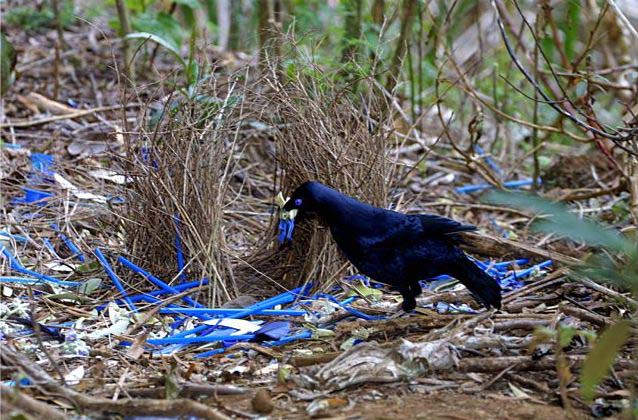
Fascinating result in this week's Science (poss. gated) suggesting that bowerbirds might be using optical illusions (viz. forced perspective) to attract mates.

The males of avenue-species bowerbirds—including great bowerbirds—construct elaborate bowers composed of two stick walls. The bowers are aligned to run from north to south, and the ends are filled with “gesso” (a collection of gray to white shells, stones, and bones), upon which colored objects are placed and thrown. [...]. Females enter bowers from their south end and watch the male at the north end carry on a display that includes vocalizations, movements, and the tossing of colored objects in front of the gesso. Many males never succeed in attracting females to their bowers, and only a select few do most of the mating after females visit and inspect their bower.[...]

In a previous report, Endler et al. (3) discovered that the arrangement of the gesso is not random: Smaller objects are arranged near the opening of the display court, and larger ones more distant from the opening. When the researchers reversed the gradient, the bowerbirds rapidly restored it to its initial distribution (but not the individual objects, just the gradient). This study showed that male bowerbirds, for whatever reason, care about the gradient. The interesting observation was that the bower creates a condition conducive to creating experiences of “forced perspective,”[...]. 

Kelley and Endler provide insight into why the males care so much about the gradient. They report that the males most adept at crafting forced-perspective illusions are most likely to achieve mating success. [...] The projected gradients, as seen from within the bower, are more predictive of mating success than the actual physical gradients. [...] Have male bowerbirds mastered the laws of perspective and learned to manipulate them to achieve lascivious ends? 

Although this possibility is intriguing, the current data are not yet sufficiently rich to sustain this remarkable hypothesis. The data provide compelling evidence that the quality of the gradient, from the vantage point of the female, predicts mating success, but the visual fact of the more uniform texture, not an illusion, may be the only factor determining her preference. Indeed, it has been previously reported that males with more symmetrical bower avenues have a higher mating success rate.
The -- immediately obvious -- argument for this view and against forced perspective qua depth-illusion is that the stones are arranged the wrong way round; they make the bower look smaller rather than bigger, and there cannot be any advantage to that as one could simply construct a smaller bower instead. (Also I don't know if bowerbirds have much depth-perception, though I'm sure this is something the authors have thought about.) But, upon reading the actual article [Science 335, 335 (2012)] it becomes clear that what the authors really want to claim is that it is the confusingness of the illusions that matters:
Any of these seven effects might hold the female’s attention longer than if absent, and still longer if the illusions interact. For example, females will not mate unless they have spent more than about 55% of their total time in the avenue watching the male display.
I'm curious to see how they test these hypotheses against each other. ("Common sense" is against the dazzle hypothesis but then it is also against the existence of bowerbirds.)

(I should remark in passing that the bowerbird has always struck me as a good symbol for most tumblrs and a certain kind of blog.)

(See also: Electric Brae.)

"Almost incurably frivolous"


Ferdinand Mount, reviewing M.R. James (LRB, gated), brings up The Other James in a way "incomparably light and deft":

Towards the end of his life, in 1929, [MR] James wrote a survey of ghost stories for the Bookman [...] The article ends in a characteristically self-deprecating but also unusually abrupt way: ‘There need not be any peroration to a series of rather disjointed reflections. I will only ask the reader to believe that, though I have not hitherto mentioned it, I have read The Turn of the Screw.’ [...] Is Henry’s exhaustive psychological analysis precisely what Monty will not permit himself, even if he were capable of it? Like Bertie Wooster, M.R. James seems not entirely at home with the psychology of the individual; for that sort of stuff, he relies on Jeeves. On his only recorded meeting with the other James, he thought that Henry looked ‘like a respectable butler’.
A few marginalia: (1) Livermere is a good place name -- at least for a ghost story -- and probably superior to Mortmere. (Liverpool might once have had similar potential.) (2) Mount on the ghost stories: "his phantoms do not, on the whole, haunt. They lie doggo in their holes and only when roused make a single surprise appearance. They are cabaret turns." (3) Also:
The spectral bedsheet in ‘Oh, Whistle and I’ll Come to You, My Lad’ attempts to thrust its ‘intensely horrible face of crumpled linen’ close into the face of Professor Parkins as he cries for help. The gender of the bedsheet is unclear, but the fear of domesticity and the fear of sex, tangled and intertwined like the bedsheet, are unmistakable.

Thursday, January 19, 2012

Torschlusspanik

From yet another list of untranslatable words (cf.):
Torschlusspanik
From German, this word literally means “gate-closing panic” and is used to describe the fear of diminishing opportunities as one ages. This word is most frequently applied to women who race the “biological clock” to wed and bear children.
This is high up on my list of frequently-felt emotions, a little behind schadenfreude and buyer's remorse, and perhaps slightly ahead of envy. Also provides an excuse to quote Auden:
Certain it became while we were still incomplete
There were certain prizes for which we would never compete:
A choice was killed by every childish illness,
The boiling tears among the hothouse plants,
The rigid promise fractured in the garden,
And the long aunts.

And every day there bolted from the field
Desires to which we could not yield;
Fewer and clearer grew the plans,
Schemes for a life and sketches for a hatred,
And early among my interesting scrawls
Appeared your portrait. 

(Another worthwhile untranslatable is "tartle" -- "a Scottish verb meaning to hesitate while introducing someone due to having forgotten his/her name.") 

Sunday, January 15, 2012

"It does seem what you need to be told"

Interesting bit of Empsoniana, via pseudopodium: an exchange of letters between E. and Rosemund Tuve, occasioned by a disagreement re George Herbert's "Sacrifice" (readers of 7 types might remember an allusion to this in the preface to the 1949-ish edition). [Grouchy aside: the introduction is awful. Says E. went to Magdalen College, Oxford -- really it was Magdalene, Cambridge -- and astoundingly asserts that "neither [E. nor T.] is noted for style".] The longer letter by Tuve is interesting for its stylistic reasons; it is arch and benignant, and also unaccountably difficult to read. Empson's letters are Empsonian to the point of self-parody -- as so much of his work is -- but I enjoyed this remark (my emphases):
I was rather shocked at your saying that I neednt rewrite my bit posted to you because it is always a nuisance to rewrite. I rewrite everything I print about twelve times, mainly in the interests of intelligibility, and I think you had much better do that too. Checking references always seems to me a trivial duty compared to checking style. I think that your style has greatly improved in your last book but is still very bad, simply from failure of communication. I also think that if you tried to write more clearly you would find your own ideas are a great deal more muddled than you suppose. So I hope very much that you will write another book, but as a labour of love, intended to be agreeable in itself – the distinction between the writer and the reader becomes unreal (because the same thing pleases both) if you take your own style as seriously as you take the style of the authors you are describing. One can imagine this doctrine working out wrong, but it does seem what you need to be told.
Tuve (whom I am more sympathetic to on the merits, and to whom E. is occasionally condescending) also has some good moments in her second letter:
how am I not to snort at you if you plant your feet wide apart and say ‘I refuse to see concordance!’ Then you must not know what you would know if you saw concordance. [...] A scholar isn’t a fetcher and carry-er so that others haven’t to trouble; it wouldn’t even be safe.

I honestly think (or did, and am pretty sure I still would; it’s a long question) that the book gives proper and sufficient data for any claim that is therein made, as far as a quite tender and delicate scholarly conscience can watch such things – there are always ways in which the mind, being fallible, goes astray. But the only way you can be sure whether I have is, is to just go and read what I had.
Another note: Tuve wants to construe Empson as saying that scholarship is of no value to literary critics, which is a straw-man version of Empson's position, but not too much of one. Empson is infuriating about not checking his quotations, etc. As for the broader point about whether relevant scholarship helps one understand texts better -- I suppose some of the New Critics denied this; that this New Critical position was ever respectable now seems mysterious.

Friday, January 13, 2012

"Met him pike hoses!"


Tickled to discover -- and so belatedly! -- that my birthday coincides with the anniversary of Joyce's death. I've been "reading" Finnegans Wake 140 characters at a time; it is much more digestible that way, one gets the intermittent good line ("the pillgrimace of Childe Horrid," "may foggy dews be-diamondise your hooprings! may the fireplug of filiality reinsure your bunghole!" "O murder mere, how did you hear?") without getting hopelessly bogged down.

Also, in re snouts, I learned on twitter today that "mere-swines" (aka "pork-fishes," aka porpoises) appear in the alliterative Morte Arthure: a character, prev. described as "harsh as a hound-fish," is now "fat as a mere-swine  with carcass full huge / and all faltered the flesh in his foul lips." (ll. 1091-1092).

Thursday, January 12, 2012

Word-hoards and lard-hoards

1. In the wake of this exchange, Calista and I have been trading literary sightings of lard, pigs, and/or gross food broadly construed; we've recently started a new tumblr (currently titled "A Child's Larder of Verse" though really there isn't much verse there) dedicated to these. No by-lines as these would be purely embarrassing for me. Swift (Jonathan, not Tom) is the genius of the place.

2. A fascinating Language Log post about the writer Paul West who "emerged from [a] stroke with a near-total obliteration of language" and how he made the best of his way back to language:
Oddly, it was often the most obscure words that were easiest to recover. He struggled with words like blanket or bed, or his wife's name Diane, words that you would think over time should have seeped into his genes. Nevertheless, he could recruit words like postillion or tardigrades to get an idea across. This led to some counter-productive interactions with a speech therapist. Since aphasics often produce nonsense words without realizing that they aren't real words, one of the goals of therapy is to give the patient feedback on which words are real. But West would often produce bona fide words that were unknown to the therapist.  [...]
The intimate wordplay between West and [his wife Diane] Ackerman also eventually resumed, with West fashioning novel terms of endearment as gifts to his wife. The offerings were delightful. Deprived of the usual routes to language, and along with them, the common clichés that many of us struggle to shed, West bestowed on his wife exquisite pet names such as: My Little Bucket of Hair; Commendatore de le Pavane Mistletoe; Dark-Eyed Junco, My Little Bunko; Diligent Apostle of Classic Stanzas.  And at one point, the man uttered what has to be the most searingly romantic sentence ever uttered in history, by anyone, in any language:

"You are the hapax legomenon of my life."

Sunday, January 8, 2012

"Irretrievable hippopotamus"

From Janet Malcolm's collages (NYRB) based on "the papers of an émigré psychiatrist who practiced in New York in the late 1940s and 1950s":
Test words for dysarthria

Royal Artillery
Methodist Episcopal
West Register Street
[crossed out]
Massachusetts Constitution
Righteous Retribution
Irish Constabulary
Irretrievable Hippopotamus
And then there was also this (under "ouch ouch disease"):

Thursday, January 5, 2012

Beak House


Some lovely photographs of waterbirds at the Guardian (via Barb Milne on twitter). The avocets naturally caught my fancy -- further sign of aging, it took me a perceptible amount of time to remember what they were called -- but the grumpy, unastonished, Jacobean-looking heron (which for some reason I associate w/ the cardinal in one of Webster's plays) is perhaps the more impressive picture:

Wednesday, January 4, 2012

"Nine foot long, and seven foot broad"

From Shakespeare's England (formerly Dainty Ballerina), the uses of polar bears (in a post that begins with a tangential remark about Jonson):
Then we rip'd up her belly, and taking out her guttes, drew her home to the House where we flayed her, and took at least one hundred pounds of fat out of her belly, which wee molt'd and burned in our Lampe. This Grease did us great good service, for by that meanes we still kept a Lampe burning all night long, which before wee could not doe, for want of Grease, and eery man had meanes to burned a Lampe in his Cabbin, for such necessaries as he had to doe. The Beares skin was nine foot long, and seven foot broad.
(Calista  (who provided the Jonson quote below) and I have lately been collecting references to grease, boars, bears, do(ugh!)nuts, etc. under the unofficial rubric of A Child's Larder of Verse.) See also: "I've measured it from side to side / 'Tis three feet long, and two feet wide." The linked bear story includes the wonderfully anticlimactic end of an Arctic explorer:
In 1611, [Jonas] Poole suffered a broken skull and collar bone on Cherry Island while handling his cargo of walrus ivory and whale fat. He was brought home by a rival whaler and recovered sufficiently from his injuries to return to the arctic the following year. However, Poole's career as a whaler was cut short in September 1612 when he was murdered in Wapping in August, having returned home from what became his final voyage.

Also bear- and grease-related: from Jonson's Bartholomew Fair, a description of the character Ursula ("Urs." / "Urse"):

Tuesday, January 3, 2012

"Vastly replenished"

1. A fine article in the LARB on dining out with Marianne Moore; here is Moore as theater critic:
But a production of Phèdre by the Comédie-Française with Marie Bell had impressed her when she hadn’t expected to be impressed. “I was so enthused after seeing Marie Bell’s Phèdre that I bought myself a bag of hot chestnuts and came home vastly replenished!”
A few bracingly negative views of younger poets (I agree with both of these):
“Randall Jarrell makes patchwork quilts of mediocre poetic ideas. His poems are good, realistic, honest — but not outstanding,” for instance, or “Richard Wilbur’s poems don’t stay in my mind, which must be an indication of their worth — to me, at least. He’s very accomplished, though. I like his translations of Molière.” When making “pronouncements” she had a way of tilting her head back a bit and lifting her right hand in the air, fingers curved, almost as if she were preparing to play the piano. 
2. Geoffrey Hill has been knighted; this particular honor seems esp. appropriate in his case. I have quoted his poems in the past, but feel obliged to record an appearance of snouts therein (Mercian Hymns XI):
Swathed bodies in the long ditch; one eye upstaring. It is safe to presume, here, the king’s anger. He reigned forty years. Seasons touched and retouched the soil.

Heathland, new-made watermeadow. Charlock, marsh-marigold. Crepitant oak forest where the boar furrowed black mould, his snout intimate with worms and leaves.

Monday, January 2, 2012

"When I brought up Jorie Graham, he claimed to admire her too"

1. Sam Anderson (NYT sentence-of-the-day guy) does a year-in-marginalia -- a form that is distinctly more natural for me than a Year in Reading (or a Month in Swindon); I particularly liked this Bolano passage:
And only then did I realize how eagerly, how recklessly he was exposing himself to the sun. He wasn't using sunscreen. And he knew he was dying and he was lying in the sun on purpose like a person saying goodbye to someone very dear. The old tourist was bidding farewell to the sun and to his own body and to his old wife sitting beside him. It was a sight to see, something to admire. It wasn't a dead body lying there on the sand, but a man. And what courage, what gallantry. 
2. Stephen Haven (a.k.a. Heaven-Haven) describes a dinner in Beijing with the wonderfully named Chinese poet Duo Duo:
Duo Duo said, “No, that is not the difference. The difference is something else. British and American poets always have to ‘tell the story,’ and at the end of their poems they sum the story up. In France and Germany poets don’t do that.” Duo Duo said he admired Rilke, Paul Celan, Apollinaire, Rene Char, André Breton. [...]  Maybe that is why modern, Continental poetry comes through better, because it is more powerfully built on imagery, especially when the imagery is surreal. Maybe Frost’s long narratives are untranslatable, I said, because they are so subtle [...] We talked about American and British poets Duo Duo admires. He said he loved Roethke, Charles Wright, R.S. Thomas, Ashbery, Mark Strand, Whitman, James Tate, James Wright, Dickinson. When I brought up Jorie Graham, he claimed to admire her too, and Hart Crane was also an important poet for him, many years ago.
3. Mark Lilla's review of The Reactionary Mind is awful in an exemplary way. (He thinks the book is awful in an exemplary way too, and perhaps it is; I haven't read it.) The book (by all accounts) argues that conservatives throughout history have really been driven by the desire to justify oppression and oppose equality. The review asserts that this is obviously incorrect because conservatives have disagreed with one another -- a non-sequitur if there ever was one; as if it weren't possible to disagree about the correct way to justify oppression -- and then goes on to restate a bunch of conventional tropes about conservatism and liberalism. (This story is evidently preempted by the argument of the book under review, which is that the metaphysics is a smokescreen for interest-group politics; but it is not clear if Lilla sees this. -- "Sees" is, incidentally, a palindrome like "eye" and its cognates.) However, I thought this antithesis of Lilla's was thought-provoking and not obviously wrong:
The quarrel between liberals and conservatives is essentially a quarrel over the nature of human beings and their relation to society. The quarrel between revolutionaries and reactionaries, on the other hand, has little to do with nature. It is a quarrel over history.
(I think the correct way to read "history" -- given the context of the rest of the article -- is as "large events"; i.e., you can unpack the claim as saying that reactionaries and revolutionaries are people whose views on politics hinge on the moral significance attached to specific historical events, rather than on a theory of human nature. It is not entirely implausible that some such distinction is behind some intra-left or intra-right squabbling. Lilla's attempts to apply this schema to contemporary politics are pretty weak, however.)

Saturday, December 31, 2011

Story of Alan's life

From Alan Bennett's 2011 diary in the LRB (gated, I think; comes with peculiarly robotic-sounding podcast -- or perhaps that is how all podcasts sound, I rarely listen to any):
15 April. Seeing a banana skin on the pavement reminds me how when I first read the Dandy and the Beano the presence of a banana skin meant that inevitably it was going to be slipped on. No matter that at that time, in the early 1940s, few children had seen let alone eaten a banana, the skin was still shorthand for calamity. Other comic clichés were a fish, almost certain to be stolen by a cat and always represented as a perfect skeleton devoid of flesh but still with the head on; a string of sausages, destined to be grabbed by a dog, the sausages trailing from the dog’s mouth like a scarf in the wind; a bull (beware of) in a field, a billy goat similarly, with a ladder another portent of disaster.

21 May. A plumpish young man gets off the train at Leeds just behind me.
‘Aren’t you famous?’
‘Well I can’t be, can I, if you don’t know my name.’
‘It’s Alan something.’
‘Yes.’
‘From Scarborough?’
‘No.’
‘So which Alan are you?’
‘I’m another Alan.’
‘Are you just a lookalike?’
‘Well, you could say so.’
He pats my arm consolingly.
‘Be happy with that.’

14 October. Were I Adam Werritty and going into lobbying and PR I would have changed my name at the outset. Verity has the literal ring of truth about it, Adam Verity a dauntless fighter for justice, whereas all Werritty suggests is some anxious yapping dog which, whatever his faults, Werritty hardly seems to have been.